

486
Appendix C Useful Theoretical Approaches and Formulas
or in vector notation after using Eq. (C.26):
au
(1 2 P )
- + v -lui + gz + - + v x u x u = O.
at
2
Pw
(C.31)
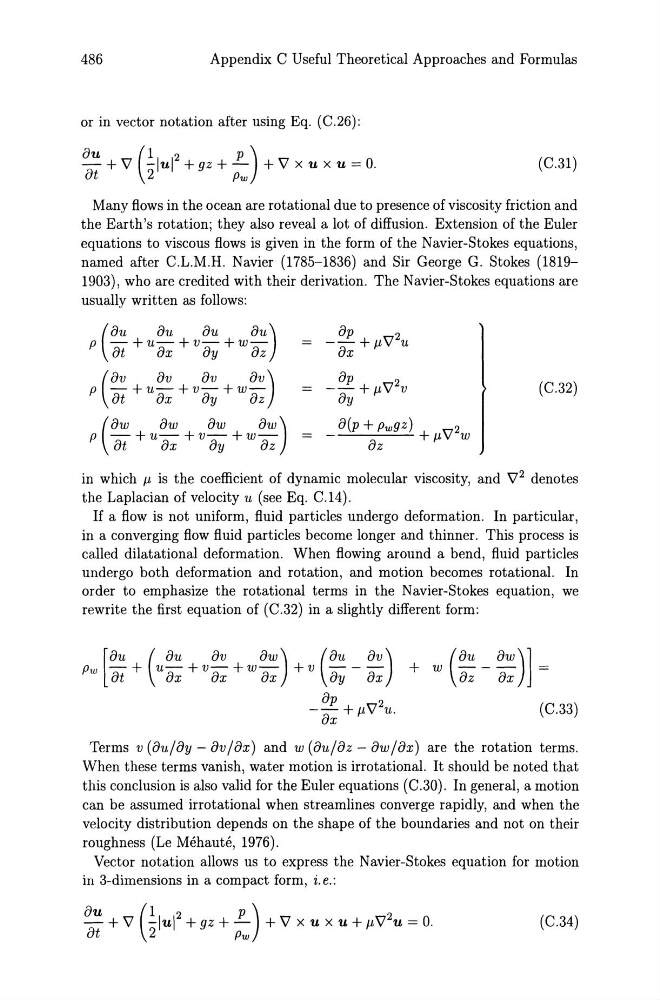
Many flows in the ocean are rotational due to presence of viscosity friction and
the Earth's rotation; they also reveal a lot of diffusion. Extension of the Euler
equations to viscous flows is given in the form of the Navier-Stokes equations,
named after C.L.M.H. Navier (1785-1836) and Sir George G. Stokes (18191903), who are credited with their derivation. The Navier-Stokes equations are
usually written as follows:
( au au au au)
P -+u-+v-+w- at ax ay az
( av av av av)
P -+u-+v-+w- at ax ay az
( aw aw aw aw)
P -+u-+v-+w- at ax ay
az
ap
2
--+{LV u
ax
ap
2
--+{LV v
ay
a(p + Pwg z ) + n2
-
{Lv W
az
(C.32)
in which {L is the coefficient of dynamic molecular viscosity, and V2 denotes
the Laplacian of velocity u (see Eq. C.14).
If a flow is not uniform, fluid particles undergo deformation. In particular,
in a converging flow fluid particles become longer and thinner. This process is
called dilatational deformation. When flowing around a bend, fluid particles
undergo both deformation and rotation, and motion becomes rotational. In
order to emphasize the rotational terms in the Navier-Stokes equation, we
rewrite the first equation of (C.32) in a slightly different form:
pw [au + (u au + v av + w aw) + v (au _ av)
at
ax ax ax
ay ax
+ w (au _ aw)] =
az ax
ap
2
- ax + {LV u.
(C.33)
Terms v (au / ay - av / ax) and w (au / a z - aw / ax) are the rotation terms.
When these terms vanish, water motion is irrotational. It should be noted that
this conclusion is also valid for the Euler equations (C.30). In general, a motion
can be assumed irrotational when streamlines converge rapidly, and when the
velocity distribution depends on the shape of the boundaries and not on their
roughness (Le Mehaute, 1976).
Vector notation allows us to express the Navier-Stokes equation for motion
in 3-dimensions in a compact form, i.e.:
au
(1 2 P )
2
- + V -lui + gz + - + V x u x u + {LV u = O.
at
2
Pw
(C.34)
Appendix C Useful Theoretical Approaches and Formulas
or in vector notation after using Eq. (C.26):
au
(1 2 P )
- + v -lui + gz + - + v x u x u = O.
at
2
Pw
(C.31)
Many flows in the ocean are rotational due to presence of viscosity friction and
the Earth's rotation; they also reveal a lot of diffusion. Extension of the Euler
equations to viscous flows is given in the form of the Navier-Stokes equations,
named after C.L.M.H. Navier (1785-1836) and Sir George G. Stokes (18191903), who are credited with their derivation. The Navier-Stokes equations are
usually written as follows:
( au au au au)
P -+u-+v-+w- at ax ay az
( av av av av)
P -+u-+v-+w- at ax ay az
( aw aw aw aw)
P -+u-+v-+w- at ax ay
az
ap
2
--+{LV u
ax
ap
2
--+{LV v
ay
a(p + Pwg z ) + n2
-
{Lv W
az
(C.32)
in which {L is the coefficient of dynamic molecular viscosity, and V2 denotes
the Laplacian of velocity u (see Eq. C.14).
If a flow is not uniform, fluid particles undergo deformation. In particular,
in a converging flow fluid particles become longer and thinner. This process is
called dilatational deformation. When flowing around a bend, fluid particles
undergo both deformation and rotation, and motion becomes rotational. In
order to emphasize the rotational terms in the Navier-Stokes equation, we
rewrite the first equation of (C.32) in a slightly different form:
pw [au + (u au + v av + w aw) + v (au _ av)
at
ax ax ax
ay ax
+ w (au _ aw)] =
az ax
ap
2
- ax + {LV u.
(C.33)
Terms v (au / ay - av / ax) and w (au / a z - aw / ax) are the rotation terms.
When these terms vanish, water motion is irrotational. It should be noted that
this conclusion is also valid for the Euler equations (C.30). In general, a motion
can be assumed irrotational when streamlines converge rapidly, and when the
velocity distribution depends on the shape of the boundaries and not on their
roughness (Le Mehaute, 1976).
Vector notation allows us to express the Navier-Stokes equation for motion
in 3-dimensions in a compact form, i.e.:
au
(1 2 P )
2
- + V -lui + gz + - + V x u x u + {LV u = O.
at
2
Pw
(C.34)