

15.2 Upwelling and Biological Production
457
o
l . . . - J
/em
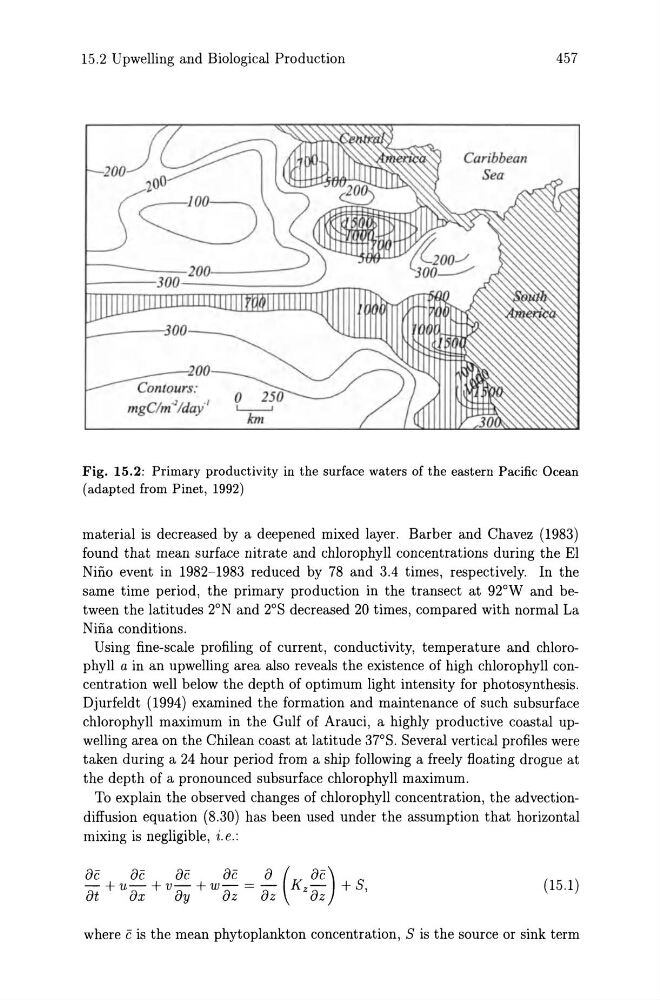
Fig. 15.2: Primary productivity in the surface waters of the eastern Pacific Ocean
(adapted from Pinet, 1992)
material is decreased by a deepened mixed layer. Barber and Chavez (1983)
found that mean surface nitrate and chlorophyll concentrations during the El
Nino event in 1982-1983 reduced by 78 and 3.4 times, respectively. In the
same time period, the primary production in the transect at 92°W and between the latitudes 2°N and 2°S decreased 20 times, compared with normal La
Nina conditions.
Using fine-scale profiling of current, conductivity, temperature and chlorophyll a in an upwelling area also reveals the existence of high chlorophyll concentration well below the depth of optimum light intensity for photosynthesis.
Djurfeldt (1994) examined the formation and maintenance of such subsurface
chlorophyll maximum in the Gulf of Arauci, a highly productive coastal upwelling area on the Chilean coast at latitude 37°S. Several vertical profiles were
taken during a 24 hour period from a ship following a freely floating drogue at
the depth of a pronounced subsurface chlorophyll maximum.
To explain the observed changes of chlorophyll concentration, the advectiondiffusion equation (8.30) has been used under the assumption that horizontal
mixing is negligible, i. e.:
-+u-+v-+w-=- Kz -
+5,
oc oc oc oc 0 ( Oc)
ot Ox oy oz oz oz
(15.1)
where C is the mean phytoplankton concentration, 5 is the source or sink term
457
o
l . . . - J
/em
Fig. 15.2: Primary productivity in the surface waters of the eastern Pacific Ocean
(adapted from Pinet, 1992)
material is decreased by a deepened mixed layer. Barber and Chavez (1983)
found that mean surface nitrate and chlorophyll concentrations during the El
Nino event in 1982-1983 reduced by 78 and 3.4 times, respectively. In the
same time period, the primary production in the transect at 92°W and between the latitudes 2°N and 2°S decreased 20 times, compared with normal La
Nina conditions.
Using fine-scale profiling of current, conductivity, temperature and chlorophyll a in an upwelling area also reveals the existence of high chlorophyll concentration well below the depth of optimum light intensity for photosynthesis.
Djurfeldt (1994) examined the formation and maintenance of such subsurface
chlorophyll maximum in the Gulf of Arauci, a highly productive coastal upwelling area on the Chilean coast at latitude 37°S. Several vertical profiles were
taken during a 24 hour period from a ship following a freely floating drogue at
the depth of a pronounced subsurface chlorophyll maximum.
To explain the observed changes of chlorophyll concentration, the advectiondiffusion equation (8.30) has been used under the assumption that horizontal
mixing is negligible, i. e.:
-+u-+v-+w-=- Kz -
+5,
oc oc oc oc 0 ( Oc)
ot Ox oy oz oz oz
(15.1)
where C is the mean phytoplankton concentration, 5 is the source or sink term