

436
14 Tides and Waves on Vegetated Coasts
in which the distances Zl and h are from the free end of coral branch. As the
current velocity, u, is constant along the coral branch, the drag force, F, is also
constant and after integration we obtain:
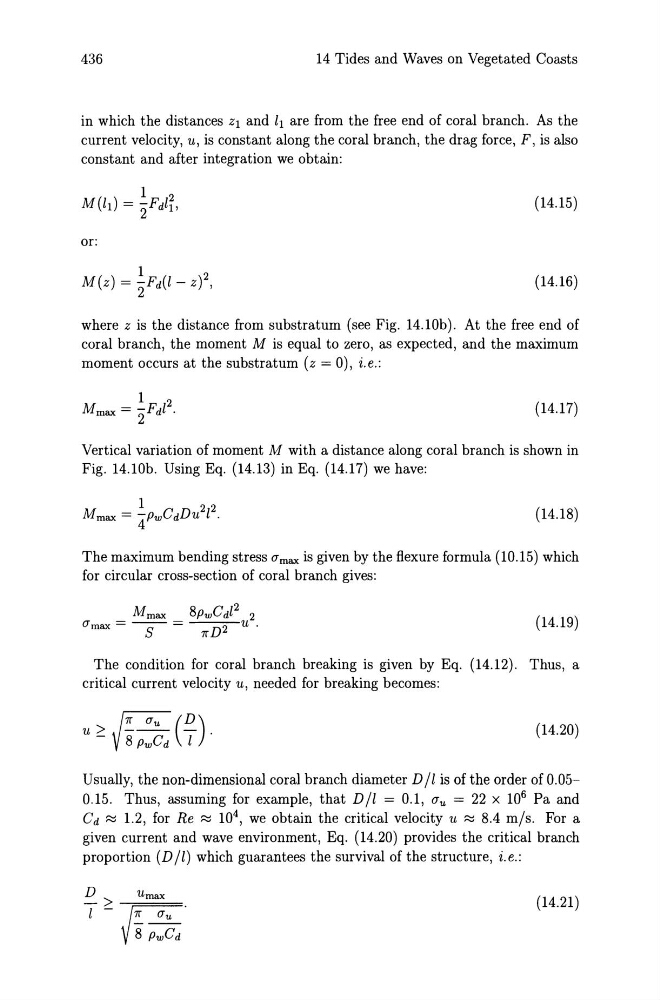
(14.15)
or:
(14.16)
where Z is the distance from substratum (see Fig. 14.10b). At the free end of
coral branch, the moment M is equal to zero, as expected, and the maximum
moment occurs at the substratum (z = 0), i.e.:
(14.17)
Vertical variation of moment M with a distance along coral branch is shown in
Fig. 14.10b. Using Eq. (14.13) in Eq. (14.17) we have:
(14.18)
The maximum bending stress O'max is given by the flexure formula (10.15) which
for circular cross-section of coral branch gives:
(14.19)
The condition for coral branch breaking is given by Eq. (14.12). Thus, a
critical current velocity u, needed for breaking becomes:
(14.20)
Usually, the non-dimensional coral branch diameter D /l is of the order of 0.050.15. Thus, assuming for example, that D /l = 0.1, O'u = 22 X 10 6 Pa and
Cd ~ 1.2, for Re ~ 10 4 , we obtain the critical velocity u ~ 8.4 m/s. For a
given current and wave environment, Eq. (14.20) provides the critical branch
proportion (D //) which guarantees the survival of the structure, i.e.:
(14.21 )
14 Tides and Waves on Vegetated Coasts
in which the distances Zl and h are from the free end of coral branch. As the
current velocity, u, is constant along the coral branch, the drag force, F, is also
constant and after integration we obtain:
(14.15)
or:
(14.16)
where Z is the distance from substratum (see Fig. 14.10b). At the free end of
coral branch, the moment M is equal to zero, as expected, and the maximum
moment occurs at the substratum (z = 0), i.e.:
(14.17)
Vertical variation of moment M with a distance along coral branch is shown in
Fig. 14.10b. Using Eq. (14.13) in Eq. (14.17) we have:
(14.18)
The maximum bending stress O'max is given by the flexure formula (10.15) which
for circular cross-section of coral branch gives:
(14.19)
The condition for coral branch breaking is given by Eq. (14.12). Thus, a
critical current velocity u, needed for breaking becomes:
(14.20)
Usually, the non-dimensional coral branch diameter D /l is of the order of 0.050.15. Thus, assuming for example, that D /l = 0.1, O'u = 22 X 10 6 Pa and
Cd ~ 1.2, for Re ~ 10 4 , we obtain the critical velocity u ~ 8.4 m/s. For a
given current and wave environment, Eq. (14.20) provides the critical branch
proportion (D //) which guarantees the survival of the structure, i.e.:
(14.21 )