

14.4 Waves at Coral Reefs
435
z
x
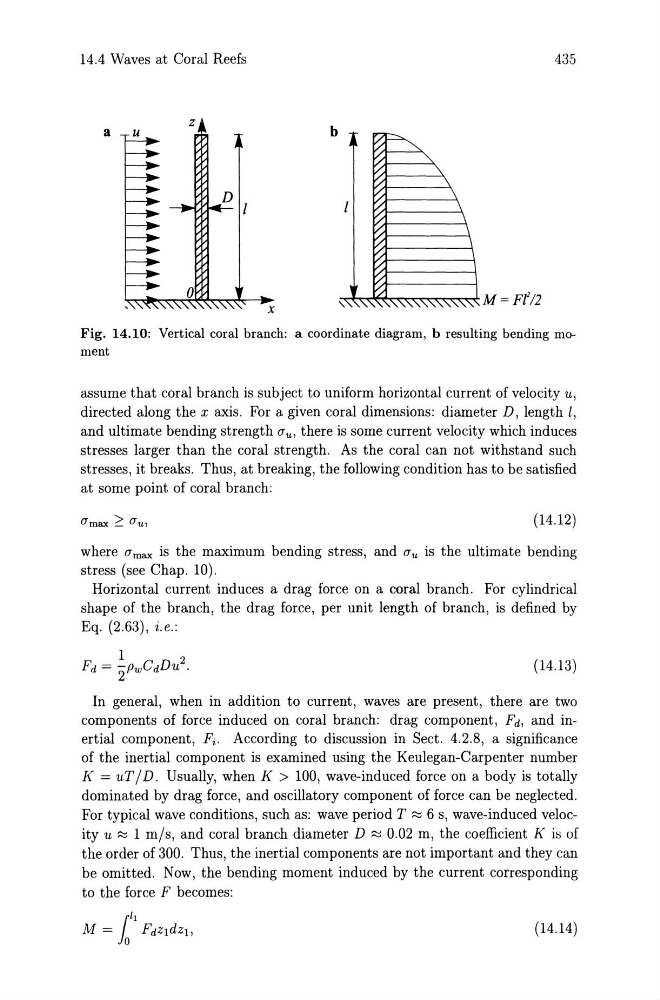
Fig. 14.10: Vertical coral branch: a coordinate diagram, b resulting bending moment
assume that coral branch is subject to uniform horizontal current of velocity u,
directed along the x axis. For a given coral dimensions: diameter D, length I,
and ultimate bending strength (Ju, there is some current velocity which induces
stresses larger than the coral strength. As the coral can not withstand such
stresses, it breaks. Thus, at breaking, the following condition has to be satisfied
at some point of coral branch:
(14.12)
where (Jrnax is the maximum bending stress, and (Ju is the ultimate bending
stress (see Chap. 10).
Horizontal current induces a drag force on a coral branch. For cylindrical
shape of the branch, the drag force, per unit length of branch, is defined by
Eq. (2.63), i.e.:
1
2
Fd = -PwCdDu .
2
(14.13)
In general, when in addition to current, waves are present, there are two
components of force induced on coral branch: drag component, Fd, and inertial component, Fi . According to discussion in Sect. 4.2.8, a significance
of the inertial component is examined using the Keulegan-Carpenter number
K = uTI D. Usually, when K > 100, wave-induced force on a body is totally
dominated by drag force, and oscillatory component of force can be neglected.
For typical wave conditions, such as: wave period T ~ 6 s, wave-induced velocity u ~ 1 mis, and coral branch diameter D ~ 0.02 m, the coefficient K is of
the order of 300. Thus, the inertial components are not important and they can
be omitted. Now, the bending moment induced by the current corresponding
to the force F becomes:
(14.14)
435
z
x
Fig. 14.10: Vertical coral branch: a coordinate diagram, b resulting bending moment
assume that coral branch is subject to uniform horizontal current of velocity u,
directed along the x axis. For a given coral dimensions: diameter D, length I,
and ultimate bending strength (Ju, there is some current velocity which induces
stresses larger than the coral strength. As the coral can not withstand such
stresses, it breaks. Thus, at breaking, the following condition has to be satisfied
at some point of coral branch:
(14.12)
where (Jrnax is the maximum bending stress, and (Ju is the ultimate bending
stress (see Chap. 10).
Horizontal current induces a drag force on a coral branch. For cylindrical
shape of the branch, the drag force, per unit length of branch, is defined by
Eq. (2.63), i.e.:
1
2
Fd = -PwCdDu .
2
(14.13)
In general, when in addition to current, waves are present, there are two
components of force induced on coral branch: drag component, Fd, and inertial component, Fi . According to discussion in Sect. 4.2.8, a significance
of the inertial component is examined using the Keulegan-Carpenter number
K = uTI D. Usually, when K > 100, wave-induced force on a body is totally
dominated by drag force, and oscillatory component of force can be neglected.
For typical wave conditions, such as: wave period T ~ 6 s, wave-induced velocity u ~ 1 mis, and coral branch diameter D ~ 0.02 m, the coefficient K is of
the order of 300. Thus, the inertial components are not important and they can
be omitted. Now, the bending moment induced by the current corresponding
to the force F becomes:
(14.14)