

430
14 Tides and Waves on Vegetated Coasts
wave breaking, water absorbs an enhanced amount of gases and other substa:J.ces which are transported to all reef areas. In the next sections, we discuss
the basic mechanisms of wave propagation and breaking on coral reefs and the
impact on the organisms that inhabit the reefs.
14.4.2 Wave Transformation and Breaking on Coral Reefs
From a hydrodynamic perspective, coral reefs represent two dimensional or
three dimensional structures with very steep and rough bottom slopes. The
refraction and diffraction effects are substantial and cannot be neglected. At
the reef edge, waves loose their stability and break, with the breaking processes dominating the wave transformation. As was shown in Chap. 4, when
the bottom slope is very gentle, wave height at a given water depth h can
be determined from a simple formula (4.50) resulting from the conservation
of energy. On the other hand, when the bottom slope is steeper, the transformation of waves becomes very rapid, with rapidly decreasing wave length
and increasing wave height. Equation (4.50) is not applicable for calculation of
wave energy transformation over steep slopes. Massel (1993a, 1996a) showed
that wave height can be calculated from the refraction-diffraction equation,
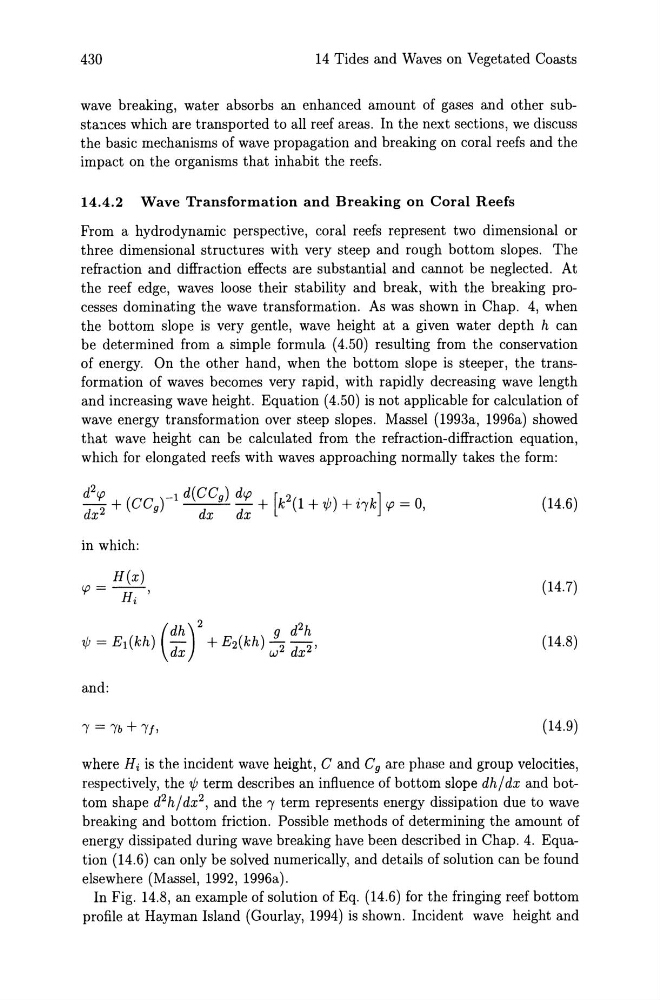
which for elongated reefs with waves approaching normally takes the form:
in which:
H(x)
'P=~,
"
and:
(14.6)
(14.7)
(14.8)
(14.9)
where Hi is the incident wave height, C and Cg are phase and group velocities,
respectively, the 1/J term describes an influence of bottom slope dh/dx and bottom shape d 2 h / dx 2 , and the 'Y term represents energy dissipation due to wave
breaking and bottom friction. Possible methods of determining the amount of
energy dissipated during wave breaking have been described in Chap. 4. Equation (14.6) can only be solved numerically, and details of solution can be found
elsewhere (Massel, 1992, 1996a).
In Fig. 14.8, an example of solution of Eq. (14.6) for the fringing reef bottom
profile at Hayman Island (Gourlay, 1994) is shown. Incident wave height and
14 Tides and Waves on Vegetated Coasts
wave breaking, water absorbs an enhanced amount of gases and other substa:J.ces which are transported to all reef areas. In the next sections, we discuss
the basic mechanisms of wave propagation and breaking on coral reefs and the
impact on the organisms that inhabit the reefs.
14.4.2 Wave Transformation and Breaking on Coral Reefs
From a hydrodynamic perspective, coral reefs represent two dimensional or
three dimensional structures with very steep and rough bottom slopes. The
refraction and diffraction effects are substantial and cannot be neglected. At
the reef edge, waves loose their stability and break, with the breaking processes dominating the wave transformation. As was shown in Chap. 4, when
the bottom slope is very gentle, wave height at a given water depth h can
be determined from a simple formula (4.50) resulting from the conservation
of energy. On the other hand, when the bottom slope is steeper, the transformation of waves becomes very rapid, with rapidly decreasing wave length
and increasing wave height. Equation (4.50) is not applicable for calculation of
wave energy transformation over steep slopes. Massel (1993a, 1996a) showed
that wave height can be calculated from the refraction-diffraction equation,
which for elongated reefs with waves approaching normally takes the form:
in which:
H(x)
'P=~,
"
and:
(14.6)
(14.7)
(14.8)
(14.9)
where Hi is the incident wave height, C and Cg are phase and group velocities,
respectively, the 1/J term describes an influence of bottom slope dh/dx and bottom shape d 2 h / dx 2 , and the 'Y term represents energy dissipation due to wave
breaking and bottom friction. Possible methods of determining the amount of
energy dissipated during wave breaking have been described in Chap. 4. Equation (14.6) can only be solved numerically, and details of solution can be found
elsewhere (Massel, 1992, 1996a).
In Fig. 14.8, an example of solution of Eq. (14.6) for the fringing reef bottom
profile at Hayman Island (Gourlay, 1994) is shown. Incident wave height and