

402
13 Transport and Mixing in Coastal Ecosystems
well as in Chaps. 14 and 15, we will examine the relationships between primary
production and physical factors for different regions. Prior to this, we will
define the basic quantities and briefly summarize the relationships between
primary production and physical processes that affect the production.
For the purpose of this book we adopt a simplified definition of primary
production as a process of building plant tissue by photosynthesis. As a result,
the inorganic material (e.g. nitrate, phosphate) is converted into new organic
compounds (e.g. lipids, proteins). The most popular method for measuring
productivity in the ocean is the 14C method. The details of this method can
be found in many biological textbooks (for example, Valiela, 1995). Here we
only note that the productivity is expressed as the amount (in mg) of carbon
fixed in new organic material per volume of water and per time. The rate of
plant material production varies from zero to as much as about 80 mg C/m 3 /hr
(Lalli and Parsons, 1997).
As chlorophyll a is universally present in all species of phytoplankton, one
obtains a measure of the growth rate in units of time (mg C per mg chlorophyll
a per hour). Because phytoplankton, which is the dominant primary producer, vary greatly in size, primary production is sometimes defined in terms
of biomass, i. e. as the total weight of all organisms in a given area or volume.
A distinction must be made between gross and net primary production. The
total amount of photosynthesis achieved by an organism during a certain period
of time is the gross production. However, during that time the organism is
also carrying out respiration. The difference between gross production and
respiration in that time is the net production.
Hydrodynamic Factors and Aquatic Productivity. The intensity of light
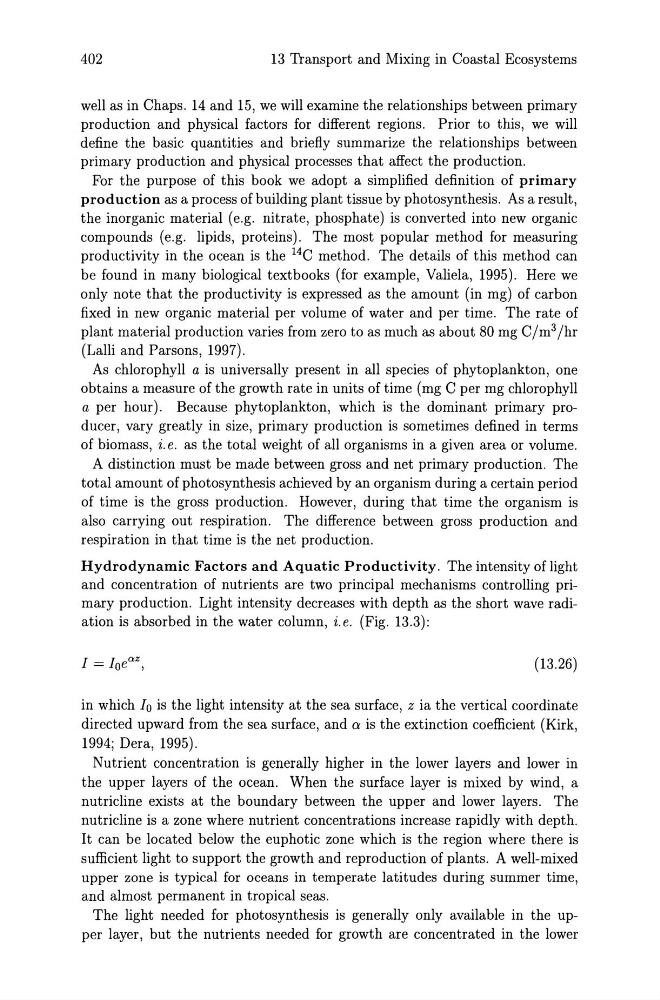
and concentration of nutrients are two principal mechanisms controlling primary production. Light intensity decreases with depth as the short wave radiation is absorbed in the water column, i.e. (Fig. 13.3):
(13.26)
in which 10 is the light intensity at the sea surface, z ia the vertical coordinate
directed upward from the sea surface, and 0: is the extinction coefficient (Kirk,
1994; Dera, 1995).
Nutrient concentration is generally higher in the lower layers and lower in
the upper layers of the ocean. When the surface layer is mixed by wind, a
nutricline exists at the boundary between the upper and lower layers. The
nutricline is a zone where nutrient concentrations increase rapidly with depth.
It can be located below the euphotic zone which is the region where there is
sufficient light to support the growth and reproduction of plants. A well-mixed
upper zone is typical for oceans in temperate latitudes during summer time,
and almost permanent in tropical seas.
The light needed for photosynthesis is generally only available in the upper layer, but the nutrients needed for growth are concentrated in the lower
13 Transport and Mixing in Coastal Ecosystems
well as in Chaps. 14 and 15, we will examine the relationships between primary
production and physical factors for different regions. Prior to this, we will
define the basic quantities and briefly summarize the relationships between
primary production and physical processes that affect the production.
For the purpose of this book we adopt a simplified definition of primary
production as a process of building plant tissue by photosynthesis. As a result,
the inorganic material (e.g. nitrate, phosphate) is converted into new organic
compounds (e.g. lipids, proteins). The most popular method for measuring
productivity in the ocean is the 14C method. The details of this method can
be found in many biological textbooks (for example, Valiela, 1995). Here we
only note that the productivity is expressed as the amount (in mg) of carbon
fixed in new organic material per volume of water and per time. The rate of
plant material production varies from zero to as much as about 80 mg C/m 3 /hr
(Lalli and Parsons, 1997).
As chlorophyll a is universally present in all species of phytoplankton, one
obtains a measure of the growth rate in units of time (mg C per mg chlorophyll
a per hour). Because phytoplankton, which is the dominant primary producer, vary greatly in size, primary production is sometimes defined in terms
of biomass, i. e. as the total weight of all organisms in a given area or volume.
A distinction must be made between gross and net primary production. The
total amount of photosynthesis achieved by an organism during a certain period
of time is the gross production. However, during that time the organism is
also carrying out respiration. The difference between gross production and
respiration in that time is the net production.
Hydrodynamic Factors and Aquatic Productivity. The intensity of light
and concentration of nutrients are two principal mechanisms controlling primary production. Light intensity decreases with depth as the short wave radiation is absorbed in the water column, i.e. (Fig. 13.3):
(13.26)
in which 10 is the light intensity at the sea surface, z ia the vertical coordinate
directed upward from the sea surface, and 0: is the extinction coefficient (Kirk,
1994; Dera, 1995).
Nutrient concentration is generally higher in the lower layers and lower in
the upper layers of the ocean. When the surface layer is mixed by wind, a
nutricline exists at the boundary between the upper and lower layers. The
nutricline is a zone where nutrient concentrations increase rapidly with depth.
It can be located below the euphotic zone which is the region where there is
sufficient light to support the growth and reproduction of plants. A well-mixed
upper zone is typical for oceans in temperate latitudes during summer time,
and almost permanent in tropical seas.
The light needed for photosynthesis is generally only available in the upper layer, but the nutrients needed for growth are concentrated in the lower