

400
13 Transport and Mixing in Coastal Ecosystems
2.3 m near the tidal inlet, to 3.2 m upstream, near the town of Emden. The
influx of freshwater is of the order of 115 m 3 /s. As a result, the average salinity
at the inlet is about 30 ppm and decreases to zero 75 km upstream.
The particle displacement in a random walk type model is a superposition of
the net displacements of particles during the preceding ebb and flood phases.
Due to interaction of the particles with residual eddies, particle trajectories
move in an irregular way and are generally random functions of time. Using the random particle displacements, the longitudinal and lateral dispersion
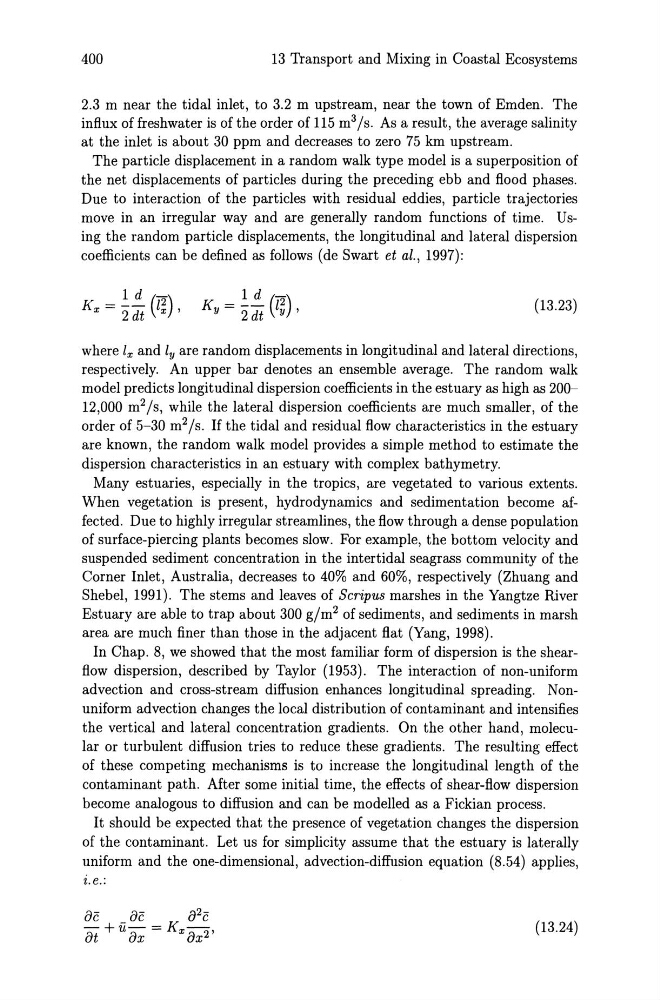
coefficients can be defined as follows (de Swart et al., 1997):
1 d (-)
K - - - l2
x - 2 dt x ,
1 d (-)
K - - - l2
y - 2 dt y ,
(13.23)
where lx and ly are random displacements in longitudinal and lateral directions,
respectively. An upper bar denotes an ensemble average. The random walk
model predicts longitudinal dispersion coefficients in the estuary as high as 20012,000 m 2 /s, while the lateral dispersion coefficients are much smaller, of the
order of 5-30 m 2 /s. If the tidal and residual flow characteristics in the estuary
are known, the random walk model provides a simple method to estimate the
dispersion characteristics in an estuary with complex bathymetry.
Many estuaries, especially in the tropics, are vegetated to various extents.
When vegetation is present, hydrodynamics and sedimentation become affected. Due to highly irregular streamlines, the flow through a dense population
of surface-piercing plants becomes slow. For example, the bottom velocity and
suspended sediment concentration in the intertidal seagrass community of the
Corner Inlet, Australia, decreases to 40% and 60%, respectively (Zhuang and
Shebel, 1991). The stems and leaves of Scripus marshes in the Yangtze River
Estuary are able to trap about 300 g/m 2 of sediments, and sediments in marsh
area are much finer than those in the adjacent flat (Yang, 1998).
In Chap. 8, we showed that the most familiar form of dispersion is the shearflow dispersion, described by Taylor (1953). The interaction of non-uniform
advection and cross-stream diffusion enhances longitudinal spreading. Nonuniform advection changes the local distribution of contaminant and intensifies
the vertical and lateral concentration gradients. On the other hand, molecular or turbulent diffusion tries to reduce these gradients. The resulting effect
of these competing mechanisms is to increase the longitudinal length of the
contaminant path. After some initial time, the effects of shear-flow dispersion
become analogous to diffusion and can be modelled as a Fickian process.
It should be expected that the presence of vegetation changes the dispersion
of the contaminant. Let us for simplicity assume that the estuary is laterally
uniform and the one-dimensional, advection-diffusion equation (8.54) applies,
z.e.:
(13.24)
13 Transport and Mixing in Coastal Ecosystems
2.3 m near the tidal inlet, to 3.2 m upstream, near the town of Emden. The
influx of freshwater is of the order of 115 m 3 /s. As a result, the average salinity
at the inlet is about 30 ppm and decreases to zero 75 km upstream.
The particle displacement in a random walk type model is a superposition of
the net displacements of particles during the preceding ebb and flood phases.
Due to interaction of the particles with residual eddies, particle trajectories
move in an irregular way and are generally random functions of time. Using the random particle displacements, the longitudinal and lateral dispersion
coefficients can be defined as follows (de Swart et al., 1997):
1 d (-)
K - - - l2
x - 2 dt x ,
1 d (-)
K - - - l2
y - 2 dt y ,
(13.23)
where lx and ly are random displacements in longitudinal and lateral directions,
respectively. An upper bar denotes an ensemble average. The random walk
model predicts longitudinal dispersion coefficients in the estuary as high as 20012,000 m 2 /s, while the lateral dispersion coefficients are much smaller, of the
order of 5-30 m 2 /s. If the tidal and residual flow characteristics in the estuary
are known, the random walk model provides a simple method to estimate the
dispersion characteristics in an estuary with complex bathymetry.
Many estuaries, especially in the tropics, are vegetated to various extents.
When vegetation is present, hydrodynamics and sedimentation become affected. Due to highly irregular streamlines, the flow through a dense population
of surface-piercing plants becomes slow. For example, the bottom velocity and
suspended sediment concentration in the intertidal seagrass community of the
Corner Inlet, Australia, decreases to 40% and 60%, respectively (Zhuang and
Shebel, 1991). The stems and leaves of Scripus marshes in the Yangtze River
Estuary are able to trap about 300 g/m 2 of sediments, and sediments in marsh
area are much finer than those in the adjacent flat (Yang, 1998).
In Chap. 8, we showed that the most familiar form of dispersion is the shearflow dispersion, described by Taylor (1953). The interaction of non-uniform
advection and cross-stream diffusion enhances longitudinal spreading. Nonuniform advection changes the local distribution of contaminant and intensifies
the vertical and lateral concentration gradients. On the other hand, molecular or turbulent diffusion tries to reduce these gradients. The resulting effect
of these competing mechanisms is to increase the longitudinal length of the
contaminant path. After some initial time, the effects of shear-flow dispersion
become analogous to diffusion and can be modelled as a Fickian process.
It should be expected that the presence of vegetation changes the dispersion
of the contaminant. Let us for simplicity assume that the estuary is laterally
uniform and the one-dimensional, advection-diffusion equation (8.54) applies,
z.e.:
(13.24)