

13.2 Transport and Mixing in Estuaries
399
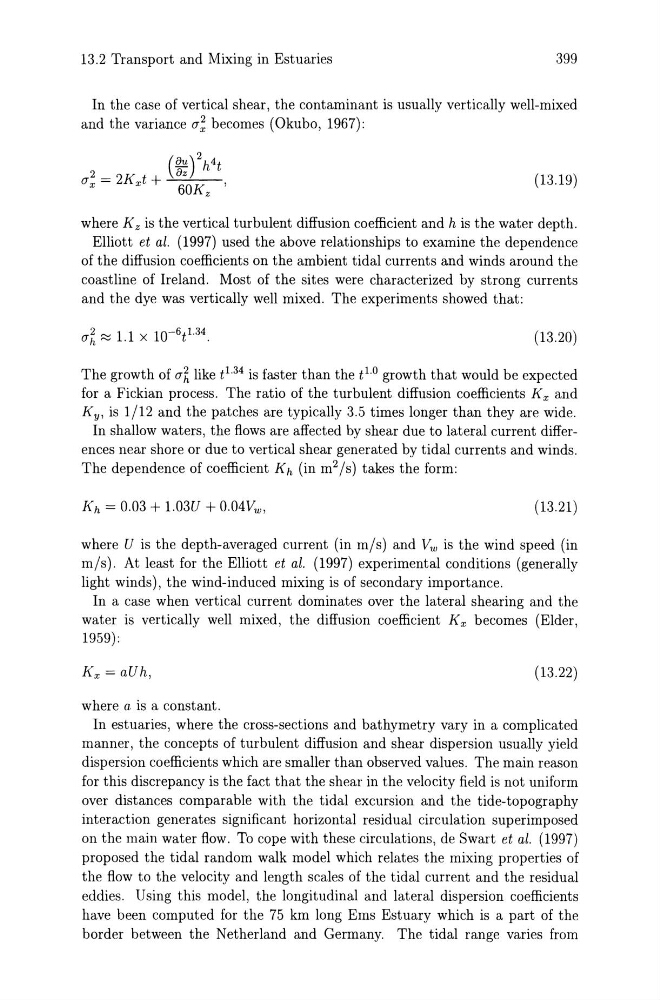
In the case of vertical shear, the contaminant is usually vertically well-mixed
and the variance 0'; becomes (Okubo, 1967):
( 8U)\4 t
0'2 = 2K t + ~8z~_
x
x
60K z '
(13.19)
where K z is the vertical turbulent diffusion coefficient and h is the water depth.
Elliott et al. (1997) used the above relationships to examine the dependence
of the diffusion coefficients on the ambient tidal currents and winds around the
coastline of Ireland. Most of the sites were characterized by strong currents
and the dye was vertically well mixed. The experiments showed that:
(13.20)
The growth of O'~ like t1.34 is faster than the t1.0 growth that would be expected
for a Fickian process. The ratio of the turbulent diffusion coefficients Kx and
K y , is 1/12 and the patches are typically 3.5 times longer than they are wide.
In shallow waters, the flows are affected by shear due to lateral current differences near shore or due to vertical shear generated by tidal currents and winds.
The dependence of coefficient Kh (in m 2 /s) takes the form:
Kh = 0.03 + 1.03U + 0.04Vw ,
(13.21)
where U is the depth-averaged current (in m/s) and Vw is the wind speed (in
m/s). At least for the Elliott et al. (1997) experimental conditions (generally
light winds), the wind-induced mixing is of secondary importance.
In a case when vertical current dominates over the lateral shearing and the
water is vertically well mixed, the diffusion coefficient Kx becomes (Elder,
1959):
Kx = aUh,
(13.22)
where a. is a constant.
In estuaries, where the cross-sections and bathymetry vary in a complicated
manner, the concepts of turbulent diffusion and shear dispersion usually yield
dispersion coefficients which are smaller than observed values. The main reason
for this discrepancy is the fact that the shear in the velocity field is not uniform
over distances comparable with the tidal excursion and the tide-topography
interaction generates significant horizontal residual circulation superimposed
on the main water flow. To cope with these circulations, de Swart et al. (1997)
proposed the tidal random walk model which relates the mixing properties of
the flow to the velocity and length scales of the tidal current and the residual
eddies. Using this model, the longitudinal and lateral dispersion coefficients
have been computed for the 75 km long Ems Estuary which is a part of the
border between the Netherland and Germany. The tidal range varies from
399
In the case of vertical shear, the contaminant is usually vertically well-mixed
and the variance 0'; becomes (Okubo, 1967):
( 8U)\4 t
0'2 = 2K t + ~8z~_
x
x
60K z '
(13.19)
where K z is the vertical turbulent diffusion coefficient and h is the water depth.
Elliott et al. (1997) used the above relationships to examine the dependence
of the diffusion coefficients on the ambient tidal currents and winds around the
coastline of Ireland. Most of the sites were characterized by strong currents
and the dye was vertically well mixed. The experiments showed that:
(13.20)
The growth of O'~ like t1.34 is faster than the t1.0 growth that would be expected
for a Fickian process. The ratio of the turbulent diffusion coefficients Kx and
K y , is 1/12 and the patches are typically 3.5 times longer than they are wide.
In shallow waters, the flows are affected by shear due to lateral current differences near shore or due to vertical shear generated by tidal currents and winds.
The dependence of coefficient Kh (in m 2 /s) takes the form:
Kh = 0.03 + 1.03U + 0.04Vw ,
(13.21)
where U is the depth-averaged current (in m/s) and Vw is the wind speed (in
m/s). At least for the Elliott et al. (1997) experimental conditions (generally
light winds), the wind-induced mixing is of secondary importance.
In a case when vertical current dominates over the lateral shearing and the
water is vertically well mixed, the diffusion coefficient Kx becomes (Elder,
1959):
Kx = aUh,
(13.22)
where a. is a constant.
In estuaries, where the cross-sections and bathymetry vary in a complicated
manner, the concepts of turbulent diffusion and shear dispersion usually yield
dispersion coefficients which are smaller than observed values. The main reason
for this discrepancy is the fact that the shear in the velocity field is not uniform
over distances comparable with the tidal excursion and the tide-topography
interaction generates significant horizontal residual circulation superimposed
on the main water flow. To cope with these circulations, de Swart et al. (1997)
proposed the tidal random walk model which relates the mixing properties of
the flow to the velocity and length scales of the tidal current and the residual
eddies. Using this model, the longitudinal and lateral dispersion coefficients
have been computed for the 75 km long Ems Estuary which is a part of the
border between the Netherland and Germany. The tidal range varies from