

2.2 Water at Rest: Hydrostatics
23
water displaced by the submerged part of the object. The discussion on how
marine organisms can control buoyancy and the significance of other physical
properties of water is given in Chap. 11.
2.2.3 Stability and Metacentric Height
In the example of the submerged cylinder, given in Sect. 2.2.2, it was assumed
that the cylinder had uniform density Pc. Thus, the centre of gravity of the
cylinder is located on its vertical axis. Also, because of symmetry, the buoyancy
force acts along the vertical axis of the cylinder. As both forces act along the
same line, the submerged cylinder either moves up, down, or remains stable,
depending on the sign of the effective density (see Eq. 2.12), and does not
rotate.
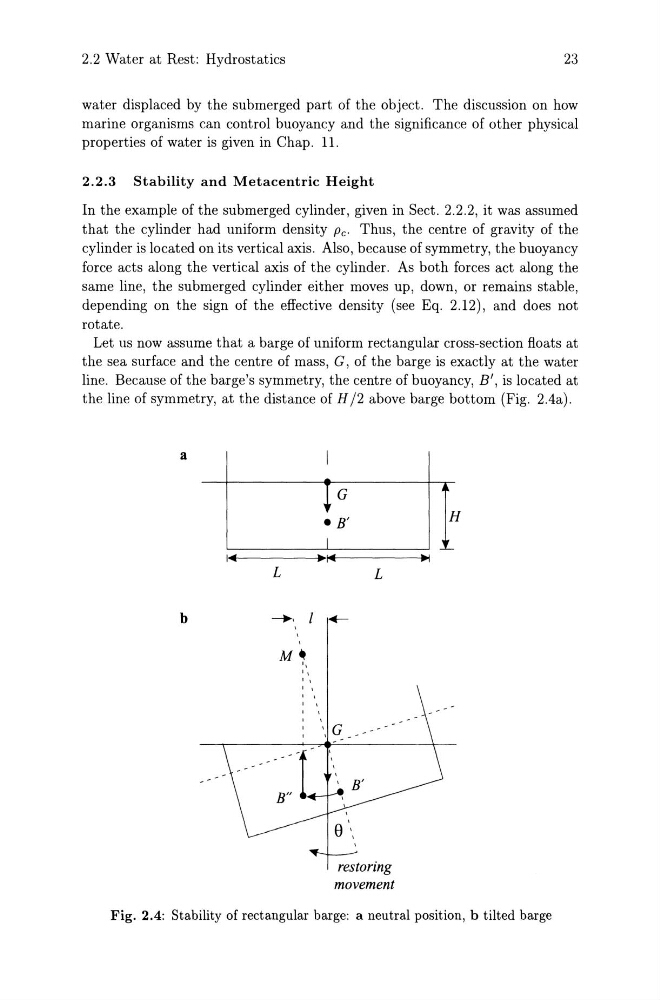
Let us now assume that a barge of uniform rectangular cross-section floats at
the sea surface and the centre of mass, G, of the barge is exactly at the water
line. Because of the barge's symmetry, the centre of buoyancy, B', is located at
the line of symmetry, at the distance of H /2 above barge bottom (Fig. 2.4a).
a
I ..
b
~G
• B'
J
.1"
L
L
--., I . -
,
M~
"
, ,
, ,
,
, ,
, ,
, ,
" G ----\
~ - -
B'
restoring
movement
H
Fig. 2.4: Stability of rectangular barge: a neutral position, b tilted barge
23
water displaced by the submerged part of the object. The discussion on how
marine organisms can control buoyancy and the significance of other physical
properties of water is given in Chap. 11.
2.2.3 Stability and Metacentric Height
In the example of the submerged cylinder, given in Sect. 2.2.2, it was assumed
that the cylinder had uniform density Pc. Thus, the centre of gravity of the
cylinder is located on its vertical axis. Also, because of symmetry, the buoyancy
force acts along the vertical axis of the cylinder. As both forces act along the
same line, the submerged cylinder either moves up, down, or remains stable,
depending on the sign of the effective density (see Eq. 2.12), and does not
rotate.
Let us now assume that a barge of uniform rectangular cross-section floats at
the sea surface and the centre of mass, G, of the barge is exactly at the water
line. Because of the barge's symmetry, the centre of buoyancy, B', is located at
the line of symmetry, at the distance of H /2 above barge bottom (Fig. 2.4a).
a
I ..
b
~G
• B'
J
.1"
L
L
--., I . -
,
M~
"
, ,
, ,
,
, ,
, ,
, ,
" G ----\
~ - -
B'
restoring
movement
H
Fig. 2.4: Stability of rectangular barge: a neutral position, b tilted barge