

22
2 Water at Rest and in Motion
water level
,
... -----~----- ..
,
-_ .. - - - - - - - - - - - - - - - - - - -
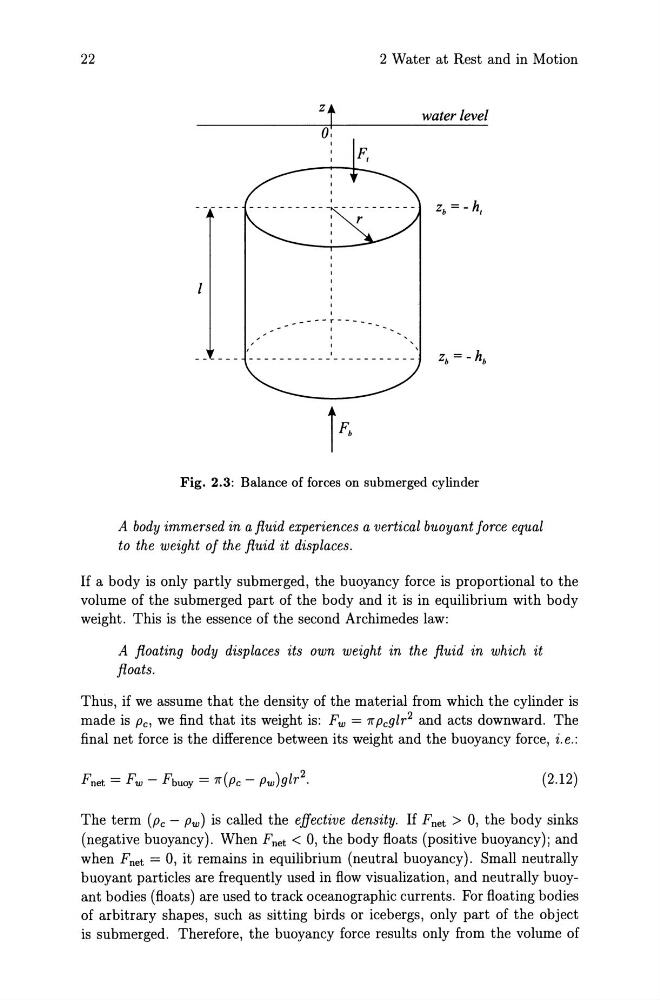
Fig. 2.3: Balance of forces on submerged cylinder
A body immersed in a fluid experiences a vertical buoyant force equal
to the weight of the fluid it displaces.
If a body is only partly submerged, the buoyancy force is proportional to the
volume of the submerged part of the body and it is in equilibrium with body
weight. This is the essence of the second Archimedes law:
A floating body displaces its own weight in the fluid in which it
floats.
Thus, if we assume that the density of the material from which the cylinder is
made is Pc, we find that its weight is: Fw = 7l'Pcglr2 and acts downward. The
final net force is the difference between its weight and the buoyancy force, i.e.:
(2.12)
The term (Pc - Pw) is called the effective density. If Fnet > 0, the body sinks
(negative buoyancy). When Fnet < 0, the body floats (positive buoyancy); and
when Fnet = 0, it remains in equilibrium (neutral buoyancy). Small neutrally
buoyant particles are frequently used in flow visualization, and neutrally buoyant bodies (floats) are used to track oceanographic currents. For floating bodies
of arbitrary shapes, such as sitting birds or icebergs, only part of the object
is submerged. Therefore, the buoyancy force results only from the volume of
2 Water at Rest and in Motion
water level
,
... -----~----- ..
,
-_ .. - - - - - - - - - - - - - - - - - - -
Fig. 2.3: Balance of forces on submerged cylinder
A body immersed in a fluid experiences a vertical buoyant force equal
to the weight of the fluid it displaces.
If a body is only partly submerged, the buoyancy force is proportional to the
volume of the submerged part of the body and it is in equilibrium with body
weight. This is the essence of the second Archimedes law:
A floating body displaces its own weight in the fluid in which it
floats.
Thus, if we assume that the density of the material from which the cylinder is
made is Pc, we find that its weight is: Fw = 7l'Pcglr2 and acts downward. The
final net force is the difference between its weight and the buoyancy force, i.e.:
(2.12)
The term (Pc - Pw) is called the effective density. If Fnet > 0, the body sinks
(negative buoyancy). When Fnet < 0, the body floats (positive buoyancy); and
when Fnet = 0, it remains in equilibrium (neutral buoyancy). Small neutrally
buoyant particles are frequently used in flow visualization, and neutrally buoyant bodies (floats) are used to track oceanographic currents. For floating bodies
of arbitrary shapes, such as sitting birds or icebergs, only part of the object
is submerged. Therefore, the buoyancy force results only from the volume of