

372
11 Locomotion of Marine Animals
Application of the model to a 1.4 em larvae of E. Mordax showed that the
resistive forces account for only 8% of the total energy required, and the inertial
energy required to move the head is only 0.2% of the total energy.
11.4 Swimming Strategy
Locomotion is an energetically costly activity that comprises a significant component of an animal's overall energy budget. Animals use various locomotion
strategies to minimize energetic expenditure. For example, fish have the option to cover a given distance by swimming steadily at a constant velocity,
or by alternating periods of active swimming with periods of passive gliding.
The selection of optimum cruising velocity is important when considering the
long-range movements of fish such as feeding and spawning migrations. The
optimal cruising velocity should be selected with respect to maximum range or
to minimize the energy required to cross a given distance.
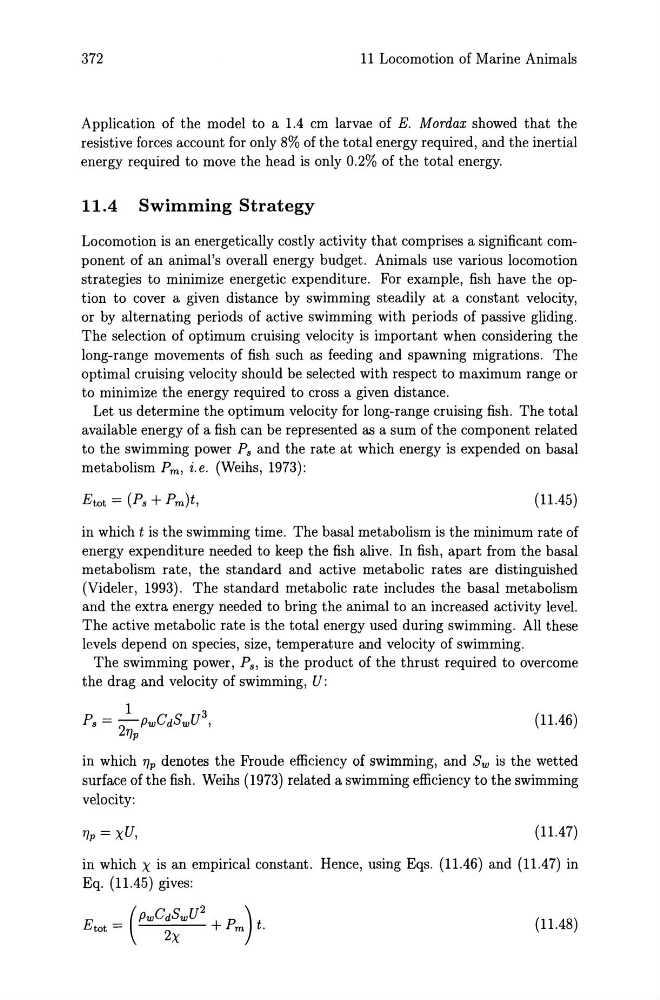
Let us determine the optimum velocity for long-range cruising fish. The total
available energy of a fish can be represented as a sum of the component related
to the swimming power Ps and the rate at which energy is expended on basal
metabolism Pm, i.e. (Weihs, 1973):
(11.45)
in which t is the swimming time. The basal metabolism is the minimum rate of
energy expenditure needed to keep the fish alive. In fish, apart from the basal
metabolism rate, the standard and active metabolic rates are distinguished
(Videler, 1993). The standard metabolic rate includes the basal metabolism
and the extra energy needed to bring the animal to an increased activity level.
The active metabolic rate is the total energy used during swimming. All these
levels depend on species, size, temperature and velocity of swimming.
The swimming power, Ps , is the product of the thrust required to overcome
the drag and velocity of swimming, U:
1
3
Ps = -PwCdSwU ,
2TJp
(11.46)
in which TJp denotes the Froude efficiency of swimming, and Sw is the wetted
surface of the fish. Weihs (1973) related a swimming efficiency to the swimming
velocity:
TJp = XU,
(11.47)
in which X is an empirical constant. Hence, using Eqs. (11.46) and (11.47) in
Eq. (11.45) gives:
(
PW C d S W U2
)
Etot =
2X
+ Pm t.
(11.48)
11 Locomotion of Marine Animals
Application of the model to a 1.4 em larvae of E. Mordax showed that the
resistive forces account for only 8% of the total energy required, and the inertial
energy required to move the head is only 0.2% of the total energy.
11.4 Swimming Strategy
Locomotion is an energetically costly activity that comprises a significant component of an animal's overall energy budget. Animals use various locomotion
strategies to minimize energetic expenditure. For example, fish have the option to cover a given distance by swimming steadily at a constant velocity,
or by alternating periods of active swimming with periods of passive gliding.
The selection of optimum cruising velocity is important when considering the
long-range movements of fish such as feeding and spawning migrations. The
optimal cruising velocity should be selected with respect to maximum range or
to minimize the energy required to cross a given distance.
Let us determine the optimum velocity for long-range cruising fish. The total
available energy of a fish can be represented as a sum of the component related
to the swimming power Ps and the rate at which energy is expended on basal
metabolism Pm, i.e. (Weihs, 1973):
(11.45)
in which t is the swimming time. The basal metabolism is the minimum rate of
energy expenditure needed to keep the fish alive. In fish, apart from the basal
metabolism rate, the standard and active metabolic rates are distinguished
(Videler, 1993). The standard metabolic rate includes the basal metabolism
and the extra energy needed to bring the animal to an increased activity level.
The active metabolic rate is the total energy used during swimming. All these
levels depend on species, size, temperature and velocity of swimming.
The swimming power, Ps , is the product of the thrust required to overcome
the drag and velocity of swimming, U:
1
3
Ps = -PwCdSwU ,
2TJp
(11.46)
in which TJp denotes the Froude efficiency of swimming, and Sw is the wetted
surface of the fish. Weihs (1973) related a swimming efficiency to the swimming
velocity:
TJp = XU,
(11.47)
in which X is an empirical constant. Hence, using Eqs. (11.46) and (11.47) in
Eq. (11.45) gives:
(
PW C d S W U2
)
Etot =
2X
+ Pm t.
(11.48)