

11.3 Mechanics of Animal Swimming
371
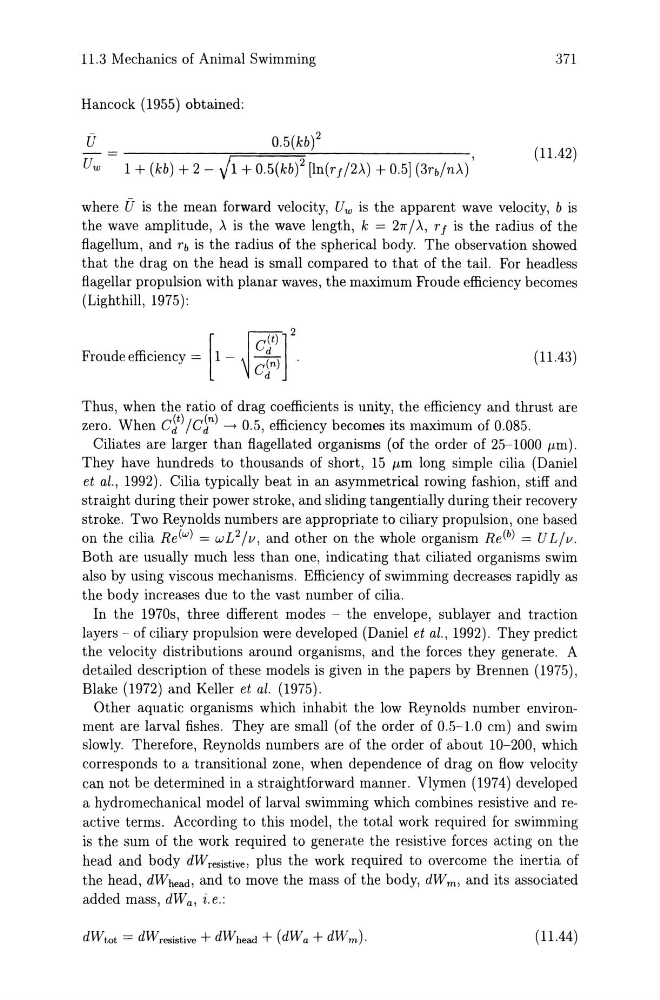
Hancock (1955) obtained:
0.5(kb)2
(11.42)
U
1 + (kb) + 2 - ";1 + 0.5(kb)2 [In(Tf/2A) + 0.5] (3Tb/nA)'
where D is the mean forward velocity, Uw is the apparent wave velocity, b is
the wave amplitude, A is the wave length, k = 271"/ A, Tf is the radius of the
flagellum, and Tb is the radius of the spherical body. The observation showed
that the drag on the head is small compared to that of the tail. For headless
flagellar propulsion with planar waves, the maximum Froude efficiency becomes
(Lighthill, 1975):
Fwude effieien,y ~ [1(11.43)
Thus, when the ratio of drag coefficients is unity, the efficiency and thrust are
zero. When C~t) /C~n) - t 0.5, efficiency becomes its maximum of 0.085.
Ciliates are larger than flagellated organisms (of the order of 25-1000 J.Lm).
They have hundreds to thousands of short, 15 J.Lm long simple cilia (Daniel
et al., 1992). Cilia typically beat in an asymmetrical rowing fashion, stiff and
straight during their power stroke, and sliding tangentially during their recovery
stroke. Two Reynolds numbers are appropriate to ciliary propulsion, one based
on the cilia Re(w) = wL 2 /v, and other on the whole organism Re(b) = UL/I/.
Both are usually much less than one, indicating that ciliated organisms swim
also by using viscous mechanisms. Efficiency of swimming decreases rapidly as
the body increases due to the vast number of cilia.
In the 1970s, three different modes - the envelope, sublayer and traction
layers - of ciliary propulsion were developed (Daniel et al., 1992). They predict
the velocity distributions around organisms, and the forces they generate. A
detailed description of these models is given in the papers by Brennen (1975),
Blake (1972) and Keller et al. (1975).
Other aquatic organisms which inhabit the low Reynolds number environment are larval fishes. They are small (of the order of 0.5-1.0 cm) and swim
slowly. Therefore, Reynolds numbers are of the order of about 10-200, which
corresponds to a transitional zone, when dependence of drag on flow velocity
can not be determined in a straightforward manner. Vlymen (1974) developed
a hydromechanical model of larval swimming which combines resistive and reactive terms. According to this model, the total work required for swimming
is the sum of the work required to generate the resistive forces acting on the
head and body dWresistive, plus the work required to overcome the inertia of
the head, dWhead, and to move the mass of the body, dW m, and its associated
added mass, dWa, i.e.:
dWtot = dWresistive + dWhead + (dWa + dWm).
(11.44)
371
Hancock (1955) obtained:
0.5(kb)2
(11.42)
U
1 + (kb) + 2 - ";1 + 0.5(kb)2 [In(Tf/2A) + 0.5] (3Tb/nA)'
where D is the mean forward velocity, Uw is the apparent wave velocity, b is
the wave amplitude, A is the wave length, k = 271"/ A, Tf is the radius of the
flagellum, and Tb is the radius of the spherical body. The observation showed
that the drag on the head is small compared to that of the tail. For headless
flagellar propulsion with planar waves, the maximum Froude efficiency becomes
(Lighthill, 1975):
Fwude effieien,y ~ [1(11.43)
Thus, when the ratio of drag coefficients is unity, the efficiency and thrust are
zero. When C~t) /C~n) - t 0.5, efficiency becomes its maximum of 0.085.
Ciliates are larger than flagellated organisms (of the order of 25-1000 J.Lm).
They have hundreds to thousands of short, 15 J.Lm long simple cilia (Daniel
et al., 1992). Cilia typically beat in an asymmetrical rowing fashion, stiff and
straight during their power stroke, and sliding tangentially during their recovery
stroke. Two Reynolds numbers are appropriate to ciliary propulsion, one based
on the cilia Re(w) = wL 2 /v, and other on the whole organism Re(b) = UL/I/.
Both are usually much less than one, indicating that ciliated organisms swim
also by using viscous mechanisms. Efficiency of swimming decreases rapidly as
the body increases due to the vast number of cilia.
In the 1970s, three different modes - the envelope, sublayer and traction
layers - of ciliary propulsion were developed (Daniel et al., 1992). They predict
the velocity distributions around organisms, and the forces they generate. A
detailed description of these models is given in the papers by Brennen (1975),
Blake (1972) and Keller et al. (1975).
Other aquatic organisms which inhabit the low Reynolds number environment are larval fishes. They are small (of the order of 0.5-1.0 cm) and swim
slowly. Therefore, Reynolds numbers are of the order of about 10-200, which
corresponds to a transitional zone, when dependence of drag on flow velocity
can not be determined in a straightforward manner. Vlymen (1974) developed
a hydromechanical model of larval swimming which combines resistive and reactive terms. According to this model, the total work required for swimming
is the sum of the work required to generate the resistive forces acting on the
head and body dWresistive, plus the work required to overcome the inertia of
the head, dWhead, and to move the mass of the body, dW m, and its associated
added mass, dWa, i.e.:
dWtot = dWresistive + dWhead + (dWa + dWm).
(11.44)