

360
11 Locomotion of Marine Animals
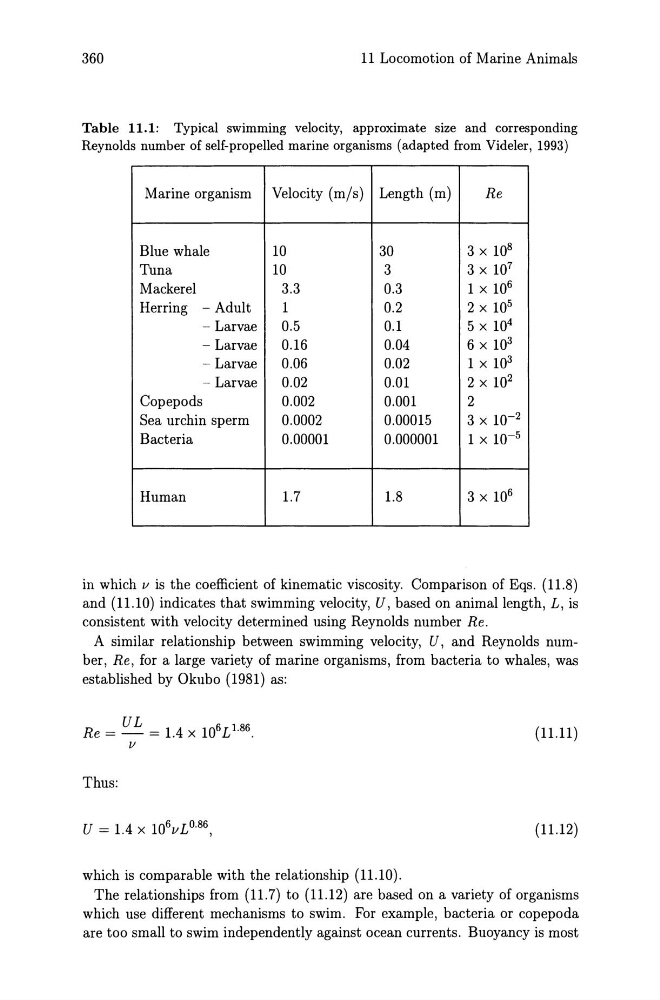
Table 11.1: Typical swimming velocity, approximate size and corresponding
Reynolds number of self-propelled marine organisms (adapted from Videler, 1993)
Marine organism Velocity (m/s) Length (m)
Re
Blue whale
10
30
3 X 10 8
Tuna
10
3
3 X 10 7
Mackerel
3.3
0.3
1 x 10 6
Herring - Adult
1
0.2
2 x 10 5
- Larvae
0.5
0.1
5 x 10 4
- Larvae
0.16
0.04
6 x 10 3
- Larvae
0.06
0.02
1 x 10 3
- Larvae
0.02
0.01
2 x 10 2
Copepods
0.002
0.001
2
Sea urchin sperm
0.0002
0.00015
3 x 10- 2
Bacteria
0.00001
0.000001
1 x 10- 5
Human
1.7
1.8
3 x 10 6
in which /I is the coefficient of kinematic viscosity. Comparison of Eqs. (11.8)
and (11.10) indicates that swimming velocity, U, based on animal length, L, is
consistent with velocity determined using Reynolds number Re.
A similar relationship between swimming velocity, U, and Reynolds number, Re, for a large variety of marine organisms, from bacteria to whales, was
established by Okubo (1981) as:
(11.11)
Thus:
(11.12)
which is comparable with the relationship (11.10).
The relationships from (11.7) to (11.12) are based on a variety of organisms
which use different mechanisms to swim. For example, bacteria or copepoda
are too small to swim independently against ocean currents. Buoyancy is most
11 Locomotion of Marine Animals
Table 11.1: Typical swimming velocity, approximate size and corresponding
Reynolds number of self-propelled marine organisms (adapted from Videler, 1993)
Marine organism Velocity (m/s) Length (m)
Re
Blue whale
10
30
3 X 10 8
Tuna
10
3
3 X 10 7
Mackerel
3.3
0.3
1 x 10 6
Herring - Adult
1
0.2
2 x 10 5
- Larvae
0.5
0.1
5 x 10 4
- Larvae
0.16
0.04
6 x 10 3
- Larvae
0.06
0.02
1 x 10 3
- Larvae
0.02
0.01
2 x 10 2
Copepods
0.002
0.001
2
Sea urchin sperm
0.0002
0.00015
3 x 10- 2
Bacteria
0.00001
0.000001
1 x 10- 5
Human
1.7
1.8
3 x 10 6
in which /I is the coefficient of kinematic viscosity. Comparison of Eqs. (11.8)
and (11.10) indicates that swimming velocity, U, based on animal length, L, is
consistent with velocity determined using Reynolds number Re.
A similar relationship between swimming velocity, U, and Reynolds number, Re, for a large variety of marine organisms, from bacteria to whales, was
established by Okubo (1981) as:
(11.11)
Thus:
(11.12)
which is comparable with the relationship (11.10).
The relationships from (11.7) to (11.12) are based on a variety of organisms
which use different mechanisms to swim. For example, bacteria or copepoda
are too small to swim independently against ocean currents. Buoyancy is most