

10.2 Definition of Mechanical Properties of Biological Materials
347
,-... 100
S
Z
'-'
~
..... 80
t'(.tS
c
~
S
61~
0
~1·
S 60
6S~
0/)
c
~~ t1
:.e c
•
~
t:Q 40
20
0
2
3
4
Section moduli S (x 1O· 6 m 3 )
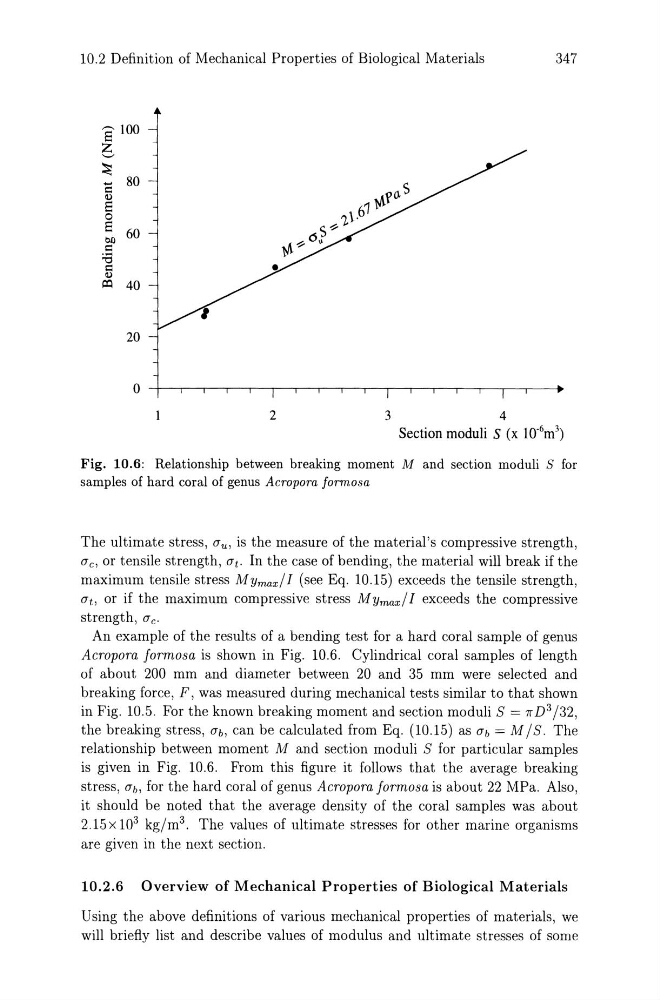
Fig. 10.6: Relationship between breaking moment M and section moduli S for
samples of hard coral of genus Acropora formosa
The ultimate stress, (Ju, is the measure of the material's compressive strength,
(Jc, or tensile strength, (Jt. In the case of bending, the material will break if the
maximum tensile stress M Ymax/ I (see Eq. 10.15) exceeds the tensile strength,
(Jt, or if the maximum compressive stress M Ymax/ I exceeds the compressive
strength, (J c'
An example of the results of a bending test for a hard coral sample of genus
Acropora formosa is shown in Fig. 10.6. Cylindrical coral samples of length
of about 200 mm and diameter between 20 and 35 mm were selected and
breaking force, F, was measured during mechanical tests similar to that shown
in Fig. 10.5. For the known breaking moment and section moduli 5 = 7r D3 /32,
the breaking stress, (Jb, can be calculated from Eq. (10.15) as (Jb = M /5. The
relationship between moment M and section moduli 5 for particular samples
is given in Fig. 10.6. From this figure it follows that the average breaking
stress, (Jb, for the hard coral of genus Acropora formosa is about 22 MPa. Also,
it should be noted that the average density of the coral samples was about
2.15x10³ kg/m 3 . The values of ultimate stresses for other marine organisms
are given in the next section.
10.2.6 Overview of Mechanical Properties of Biological Materials
Using the above definitions of various mechanical properties of materials, we
will briefly list and describe values of modulus and ultimate stresses of some
347
,-... 100
S
Z
'-'
~
..... 80
t'(.tS
c
~
S
61~
0
~1·
S 60
6S~
0/)
c
~~ t1
:.e c
•
~
t:Q 40
20
0
2
3
4
Section moduli S (x 1O· 6 m 3 )
Fig. 10.6: Relationship between breaking moment M and section moduli S for
samples of hard coral of genus Acropora formosa
The ultimate stress, (Ju, is the measure of the material's compressive strength,
(Jc, or tensile strength, (Jt. In the case of bending, the material will break if the
maximum tensile stress M Ymax/ I (see Eq. 10.15) exceeds the tensile strength,
(Jt, or if the maximum compressive stress M Ymax/ I exceeds the compressive
strength, (J c'
An example of the results of a bending test for a hard coral sample of genus
Acropora formosa is shown in Fig. 10.6. Cylindrical coral samples of length
of about 200 mm and diameter between 20 and 35 mm were selected and
breaking force, F, was measured during mechanical tests similar to that shown
in Fig. 10.5. For the known breaking moment and section moduli 5 = 7r D3 /32,
the breaking stress, (Jb, can be calculated from Eq. (10.15) as (Jb = M /5. The
relationship between moment M and section moduli 5 for particular samples
is given in Fig. 10.6. From this figure it follows that the average breaking
stress, (Jb, for the hard coral of genus Acropora formosa is about 22 MPa. Also,
it should be noted that the average density of the coral samples was about
2.15x10³ kg/m 3 . The values of ultimate stresses for other marine organisms
are given in the next section.
10.2.6 Overview of Mechanical Properties of Biological Materials
Using the above definitions of various mechanical properties of materials, we
will briefly list and describe values of modulus and ultimate stresses of some