

346
10 Mechanical Properties of Biological Materials
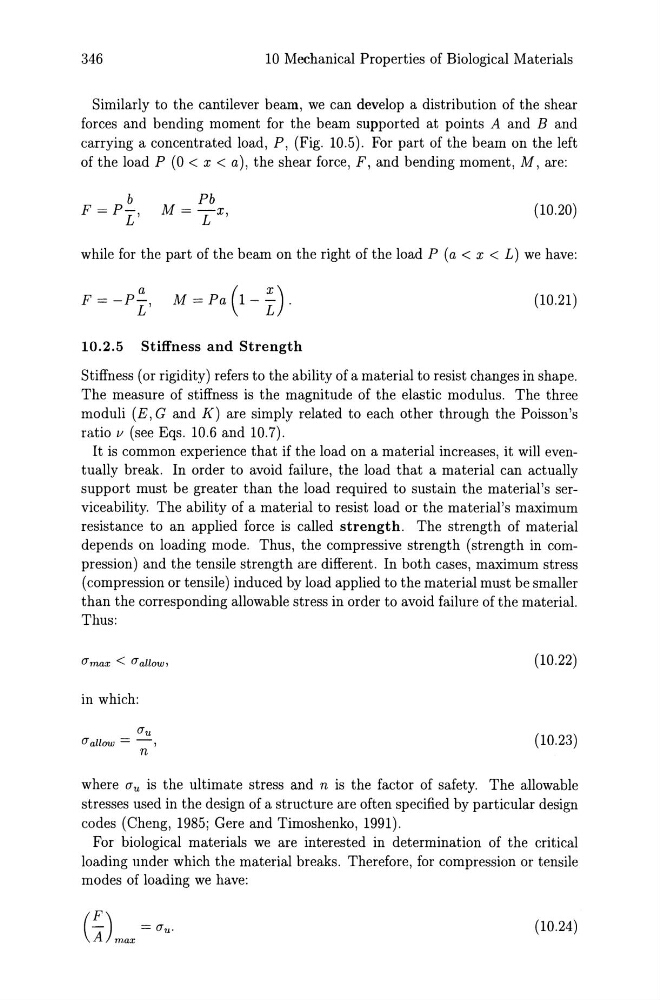
Similarly to the cantilever beam, we can develop a distribution of the shear
forces and bending moment for the beam supported at points A and Band
carrying a concentrated load, P, (Fig. 10.5). For part of the beam on the left
of the load P (0 < x < a), the shear force, F, and bending moment, M, are:
b
F=PL'
Pb
M=-x
L '
(10.20)
while for the part of the beam on the right of the load P (a < x < L) we have:
(10.21 )
10.2.5 Stiffness and Strength
Stiffness (or rigidity) refers to the ability of a material to resist changes in shape.
The measure of stiffness is the magnitude of the elastic modulus. The three
moduli (E, G and K) are simply related to each other through the Poisson's
ratio II (see Eqs. 10.6 and 10.7).
It is common experience that if the load on a material increases, it will eventually break. In order to avoid failure, the load that a material can actually
support must be greater than the load required to sustain the material's serviceability. The ability of a material to resist load or the material's maximum
resistance to an applied force is called strength. The strength of material
depends on loading mode. Thus, the compressive strength (strength in compression) and the tensile strength are different. In both cases, maximum stress
(compression or tensile) induced by load applied to the material must be smaller
than the corresponding allowable stress in order to avoid failure of the material.
Thus:
0" max < 0" allow,
in which:
O"u
O"allow = - ,
n
(10.22)
(10.23)
where O"u is the ultimate stress and n is the factor of safety. The allowable
stresses used in the design of a structure are often specified by particular design
codes (Cheng, 1985; Gere and Timoshenko, 1991).
For biological materials we are interested in determination of the critical
loading under which the material breaks. Therefore, for compression or tensile
modes of loading we have:
( F)
-
=O"u
A max
.
(10.24)
10 Mechanical Properties of Biological Materials
Similarly to the cantilever beam, we can develop a distribution of the shear
forces and bending moment for the beam supported at points A and Band
carrying a concentrated load, P, (Fig. 10.5). For part of the beam on the left
of the load P (0 < x < a), the shear force, F, and bending moment, M, are:
b
F=PL'
Pb
M=-x
L '
(10.20)
while for the part of the beam on the right of the load P (a < x < L) we have:
(10.21 )
10.2.5 Stiffness and Strength
Stiffness (or rigidity) refers to the ability of a material to resist changes in shape.
The measure of stiffness is the magnitude of the elastic modulus. The three
moduli (E, G and K) are simply related to each other through the Poisson's
ratio II (see Eqs. 10.6 and 10.7).
It is common experience that if the load on a material increases, it will eventually break. In order to avoid failure, the load that a material can actually
support must be greater than the load required to sustain the material's serviceability. The ability of a material to resist load or the material's maximum
resistance to an applied force is called strength. The strength of material
depends on loading mode. Thus, the compressive strength (strength in compression) and the tensile strength are different. In both cases, maximum stress
(compression or tensile) induced by load applied to the material must be smaller
than the corresponding allowable stress in order to avoid failure of the material.
Thus:
0" max < 0" allow,
in which:
O"u
O"allow = - ,
n
(10.22)
(10.23)
where O"u is the ultimate stress and n is the factor of safety. The allowable
stresses used in the design of a structure are often specified by particular design
codes (Cheng, 1985; Gere and Timoshenko, 1991).
For biological materials we are interested in determination of the critical
loading under which the material breaks. Therefore, for compression or tensile
modes of loading we have:
( F)
-
=O"u
A max
.
(10.24)