

342
10 Mechanical Properties of Biological Materials
Therefore, the stress is linearly proportional to strain through the Young's
modulus, E, the shear modulus, G, or bulk modulus, K, depending upon
whether the stress applied is tension, shear or pressure.
10.2.3 Viscoelasticity
In all definitions given above we have tentatively assumed that the materials
are 'solid'. However, under some circumstances, all real materials behave as if
they have the properties of fluids. For example, a mixture of sand and water
which contains more than 65% of volume of sand is a stiff paste, but a mixture
containing less than about 60% of volume of sand behaves as a Newtonian
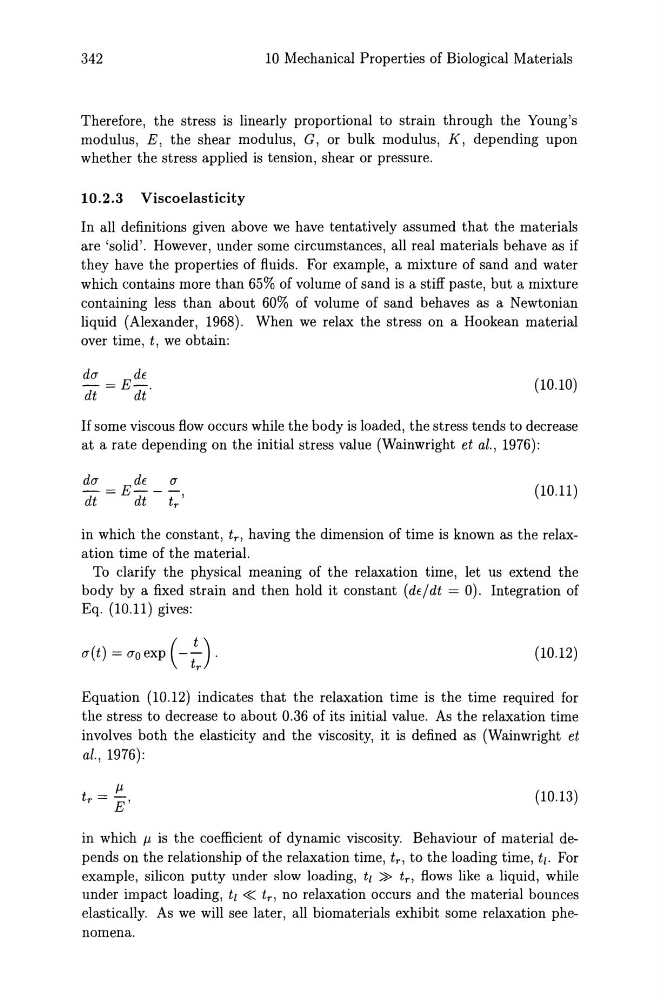
liquid (Alexander, 1968). When we relax the stress on a Hookean material
over time, t, we obtain:
d(J
dE
-=E-.
dt
dt
(10.10)
If some viscous flow occurs while the body is loaded, the stress tends to decrease
at a rate depending on the initial stress value (Wainwright et ai., 1976):
d(J
dE
(J
- = E - - -
dt
dt
tr '
(10.11)
in which the constant, tr , having the dimension of time is known as the relaxation time of the material.
To clarify the physical meaning of the relaxation time, let us extend the
body by a fixed strain and then hold it constant (dE/dt = 0). Integration of
Eq. (10.11) gives:
(J(t) = (Joexp (-t).
(10.12)
Equation (10.12) indicates that the relaxation time is the time required for
the stress to decrease to about 0.36 of its initial value. As the relaxation time
involves both the elasticity and the viscosity, it is defined as (Wainwright et
ai., 1976):
(10.13)
in which fL is the coefficient of dynamic viscosity. Behaviour of material depends on the relationship of the relaxation time, tTl to the loading time, tl. For
example, silicon putty under slow loading, tz » tr , flows like a liquid, while
under impact loading, tl « t r , no relaxation occurs and the material bounces
elastically. As we will see later, all biomaterials exhibit some relaxation phenomena.
10 Mechanical Properties of Biological Materials
Therefore, the stress is linearly proportional to strain through the Young's
modulus, E, the shear modulus, G, or bulk modulus, K, depending upon
whether the stress applied is tension, shear or pressure.
10.2.3 Viscoelasticity
In all definitions given above we have tentatively assumed that the materials
are 'solid'. However, under some circumstances, all real materials behave as if
they have the properties of fluids. For example, a mixture of sand and water
which contains more than 65% of volume of sand is a stiff paste, but a mixture
containing less than about 60% of volume of sand behaves as a Newtonian
liquid (Alexander, 1968). When we relax the stress on a Hookean material
over time, t, we obtain:
d(J
dE
-=E-.
dt
dt
(10.10)
If some viscous flow occurs while the body is loaded, the stress tends to decrease
at a rate depending on the initial stress value (Wainwright et ai., 1976):
d(J
dE
(J
- = E - - -
dt
dt
tr '
(10.11)
in which the constant, tr , having the dimension of time is known as the relaxation time of the material.
To clarify the physical meaning of the relaxation time, let us extend the
body by a fixed strain and then hold it constant (dE/dt = 0). Integration of
Eq. (10.11) gives:
(J(t) = (Joexp (-t).
(10.12)
Equation (10.12) indicates that the relaxation time is the time required for
the stress to decrease to about 0.36 of its initial value. As the relaxation time
involves both the elasticity and the viscosity, it is defined as (Wainwright et
ai., 1976):
(10.13)
in which fL is the coefficient of dynamic viscosity. Behaviour of material depends on the relationship of the relaxation time, tTl to the loading time, tl. For
example, silicon putty under slow loading, tz » tr , flows like a liquid, while
under impact loading, tl « t r , no relaxation occurs and the material bounces
elastically. As we will see later, all biomaterials exhibit some relaxation phenomena.