

10.2 Definition of Mechanical Properties of Biological Materials
z
e I
I
I
I
"
"
"
----.. 'XZ
Ar~r-------------~~----~ -1
"
I I
I I
II
II "
~" "
e I
I
I
- - - - - - - - + - -
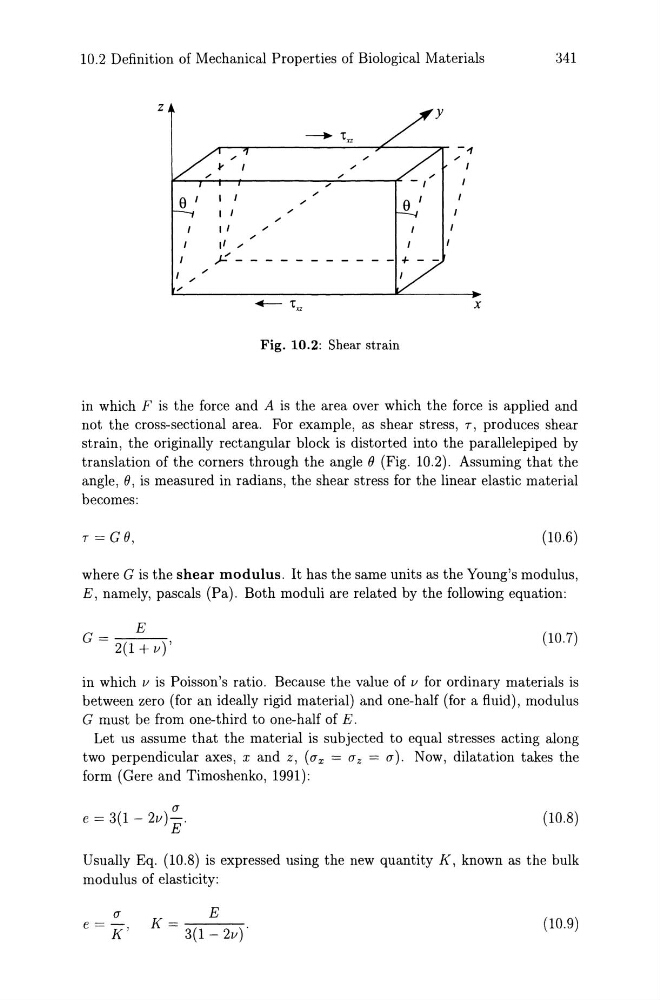
Fig. 10.2: Shear strain
"
I
I
341
in which F is the force and A is the area over which the force is applied and
not the cross-sectional area. For example, as shear stress, T, produces shear
strain, the originally rectangular block is distorted into the parallelepiped by
translation of the corners through the angle () (Fig. 10.2). Assuming that the
angle, (), is measured in radians, the shear stress for the linear elastic material
becomes:
T = G (),
(10.6)
where G is the shear modulus. It has the same units as the Young's modulus,
E, namely, pascals (Pa). Both moduli are related by the following equation:
G =
E
2(1+v)'
(10.7)
in which v is Poisson's ratio. Because the value of v for ordinary materials is
between zero (for an ideally rigid material) and one-half (for a fluid), modulus
G must be from one-third to one-half of E.
Let us assume that the material is subjected to equal stresses acting along
two perpendicular axes, x and z, (O"x = O"z = 0"). Now, dilatation takes the
form (Gere and Timoshenko, 1991):
0"
e = 3(1 - 2v)-.
E
(10.8)
Usually Eq. (10.8) is expressed using the new quantity K, known as the bulk
modulus of elasticity:
0"
e = -
K'
E
K = -.,.---..,.3(1-2v)·
(10.9)
z
e I
I
I
I
"
"
"
----.. 'XZ
Ar~r-------------~~----~ -1
"
I I
I I
II
II "
~" "
e I
I
I
- - - - - - - - + - -
Fig. 10.2: Shear strain
"
I
I
341
in which F is the force and A is the area over which the force is applied and
not the cross-sectional area. For example, as shear stress, T, produces shear
strain, the originally rectangular block is distorted into the parallelepiped by
translation of the corners through the angle () (Fig. 10.2). Assuming that the
angle, (), is measured in radians, the shear stress for the linear elastic material
becomes:
T = G (),
(10.6)
where G is the shear modulus. It has the same units as the Young's modulus,
E, namely, pascals (Pa). Both moduli are related by the following equation:
G =
E
2(1+v)'
(10.7)
in which v is Poisson's ratio. Because the value of v for ordinary materials is
between zero (for an ideally rigid material) and one-half (for a fluid), modulus
G must be from one-third to one-half of E.
Let us assume that the material is subjected to equal stresses acting along
two perpendicular axes, x and z, (O"x = O"z = 0"). Now, dilatation takes the
form (Gere and Timoshenko, 1991):
0"
e = 3(1 - 2v)-.
E
(10.8)
Usually Eq. (10.8) is expressed using the new quantity K, known as the bulk
modulus of elasticity:
0"
e = -
K'
E
K = -.,.---..,.3(1-2v)·
(10.9)