

9.2 Field and Laboratory Measurement Techniques
309
very low water velocity, flow around a sphere is laminar and separation from
the rear of the sphere does not occur. At higher speeds, the flow becomes turbulent. In order to avoid separation of flow from the sphere, the surface was
grooved vertically. 84 current meters can be equipped with a pressure sensor
to estimate water depth and measure waves (see next section).
Ocean Current Profilers. As we found in Chap. 7, current velocity changes
with depth, and measurement at a single point is not sufficient to characterize the flow field. It is possible to construct a string of current meters and
to measure velocity at a few points simultaneously. Although this approach
is popular, such instrument moorings are expensive and time consuming to
deploy.
An alternative solution is to use an Acoustic Doppler Current Profiler (ADCP).
As these instruments have only recently been introduced into oceanographic
practice, we will describe them in some detail. The measurement principle is
based on the Doppler effect. This term describes a change in the observed
sound pitch that results from relative motion. An example of this effect is the
sound made by a train as it approaches. As the train passes the observer, the
pitch of the sound changes to a lower frequency. The change in pitch is directly
proportional to the speed of the train. In other words, if the change of pitch is
known, then the velocity of the train can be calculated.
The ADCP uses the Doppler effect by transmitting sound at a fixed frequency
and listening to echoes returning from sound scatterers in the water. The sound
scatterers in the water are any small particles or plankton which reflect the
sound back to the instrument. These particles are usually neutrally buoyant
and they move at the same velocity as the water. When scatterers move toward
the ADCP, the sound heard by the scatterers is Doppler-shifted to a higher
frequency and this shift is proportional to the relative velocity between the
ADCP and scatterer. Some part of this sound is reflected back towards the
ADCP. There is a double Doppler frequency shift, !J.fD, as the ADCP both
transmits and receives sound, i.e.:
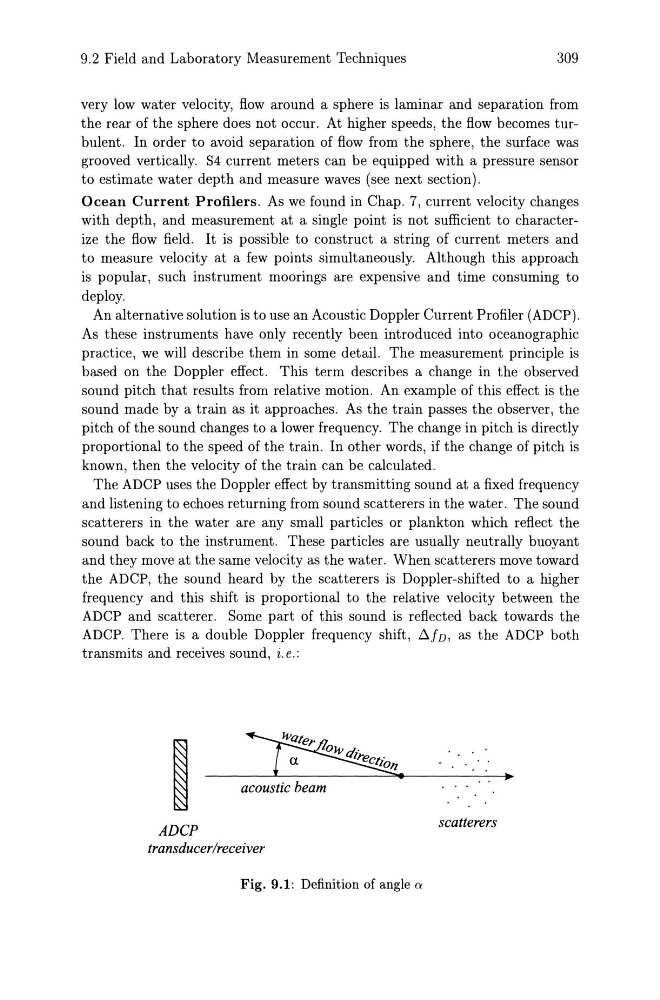
acoustic beam
ADCP
transducer/receiver
Fig. 9.1: Definition of angle a
scatterers
309
very low water velocity, flow around a sphere is laminar and separation from
the rear of the sphere does not occur. At higher speeds, the flow becomes turbulent. In order to avoid separation of flow from the sphere, the surface was
grooved vertically. 84 current meters can be equipped with a pressure sensor
to estimate water depth and measure waves (see next section).
Ocean Current Profilers. As we found in Chap. 7, current velocity changes
with depth, and measurement at a single point is not sufficient to characterize the flow field. It is possible to construct a string of current meters and
to measure velocity at a few points simultaneously. Although this approach
is popular, such instrument moorings are expensive and time consuming to
deploy.
An alternative solution is to use an Acoustic Doppler Current Profiler (ADCP).
As these instruments have only recently been introduced into oceanographic
practice, we will describe them in some detail. The measurement principle is
based on the Doppler effect. This term describes a change in the observed
sound pitch that results from relative motion. An example of this effect is the
sound made by a train as it approaches. As the train passes the observer, the
pitch of the sound changes to a lower frequency. The change in pitch is directly
proportional to the speed of the train. In other words, if the change of pitch is
known, then the velocity of the train can be calculated.
The ADCP uses the Doppler effect by transmitting sound at a fixed frequency
and listening to echoes returning from sound scatterers in the water. The sound
scatterers in the water are any small particles or plankton which reflect the
sound back to the instrument. These particles are usually neutrally buoyant
and they move at the same velocity as the water. When scatterers move toward
the ADCP, the sound heard by the scatterers is Doppler-shifted to a higher
frequency and this shift is proportional to the relative velocity between the
ADCP and scatterer. Some part of this sound is reflected back towards the
ADCP. There is a double Doppler frequency shift, !J.fD, as the ADCP both
transmits and receives sound, i.e.:
acoustic beam
ADCP
transducer/receiver
Fig. 9.1: Definition of angle a
scatterers