

300
8 Transport in the Oceans and Coastal Zone
by Schoonees and Theron (1994). In this section, a so-called 'energetic' model
for numerical simulation of longshore transport is considered (McDougal and
Hudspeth, 1983; 1989). The model assumes that the orbital wave motion
mobilizes the beach sand and wave power is then expended, maintaining the
sand in motion. The presence of a current, regardless of how small, transports
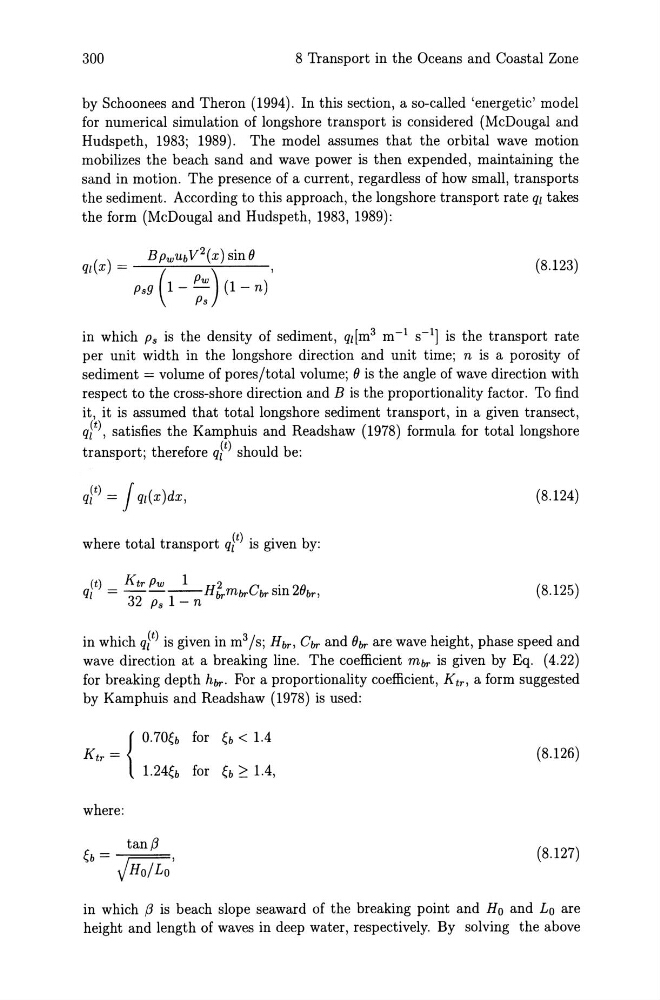
the sediment. According to this approach, the longshore transport rate qz takes
the form (McDougal and Hudspeth, 1983, 1989):
( )
B PwUb V 2 (x) sin ()
qz x =
,
Psg (1 - ::) (1 -n)
(8.123)
in which Ps is the density of sediment, qz[m 3 m- l s-l] is the transport rate
per unit width in the longshore direction and unit time; n is a porosity of
sediment = volume of pores/total volume; () is the angle of wave direction with
respect to the cross-shore direction and B is the proportionality factor. To find
it, it is assumed that total longshore sediment transport, in a given transect,
q?), satisfies the Kamphuis and Readshaw (1978) formula for total longshore
transport; therefore q?) should be:
(8.124)
where total transport q?) is given by:
(8.125)
in which qz(t) is given in m 3 /s; Hbr , Cbr and (}br are wave height, phase speed and
wave direction at a breaking line. The coefficient mbr is given by Eq. (4.22)
for breaking depth hbr. For a proportionality coefficient, KtTl a form suggested
by Kamphuis and Readshaw (1978) is used:
O. 70~b for ~b < 1.4
(8.126)
1.24~b for ~b::::: 1.4,
where:
tanf3
~b =
,
jHo/Lo
(8.127)
in which f3 is beach slope seaward of the breaking point and Ho and Lo are
height and length of waves in deep water, respectively. By solving the above
8 Transport in the Oceans and Coastal Zone
by Schoonees and Theron (1994). In this section, a so-called 'energetic' model
for numerical simulation of longshore transport is considered (McDougal and
Hudspeth, 1983; 1989). The model assumes that the orbital wave motion
mobilizes the beach sand and wave power is then expended, maintaining the
sand in motion. The presence of a current, regardless of how small, transports
the sediment. According to this approach, the longshore transport rate qz takes
the form (McDougal and Hudspeth, 1983, 1989):
( )
B PwUb V 2 (x) sin ()
qz x =
,
Psg (1 - ::) (1 -n)
(8.123)
in which Ps is the density of sediment, qz[m 3 m- l s-l] is the transport rate
per unit width in the longshore direction and unit time; n is a porosity of
sediment = volume of pores/total volume; () is the angle of wave direction with
respect to the cross-shore direction and B is the proportionality factor. To find
it, it is assumed that total longshore sediment transport, in a given transect,
q?), satisfies the Kamphuis and Readshaw (1978) formula for total longshore
transport; therefore q?) should be:
(8.124)
where total transport q?) is given by:
(8.125)
in which qz(t) is given in m 3 /s; Hbr , Cbr and (}br are wave height, phase speed and
wave direction at a breaking line. The coefficient mbr is given by Eq. (4.22)
for breaking depth hbr. For a proportionality coefficient, KtTl a form suggested
by Kamphuis and Readshaw (1978) is used:
O. 70~b for ~b < 1.4
(8.126)
1.24~b for ~b::::: 1.4,
where:
tanf3
~b =
,
jHo/Lo
(8.127)
in which f3 is beach slope seaward of the breaking point and Ho and Lo are
height and length of waves in deep water, respectively. By solving the above