

8.6 Sediment Transport in Coastal Zone
297
tide was about 400 m 3 /s. Roughness length, zo, is in general, the function of
intensity of flow. When mean flow velocity increases, the flow becomes stratified and well-mixed in the decelerating phase. This is due to the turbulent
mixing process that increases during the decelerating phase of the flow.
Moreover, field experiments show that the unsteady phases of the flow have
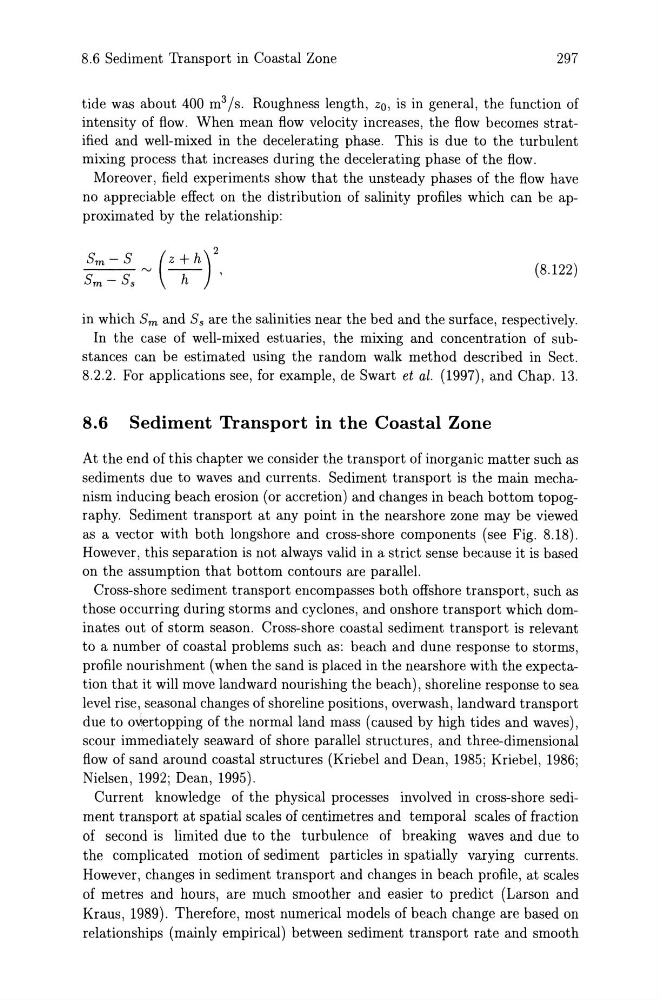
no appreciable effect on the distribution of salinity profiles which can be approximated by the relationship:
(8.122)
in which Sm and 58 are the salinities near the bed and the surface, respectively.
In the case of well-mixed estuaries, the mixing and concentration of substances can be estimated using the random walk method described in Sect.
8.2.2. For applications see, for example, de Swart et al. (1997), and Chap. 13.
8.6 Sediment Transport in the Coastal Zone
At the end of this chapter we consider the transport of inorganic matter such as
sediments due to waves and currents. Sediment transport is the main mechanism inducing beach erosion (or accretion) and changes in beach bottom topography. Sediment transport at any point in the nearshore zone may be viewed
as a vector with both longshore and cross-shore components (see Fig. 8.18).
However, this separation is not always valid in a strict sense because it is based
on the assumption that bottom contours are parallel.
Cross-shore sediment transport encompasses both offshore transport, such as
those occurring during storms and cyclones, and onshore transport which dominates out of storm season. Cross-shore coastal sediment transport is relevant
to a number of coastal problems such as: beach and dune response to storms,
profile nourishment (when the sand is placed in the nearshore with the expectation that it will move landward nourishing the beach), shoreline response to sea
level rise, seasonal changes of shoreline positions, overwash, landward transport
due to overtopping of the normal land mass (caused by high tides and waves),
scour immediately seaward of shore parallel structures, and three-dimensional
flow of sand around coastal structures (Kriebel and Dean, 1985; Kriebel, 1986;
Nielsen, 1992; Dean, 1995).
Current knowledge of the physical processes involved in cross-shore sediment transport at spatial scales of centimetres and temporal scales of fraction
of second is limited due to the turbulence of breaking waves and due to
the complicated motion of sediment particles in spatially varying currents.
However, changes in sediment transport and changes in beach profile, at scales
of metres and hours, are much smoother and easier to predict (Larson and
Kraus, 1989). Therefore, most numerical models of beach change are based on
relationships (mainly empirical) between sediment transport rate and smooth
297
tide was about 400 m 3 /s. Roughness length, zo, is in general, the function of
intensity of flow. When mean flow velocity increases, the flow becomes stratified and well-mixed in the decelerating phase. This is due to the turbulent
mixing process that increases during the decelerating phase of the flow.
Moreover, field experiments show that the unsteady phases of the flow have
no appreciable effect on the distribution of salinity profiles which can be approximated by the relationship:
(8.122)
in which Sm and 58 are the salinities near the bed and the surface, respectively.
In the case of well-mixed estuaries, the mixing and concentration of substances can be estimated using the random walk method described in Sect.
8.2.2. For applications see, for example, de Swart et al. (1997), and Chap. 13.
8.6 Sediment Transport in the Coastal Zone
At the end of this chapter we consider the transport of inorganic matter such as
sediments due to waves and currents. Sediment transport is the main mechanism inducing beach erosion (or accretion) and changes in beach bottom topography. Sediment transport at any point in the nearshore zone may be viewed
as a vector with both longshore and cross-shore components (see Fig. 8.18).
However, this separation is not always valid in a strict sense because it is based
on the assumption that bottom contours are parallel.
Cross-shore sediment transport encompasses both offshore transport, such as
those occurring during storms and cyclones, and onshore transport which dominates out of storm season. Cross-shore coastal sediment transport is relevant
to a number of coastal problems such as: beach and dune response to storms,
profile nourishment (when the sand is placed in the nearshore with the expectation that it will move landward nourishing the beach), shoreline response to sea
level rise, seasonal changes of shoreline positions, overwash, landward transport
due to overtopping of the normal land mass (caused by high tides and waves),
scour immediately seaward of shore parallel structures, and three-dimensional
flow of sand around coastal structures (Kriebel and Dean, 1985; Kriebel, 1986;
Nielsen, 1992; Dean, 1995).
Current knowledge of the physical processes involved in cross-shore sediment transport at spatial scales of centimetres and temporal scales of fraction
of second is limited due to the turbulence of breaking waves and due to
the complicated motion of sediment particles in spatially varying currents.
However, changes in sediment transport and changes in beach profile, at scales
of metres and hours, are much smoother and easier to predict (Larson and
Kraus, 1989). Therefore, most numerical models of beach change are based on
relationships (mainly empirical) between sediment transport rate and smooth