

1.2 Physical and Chemical Properties of Sea Water
""' 100
~
'-'
= 90
.8
~
.0
80
'5
'"
:e 70
~
:>
.~
60
'3
D50= 0.2 mm
E 50
::I
U
40
30
20
10
0
1.00
I
I
0.00
1.00
15
0.10
Particle dimension (mm)
2.32
I I
3.30
scale
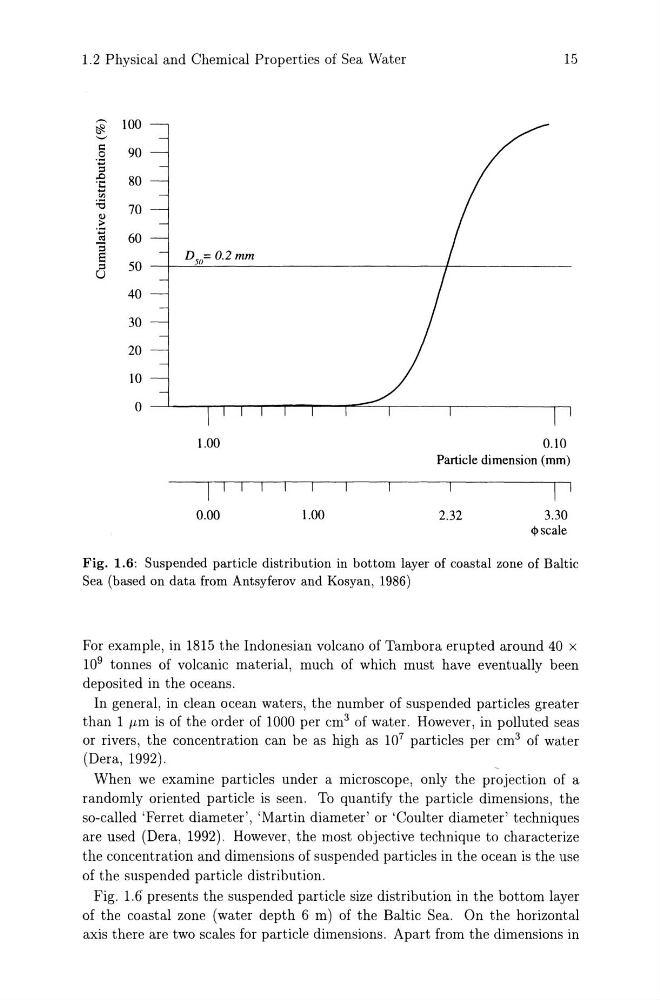
Fig. 1.6: Suspended particle distribution in bottom layer of coastal zone of Baltic
Sea (based on data from Antsyferov and Kosyan, 1986)
For example, in 1815 the Indonesian volcano of Tambora erupted around 40 x
10 9 tonnes of volcanic material, much of which must have eventually been
deposited in the oceans.
In general, in clean ocean waters, the number of suspended particles greater
than 1 /-im is of the order of 1000 per cm 3 of water. However, in polluted seas
or rivers, the concentration can be as high as 10 7 particles per cm 3 of water
(Dera, 1992).
When we examine particles under a microscope, only the projection of a
randomly oriented particle is seen. To quantify the particle dimensions, the
so-called 'Ferret diameter', 'Martin diameter' or 'Coulter diameter' techniques
are used (Dera, 1992). However, the most objective technique to characterize
the concentration and dimensions of suspended particles in the ocean is the use
of the suspended particle distribution.
Fig. 1.6" presents the suspended particle size distribution in the bottom layer
of the coastal zone (water depth 6 m) of the Baltic Sea. On the horizontal
axis there are two scales for particle dimensions. Apart from the dimensions in
""' 100
~
'-'
= 90
.8
~
.0
80
'5
'"
:e 70
~
:>
.~
60
'3
D50= 0.2 mm
E 50
::I
U
40
30
20
10
0
1.00
I
I
0.00
1.00
15
0.10
Particle dimension (mm)
2.32
I I
3.30
scale
Fig. 1.6: Suspended particle distribution in bottom layer of coastal zone of Baltic
Sea (based on data from Antsyferov and Kosyan, 1986)
For example, in 1815 the Indonesian volcano of Tambora erupted around 40 x
10 9 tonnes of volcanic material, much of which must have eventually been
deposited in the oceans.
In general, in clean ocean waters, the number of suspended particles greater
than 1 /-im is of the order of 1000 per cm 3 of water. However, in polluted seas
or rivers, the concentration can be as high as 10 7 particles per cm 3 of water
(Dera, 1992).
When we examine particles under a microscope, only the projection of a
randomly oriented particle is seen. To quantify the particle dimensions, the
so-called 'Ferret diameter', 'Martin diameter' or 'Coulter diameter' techniques
are used (Dera, 1992). However, the most objective technique to characterize
the concentration and dimensions of suspended particles in the ocean is the use
of the suspended particle distribution.
Fig. 1.6" presents the suspended particle size distribution in the bottom layer
of the coastal zone (water depth 6 m) of the Baltic Sea. On the horizontal
axis there are two scales for particle dimensions. Apart from the dimensions in