

14
1 Introducing Sea Water
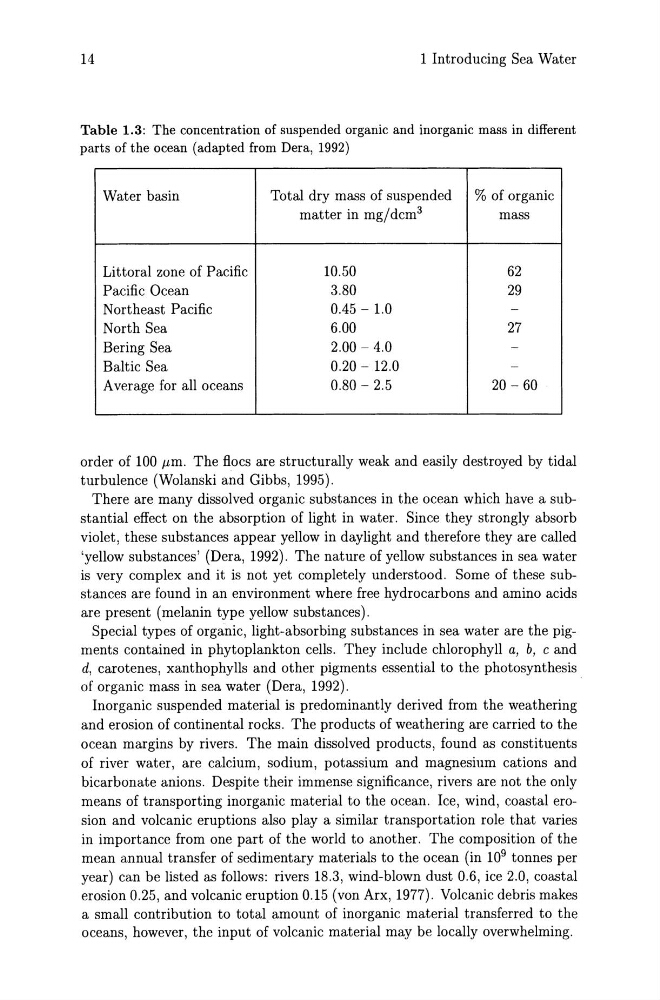
Table 1.3: The concentration of suspended organic and inorganic mass in different
parts of the ocean (adapted from Dera, 1992)
Water basin
Total dry mass of suspended
% of organic
matter in mg/dcm 3
mass
Littoral zone of Pacific
10.50
62
Pacific Ocean
3.80
29
Northeast Pacific
0.45 ~ 1.0
~
North Sea
6.00
27
Bering Sea
2.00 ~ 4.0
~
Baltic Sea
0.20 ~ 12.0
~
Average for all oceans
0.80 ~ 2.5
20 ~ 60
order of 100 /-lm. The flocs are structurally weak and easily destroyed by tidal
turbulence (Wolanski and Gibbs, 1995).
There are many dissolved organic substances in the ocean which have a substantial effect on the absorption of light in water. Since they strongly absorb
violet, these substances appear yellow in daylight and therefore they are called
'yellow substances' (Dera, 1992). The nature of yellow substances in sea water
is very complex and it is not yet completely understood. Some of these substances are found in an environment where free hydrocarbons and amino acids
are present (melanin type yellow substances).
Special types of organic, light-absorbing substances in sea water are the pigments contained in phytoplankton cells. They include chlorophyll a, b, c and
d, carotenes, xanthophylls and other pigments essential to the photosynthesis
of organic mass in sea water (Dera, 1992).
.
Inorganic suspended material is predominantly derived from the weathering
and erosion of continental rocks. The products of weathering are carried to the
ocean margins by rivers. The main dissolved products, found as constituents
of river water, are calcium, sodium, potassium and magnesium cations and
bicarbonate anions. Despite their immense significance, rivers are not the only
means of transporting inorganic material to the ocean. Ice, wind, coastal erosion and volcanic eruptions also playa similar transportation role that varies
in importance from one part of the world to another. The composition of the
mean annual transfer of sedimentary materials to the ocean (in 10 9 tonnes per
year) can be listed as follows: rivers 18.3, wind-blown dust 0.6, ice 2.0, coastal
erosion 0.25, and volcanic eruption 0.15 (von Arx, 1977). Volcanic debris makes
a small contribution to total amount of inorganic material transferred to the
oceans, however, the input of volcanic material may be locally overwhelming.
1 Introducing Sea Water
Table 1.3: The concentration of suspended organic and inorganic mass in different
parts of the ocean (adapted from Dera, 1992)
Water basin
Total dry mass of suspended
% of organic
matter in mg/dcm 3
mass
Littoral zone of Pacific
10.50
62
Pacific Ocean
3.80
29
Northeast Pacific
0.45 ~ 1.0
~
North Sea
6.00
27
Bering Sea
2.00 ~ 4.0
~
Baltic Sea
0.20 ~ 12.0
~
Average for all oceans
0.80 ~ 2.5
20 ~ 60
order of 100 /-lm. The flocs are structurally weak and easily destroyed by tidal
turbulence (Wolanski and Gibbs, 1995).
There are many dissolved organic substances in the ocean which have a substantial effect on the absorption of light in water. Since they strongly absorb
violet, these substances appear yellow in daylight and therefore they are called
'yellow substances' (Dera, 1992). The nature of yellow substances in sea water
is very complex and it is not yet completely understood. Some of these substances are found in an environment where free hydrocarbons and amino acids
are present (melanin type yellow substances).
Special types of organic, light-absorbing substances in sea water are the pigments contained in phytoplankton cells. They include chlorophyll a, b, c and
d, carotenes, xanthophylls and other pigments essential to the photosynthesis
of organic mass in sea water (Dera, 1992).
.
Inorganic suspended material is predominantly derived from the weathering
and erosion of continental rocks. The products of weathering are carried to the
ocean margins by rivers. The main dissolved products, found as constituents
of river water, are calcium, sodium, potassium and magnesium cations and
bicarbonate anions. Despite their immense significance, rivers are not the only
means of transporting inorganic material to the ocean. Ice, wind, coastal erosion and volcanic eruptions also playa similar transportation role that varies
in importance from one part of the world to another. The composition of the
mean annual transfer of sedimentary materials to the ocean (in 10 9 tonnes per
year) can be listed as follows: rivers 18.3, wind-blown dust 0.6, ice 2.0, coastal
erosion 0.25, and volcanic eruption 0.15 (von Arx, 1977). Volcanic debris makes
a small contribution to total amount of inorganic material transferred to the
oceans, however, the input of volcanic material may be locally overwhelming.