

8.3 Concentration of Matter for Molecular and Turbulent Diffusion
265
in which T is the mean temperature and KF), K~T) and KiT) are the coefficients
of turbulent heat exchange. Equation (8.32) is valid assuming that the water
density pw is constant and the specific heat cpt is constant.
Magnitude of the Coefficients of Turbulent Diffusion. The first estimation of the coefficient of vertical turbulent diffusion, K z, for salt in Kattegat
Strait by Jacobsen gave a value of the order of 10- 3 m 2 /s, which is a few orders
of magnitude higher than the coefficient D ('" 10- 9 m 2 /s). Ozmidov (1986)
found that the coefficient, K z , for 90Sr in Atlantic waters was about 3x 10- 3
m 2 /s, and in the Sargasso Sea, Kz changes between 2.3x1O-4 and 9.5x10- 4
m 2 Is for the upper ocean layer up to 50 m water depth, while for water 50-100
m deep, it varies between 1.4 x10- 4 and 9x1O-4 m 2 /s. For deeper water between 100 m and 200 m, coefficient, K z , changes between 1.4x 10- 3 m 2 /s and
2.2 x 10- 3 m 2 /s.
Therefore, in general the coefficient of vertical turbulent diffusion is in fact
a function of vertical coordinate. Dependence of the coefficient, K z, on z is
strongly related to the stratification of ocean waters.
The coefficients of horizontal turbulent diffusion, Kx and K y , are much higher
than the coefficient K z. Initial estimations of the horizontal coefficients by
Montgomery and Sverdrup (Kamenkovitch, 1978) in late thirties showed that
they are of the order of 10 3 -10 4 m 2 /s. On the other hand, Munk et al. (1949)
obtained values of Kx and Ky of the order of only 15 m 2 /s for diffusion of
contaminants in the lagoon of Bikini.
However, it soon became clear that the value of coefficients, K x and K y
strongly depends on the spatial scale, L, of a given phenomenon. As L becomes
larger, more and larger eddies participate in diffusion, and the diffusivity increases. Let us add that the coefficient of vertical turbulent diffusion of heat is
of the order of 10- 5 m 2 /s, and the coefficient of vertical turbulent diffusion of
salt is of the same order of magnitude.
There are two methods commonly used to quantify turbulent diffusivity. The
first one is based on the observation of the rate at which particles spread after
being released from some point. Initially, concentration is very high, but with
passing time the cloud of particles spreads out. The spreading of the particle
cloud is faster when the rate of turbulent diffusion is higher.
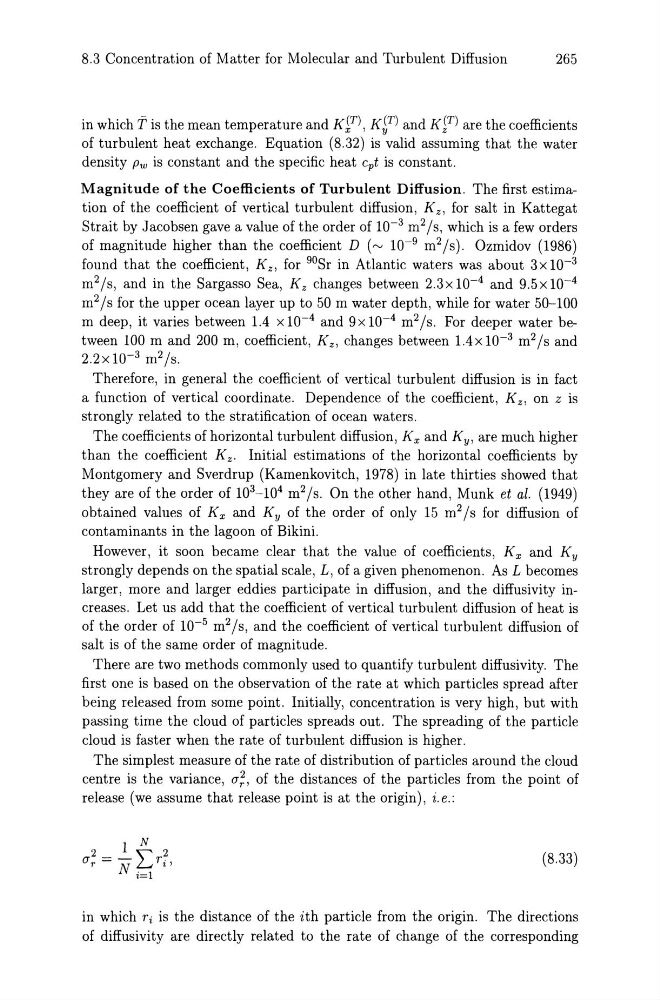
The simplest measure of the rate of distribution of particles around the cloud
centre is the variance, (J;, of the distances of the particles from the point of
release (we assume that release point is at the origin), i. e.:
(8.33)
in which ri is the distance of the ith particle from the origin. The directions
of diffusivity are directly related to the rate of change of the corresponding
265
in which T is the mean temperature and KF), K~T) and KiT) are the coefficients
of turbulent heat exchange. Equation (8.32) is valid assuming that the water
density pw is constant and the specific heat cpt is constant.
Magnitude of the Coefficients of Turbulent Diffusion. The first estimation of the coefficient of vertical turbulent diffusion, K z, for salt in Kattegat
Strait by Jacobsen gave a value of the order of 10- 3 m 2 /s, which is a few orders
of magnitude higher than the coefficient D ('" 10- 9 m 2 /s). Ozmidov (1986)
found that the coefficient, K z , for 90Sr in Atlantic waters was about 3x 10- 3
m 2 /s, and in the Sargasso Sea, Kz changes between 2.3x1O-4 and 9.5x10- 4
m 2 Is for the upper ocean layer up to 50 m water depth, while for water 50-100
m deep, it varies between 1.4 x10- 4 and 9x1O-4 m 2 /s. For deeper water between 100 m and 200 m, coefficient, K z , changes between 1.4x 10- 3 m 2 /s and
2.2 x 10- 3 m 2 /s.
Therefore, in general the coefficient of vertical turbulent diffusion is in fact
a function of vertical coordinate. Dependence of the coefficient, K z, on z is
strongly related to the stratification of ocean waters.
The coefficients of horizontal turbulent diffusion, Kx and K y , are much higher
than the coefficient K z. Initial estimations of the horizontal coefficients by
Montgomery and Sverdrup (Kamenkovitch, 1978) in late thirties showed that
they are of the order of 10 3 -10 4 m 2 /s. On the other hand, Munk et al. (1949)
obtained values of Kx and Ky of the order of only 15 m 2 /s for diffusion of
contaminants in the lagoon of Bikini.
However, it soon became clear that the value of coefficients, K x and K y
strongly depends on the spatial scale, L, of a given phenomenon. As L becomes
larger, more and larger eddies participate in diffusion, and the diffusivity increases. Let us add that the coefficient of vertical turbulent diffusion of heat is
of the order of 10- 5 m 2 /s, and the coefficient of vertical turbulent diffusion of
salt is of the same order of magnitude.
There are two methods commonly used to quantify turbulent diffusivity. The
first one is based on the observation of the rate at which particles spread after
being released from some point. Initially, concentration is very high, but with
passing time the cloud of particles spreads out. The spreading of the particle
cloud is faster when the rate of turbulent diffusion is higher.
The simplest measure of the rate of distribution of particles around the cloud
centre is the variance, (J;, of the distances of the particles from the point of
release (we assume that release point is at the origin), i. e.:
(8.33)
in which ri is the distance of the ith particle from the origin. The directions
of diffusivity are directly related to the rate of change of the corresponding