

264
8 Transport in the Oceans and Coastal Zone
in which over bars denote averaging in a stochastic sense. The last three terms
on the right side of this equation result from the turbulent character of water motion and they describe the input of the turbulent fluctuations into the
balance of mass transport. These terms are unknown a priori and have to be
defined through other variables, for example, the mean concentration e. Using
the so called Boussinesq approximation, we can write:
u'c'
oe
-K- xox
v'c'
oe
-K- Yoy
(8.29)
w'c'
oe
-K- z oz
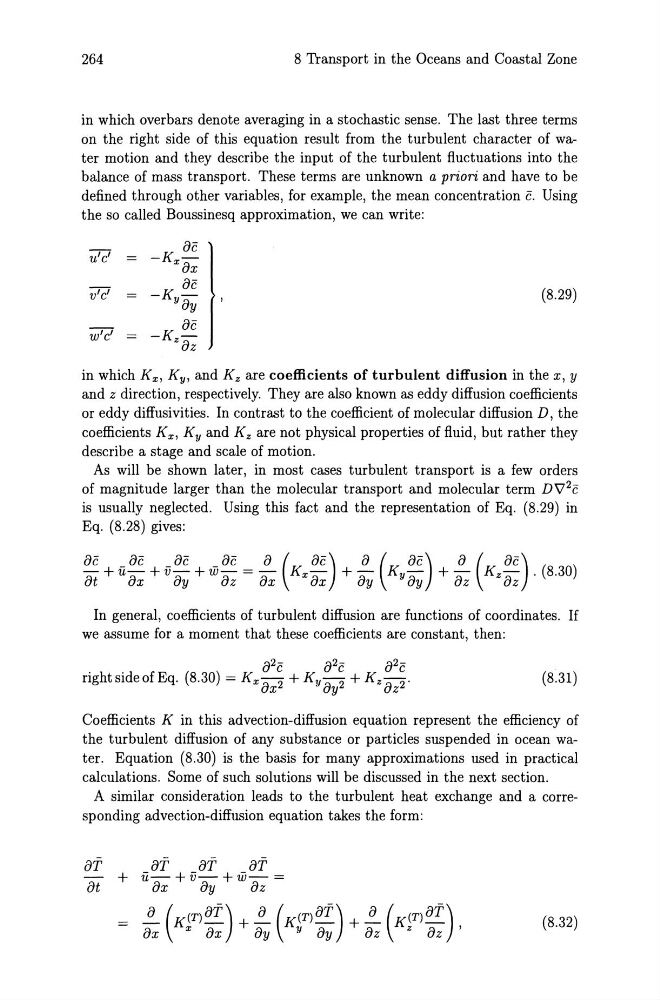
in which Kx, Ky, and Kz are coefficients of turbulent diffusion in the x, y
and z direction, respectively. They are also known as eddy diffusion coefficients
or eddy diffusivities. In contrast to the coefficient of molecular diffusion D, the
coefficients Kx, Ky and Kz are not physical properties of fluid, but rather they
describe a stage and scale of motion.
As will be shown later, in most cases turbulent transport is a few orders
of magnitude larger than the molecular transport and molecular term DV 2 e
is usually neglected. Using this fact and the representation of Eq. (8.29) in
Eq. (8.28) gives:
In general, coefficients of turbulent diffusion are functions of coordinates. If
we assume for a moment that these coefficients are constant, then:
(8.31)
Coefficients K in this advection-diffusion equation represent the efficiency of
the turbulent diffusion of any substance or particles suspended in ocean water. Equation (8.30) is the basis for many approximations used in practical
calculations. Some of such solutions will be discussed in the next section.
A similar consideration leads to the turbulent heat exchange and a corresponding advection-diffusion equation takes the form:
or
ot
or or or
+ iJ,-+v-+w-=
ox oy
oz
~ (Kf)Or) + ~ (K(T)Or) + i. (KiT)Ot) ,
ox
ox oy y oy oz
oz
(8.32)
8 Transport in the Oceans and Coastal Zone
in which over bars denote averaging in a stochastic sense. The last three terms
on the right side of this equation result from the turbulent character of water motion and they describe the input of the turbulent fluctuations into the
balance of mass transport. These terms are unknown a priori and have to be
defined through other variables, for example, the mean concentration e. Using
the so called Boussinesq approximation, we can write:
u'c'
oe
-K- xox
v'c'
oe
-K- Yoy
(8.29)
w'c'
oe
-K- z oz
in which Kx, Ky, and Kz are coefficients of turbulent diffusion in the x, y
and z direction, respectively. They are also known as eddy diffusion coefficients
or eddy diffusivities. In contrast to the coefficient of molecular diffusion D, the
coefficients Kx, Ky and Kz are not physical properties of fluid, but rather they
describe a stage and scale of motion.
As will be shown later, in most cases turbulent transport is a few orders
of magnitude larger than the molecular transport and molecular term DV 2 e
is usually neglected. Using this fact and the representation of Eq. (8.29) in
Eq. (8.28) gives:
In general, coefficients of turbulent diffusion are functions of coordinates. If
we assume for a moment that these coefficients are constant, then:
(8.31)
Coefficients K in this advection-diffusion equation represent the efficiency of
the turbulent diffusion of any substance or particles suspended in ocean water. Equation (8.30) is the basis for many approximations used in practical
calculations. Some of such solutions will be discussed in the next section.
A similar consideration leads to the turbulent heat exchange and a corresponding advection-diffusion equation takes the form:
or
ot
or or or
+ iJ,-+v-+w-=
ox oy
oz
~ (Kf)Or) + ~ (K(T)Or) + i. (KiT)Ot) ,
ox
ox oy y oy oz
oz
(8.32)