

8.3 Concentration of Matter for Molecular and Turbulent Diffusion
259
the turbulent motion of particles is continuous, and oscillations separated by
small time intervals are correlated with each other. Therefore, a random walk
model which assumes that all particle movements are uncorrelated can not be
applied in a straightforward manner for turbulent environment. We will return
to modelling turbulent diffusion later in this chapter.
8.3 Concentration of Matter for Molecular and Turbulent Diffusion
8.3.1 Concentration of Matter for Molecular Diffusion
Fick's Eq. (8.12) describes the relationship between the flux of matter, Ix, and
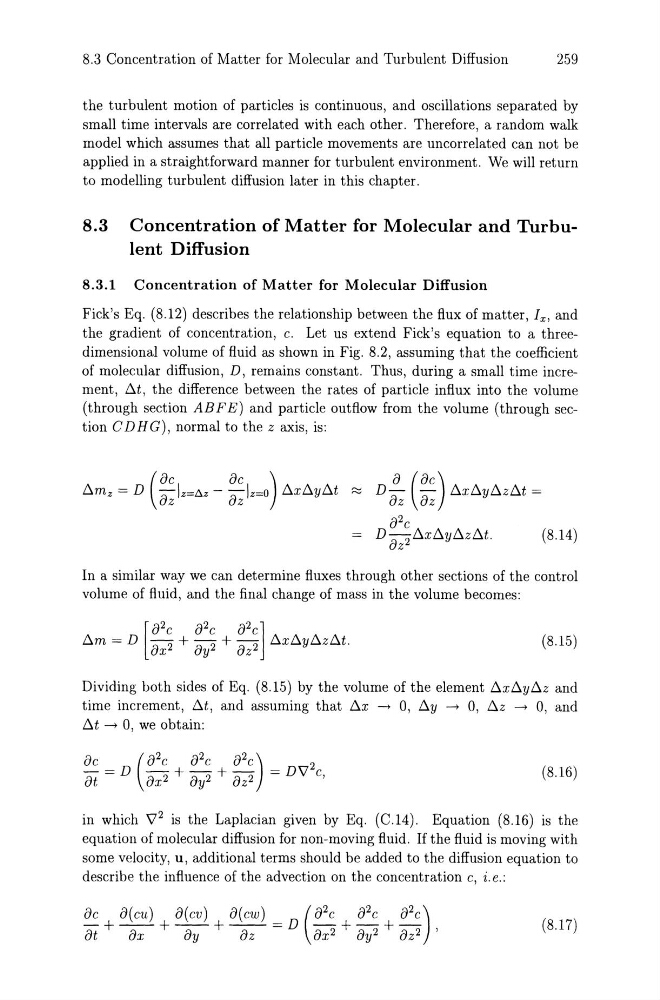
the gradient of concentration, c. Let us extend Fick's equation to a threedimensional volume of fluid as shown in Fig. 8.2, assuming that the coefficient
of molecular diffusion, D, remains constant. Thus, during a small time increment, !:,.t, the difference between the rates of particle influx into the volume
(through section AB F E) and particle outflow from the volume (through section CD H G), normal to the z axis, is:
In a similar way we can determine fluxes through other sections of the control
volume of fluid, and the final change of mass in the volume becomes:
(8.15)
Dividing both sides of Eq. (8.15) by the volume of the element !:"x!:,.y!:,.z and
time increment, !:,.t, and assuming that !:"x --> 0, !:"y --> 0, !:"z --> 0, and
!:"t --> 0, we obtain:
fjc _
(fj 2 c
fj 2 c
fj 2 c) _
2
fjt - D fjx 2 + fjy2 + fj z 2 - D'\1 c,
(8.16)
in which '\1 2 is the Laplacian given by Eq. (C.14). Equation (8.16) is the
equation of molecular diffusion for non-moving fluid. If the fluid is moving with
some velocity, u, additional terms should be added to the diffusion equation to
describe the influence of the advection on the concentration c, i. e.:
(8.17)
259
the turbulent motion of particles is continuous, and oscillations separated by
small time intervals are correlated with each other. Therefore, a random walk
model which assumes that all particle movements are uncorrelated can not be
applied in a straightforward manner for turbulent environment. We will return
to modelling turbulent diffusion later in this chapter.
8.3 Concentration of Matter for Molecular and Turbulent Diffusion
8.3.1 Concentration of Matter for Molecular Diffusion
Fick's Eq. (8.12) describes the relationship between the flux of matter, Ix, and
the gradient of concentration, c. Let us extend Fick's equation to a threedimensional volume of fluid as shown in Fig. 8.2, assuming that the coefficient
of molecular diffusion, D, remains constant. Thus, during a small time increment, !:,.t, the difference between the rates of particle influx into the volume
(through section AB F E) and particle outflow from the volume (through section CD H G), normal to the z axis, is:
In a similar way we can determine fluxes through other sections of the control
volume of fluid, and the final change of mass in the volume becomes:
(8.15)
Dividing both sides of Eq. (8.15) by the volume of the element !:"x!:,.y!:,.z and
time increment, !:,.t, and assuming that !:"x --> 0, !:"y --> 0, !:"z --> 0, and
!:"t --> 0, we obtain:
fjc _
(fj 2 c
fj 2 c
fj 2 c) _
2
fjt - D fjx 2 + fjy2 + fj z 2 - D'\1 c,
(8.16)
in which '\1 2 is the Laplacian given by Eq. (C.14). Equation (8.16) is the
equation of molecular diffusion for non-moving fluid. If the fluid is moving with
some velocity, u, additional terms should be added to the diffusion equation to
describe the influence of the advection on the concentration c, i. e.:
(8.17)