

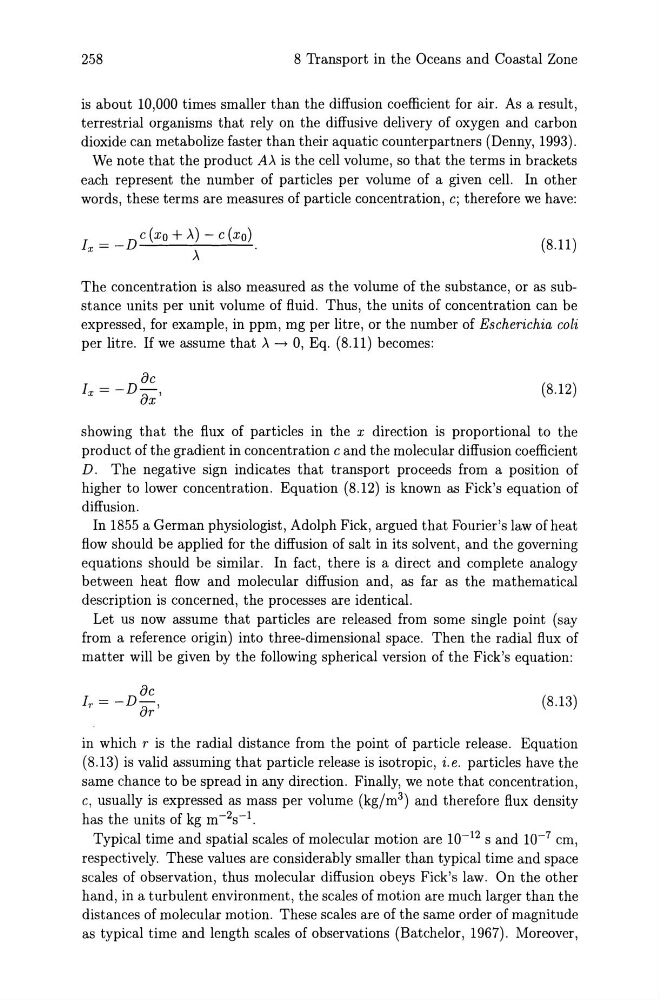
258
8 Transport in the Oceans and Coastal Zone
is about 10,000 times smaller than the diffusion coefficient for air. As a result,
terrestrial organisms that rely on the diffusive delivery of oxygen and carbon
dioxide can metabolize faster than their aquatic counterpartners (Denny, 1993).
We note that the product A), is the cell volume, so that the terms in brackets
each represent the number of particles per volume of a given cell. In other
words, these terms are measures of particle concentration, c; therefore we have:
c (xo + ),) - c (xo)
Ix = -D
.
),
(8.11)
The concentration is also measured as the volume of the substance, or as substance units per unit volume of fluid. Thus, the units of concentration can be
expressed, for example, in ppm, mg per litre, or the number of Escherichia coli
per litre. If we assume that), ---> 0, Eq. (8.11) becomes:
oc
I =-Dx
ox'
(8.12)
showing that the flux of particles in the x direction is proportional to the
product of the gradient in concentration c and the molecular diffusion coefficient
D. The negative sign indicates that transport proceeds from a position of
higher to lower concentration. Equation (8.12) is known as Fick's equation of
diffusion.
In 1855 a German physiologist, Adolph Fick, argued that Fourier's law of heat
flow should be applied for the diffusion of salt in its solvent, and the governing
equations should be similar. In fact, there is a direct and complete analogy
between heat flow and molecular diffusion and, as far as the mathematical
description is concerned, the processes are identical.
Let us now assume that particles are released from some single point (say
from a reference origin) into three-dimensional space. Then the radial flux of
matter will be given by the following spherical version of the Fick's equation:
oc
I =-Dr
or'
(8.13)
in which r is the radial distance from the point of particle release. Equation
(8.13) is valid assuming that particle release is isotropic, i.e. particles have the
same chance to be spread in any direction. Finally, we note that concentration,
c, usually is expressed as mass per volume (kg/m 3 ) and therefore flux density
has the units of kg m- 2 s- 1 .
Typical time and spatial scales of molecular motion are 10- 12 sand 10- 7 cm,
respectively. These values are considerably smaller than typical time and space
scales of observation, thus molecular diffusion obeys Fick's law. On the other
hand, in a turbulent environment, the scales of motion are much larger than the
distances of molecular motion. These scales are of the same order of magnitude
as typical time and length scales of observations (Batchelor, 1967). Moreover,
8 Transport in the Oceans and Coastal Zone
is about 10,000 times smaller than the diffusion coefficient for air. As a result,
terrestrial organisms that rely on the diffusive delivery of oxygen and carbon
dioxide can metabolize faster than their aquatic counterpartners (Denny, 1993).
We note that the product A), is the cell volume, so that the terms in brackets
each represent the number of particles per volume of a given cell. In other
words, these terms are measures of particle concentration, c; therefore we have:
c (xo + ),) - c (xo)
Ix = -D
.
),
(8.11)
The concentration is also measured as the volume of the substance, or as substance units per unit volume of fluid. Thus, the units of concentration can be
expressed, for example, in ppm, mg per litre, or the number of Escherichia coli
per litre. If we assume that), ---> 0, Eq. (8.11) becomes:
oc
I =-Dx
ox'
(8.12)
showing that the flux of particles in the x direction is proportional to the
product of the gradient in concentration c and the molecular diffusion coefficient
D. The negative sign indicates that transport proceeds from a position of
higher to lower concentration. Equation (8.12) is known as Fick's equation of
diffusion.
In 1855 a German physiologist, Adolph Fick, argued that Fourier's law of heat
flow should be applied for the diffusion of salt in its solvent, and the governing
equations should be similar. In fact, there is a direct and complete analogy
between heat flow and molecular diffusion and, as far as the mathematical
description is concerned, the processes are identical.
Let us now assume that particles are released from some single point (say
from a reference origin) into three-dimensional space. Then the radial flux of
matter will be given by the following spherical version of the Fick's equation:
oc
I =-Dr
or'
(8.13)
in which r is the radial distance from the point of particle release. Equation
(8.13) is valid assuming that particle release is isotropic, i.e. particles have the
same chance to be spread in any direction. Finally, we note that concentration,
c, usually is expressed as mass per volume (kg/m 3 ) and therefore flux density
has the units of kg m- 2 s- 1 .
Typical time and spatial scales of molecular motion are 10- 12 sand 10- 7 cm,
respectively. These values are considerably smaller than typical time and space
scales of observation, thus molecular diffusion obeys Fick's law. On the other
hand, in a turbulent environment, the scales of motion are much larger than the
distances of molecular motion. These scales are of the same order of magnitude
as typical time and length scales of observations (Batchelor, 1967). Moreover,