

256
8 Transport in the Oceans and Coastal Zone
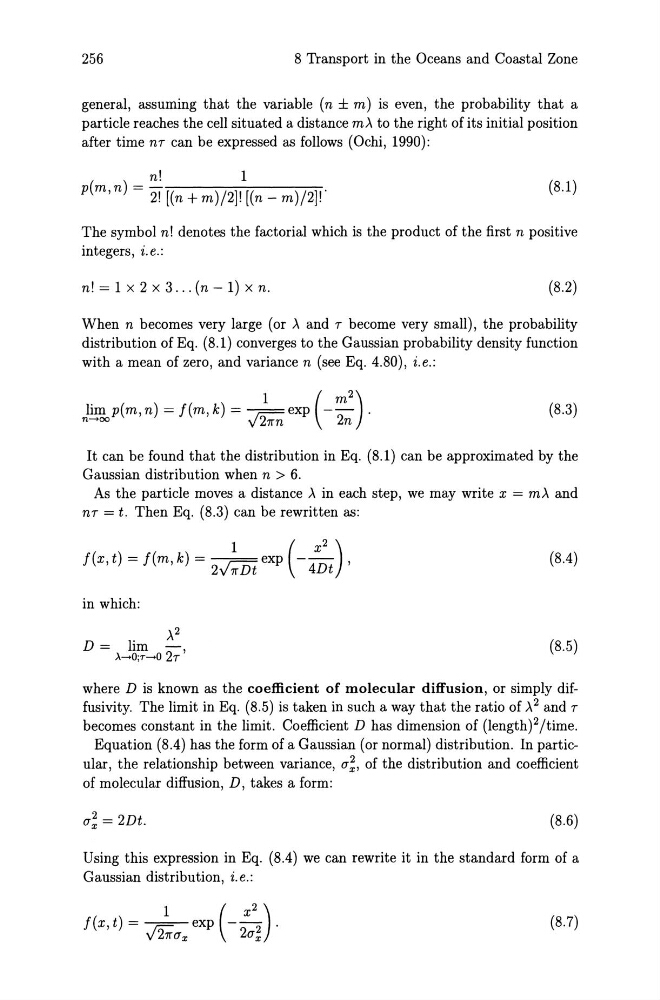
general, assuming that the variable (n ± m) is even, the probability that a
particle reaches the cell situated a distance m). to the right of its initial position
after time n7 can be expressed as follows (Ochi, 1990):
n!
1
p(m, n) = 2! [(n + m)/2]! [(n - m)/2]!'
(8.1)
The symbol n! denotes the factorial which is the product of the first n positive
integers, i. e.:
n! = 1 x 2 x 3 ... (n - 1) x n.
(8.2)
When n becomes very large (or). and 7 become very small), the probability
distribution of Eq. (8.1) converges to the Gaussian probability density function
with a mean of zero, and variance n (see Eq. 4.80), i.e.:
1
(m2)
lim p(m, n) = f(m, k) = ;n-- exp --2 .
n-+oo
V 27rn
n
(8.3)
It can be found that the distribution in Eq. (8.1) can be approximated by the
Gaussian distribution when n > 6.
As the particle moves a distance). in each step, we may write x = m). and
n7 = t. Then Eq. (8.3) can be rewritten as:
1
(x2 )
f(x, t) = f(m, k) = 2v;;:Dt exp - 4Dt '
in which:
).2
D =
lim -
>'-+O;T-+O 27 '
(8.4)
(8.5)
where D is known as the coefficient of molecular diffusion, or simply diffusivity. The limit in Eq. (8.5) is taken in such a way that the ratio of ).2 and 7
becomes constant in the limit. Coefficient D has dimension of (length) 2 /time.
Equation (8.4) has the form of a Gaussian (or normal) distribution. In particular, the relationship between variance, 0' ;, of the distribution and coefficient
of molecular diffusion, D, takes a form:
0' ; = 2Dt.
(8.6)
Using this expression in Eq. (8.4) we can rewrite it in the standard form of a
Gaussian distribution, i.e.:
1
(x2 )
f(x, t) = In exp -2'2 .
V 27rO'x
O'x
(8.7)
8 Transport in the Oceans and Coastal Zone
general, assuming that the variable (n ± m) is even, the probability that a
particle reaches the cell situated a distance m). to the right of its initial position
after time n7 can be expressed as follows (Ochi, 1990):
n!
1
p(m, n) = 2! [(n + m)/2]! [(n - m)/2]!'
(8.1)
The symbol n! denotes the factorial which is the product of the first n positive
integers, i. e.:
n! = 1 x 2 x 3 ... (n - 1) x n.
(8.2)
When n becomes very large (or). and 7 become very small), the probability
distribution of Eq. (8.1) converges to the Gaussian probability density function
with a mean of zero, and variance n (see Eq. 4.80), i.e.:
1
(m2)
lim p(m, n) = f(m, k) = ;n-- exp --2 .
n-+oo
V 27rn
n
(8.3)
It can be found that the distribution in Eq. (8.1) can be approximated by the
Gaussian distribution when n > 6.
As the particle moves a distance). in each step, we may write x = m). and
n7 = t. Then Eq. (8.3) can be rewritten as:
1
(x2 )
f(x, t) = f(m, k) = 2v;;:Dt exp - 4Dt '
in which:
).2
D =
lim -
>'-+O;T-+O 27 '
(8.4)
(8.5)
where D is known as the coefficient of molecular diffusion, or simply diffusivity. The limit in Eq. (8.5) is taken in such a way that the ratio of ).2 and 7
becomes constant in the limit. Coefficient D has dimension of (length) 2 /time.
Equation (8.4) has the form of a Gaussian (or normal) distribution. In particular, the relationship between variance, 0' ;, of the distribution and coefficient
of molecular diffusion, D, takes a form:
0' ; = 2Dt.
(8.6)
Using this expression in Eq. (8.4) we can rewrite it in the standard form of a
Gaussian distribution, i.e.:
1
(x2 )
f(x, t) = In exp -2'2 .
V 27rO'x
O'x
(8.7)