

7.3 Wind-Driven Surface and Near-Surface Currents
215
In the ocean, where the motion is generally turbulent, the coefficient of kinematic viscosity is replaced by the coefficients of turbulent viscosity (known also
as eddy viscosity coefficients) Ax, A y, and Az, for the x, y and z directions,
respectively (see also Sect. 1.2). Thus, the eddy friction stress:
(7.16)
expresses the force of one layer of fluid on an area of its neighbour above or
below. To substitute in Eq. (7.14), we need an expression for the forces F',; and
Fy per unit of mass of fluid. It can be shown that these forces can be written
as follows:
Fx
{hx
fj (
fjU)
fj 2 u }
8z = fjz PwAz fjz = PwAz fj z 2
fjTy _
A fj 2 v
(7.17)
Fy = fjz - Pw z fj z 2
As very little information on the variation of Az with depth is available, this
value is assumed to be constant. After substitution of Eq. (7.17) into Eq. (7.14)
we have:
= o}.
= 0
(7.18)
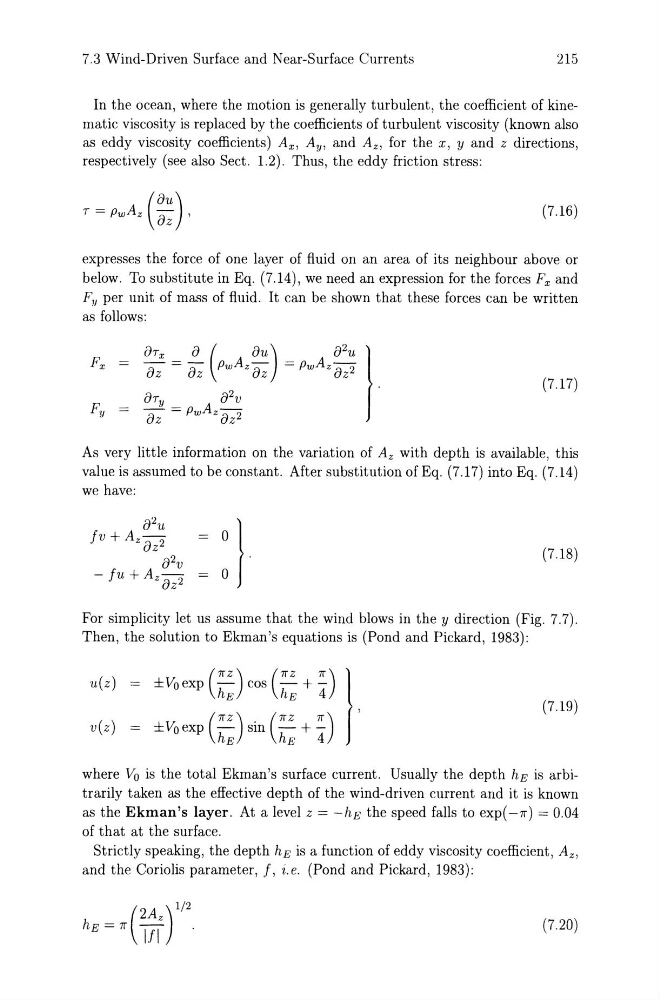
For simplicity let us assume that the wind blows in the y direction (Fig. 7.7).
Then, the solution to Ekman's equations is (Pond and Pickard, 1983):
( 7rZ) (7rZ 7r)}
u(z) = ±Voexp -
cos - +hE
hE
4
v(z) = ±Voexp (~:) sin G: + ~) ,
(7.19)
where Vo is the total Ekman's surface current. Usually the depth hE is arbitrarily taken as the effective depth of the wind-driven current and it is known
as the Ekman's layer. At a level z = -hE the speed falls to exp(-rr) = 0.04
of that at the surface.
Strictly speaking, the depth hE is a function of eddy viscosity coefficient, A z ,
and the Coriolis parameter, f, i.e. (Pond and Pickard, 1983):
_ (2Az)1/2
hE - rr ifi
(7.20)
215
In the ocean, where the motion is generally turbulent, the coefficient of kinematic viscosity is replaced by the coefficients of turbulent viscosity (known also
as eddy viscosity coefficients) Ax, A y, and Az, for the x, y and z directions,
respectively (see also Sect. 1.2). Thus, the eddy friction stress:
(7.16)
expresses the force of one layer of fluid on an area of its neighbour above or
below. To substitute in Eq. (7.14), we need an expression for the forces F',; and
Fy per unit of mass of fluid. It can be shown that these forces can be written
as follows:
Fx
{hx
fj (
fjU)
fj 2 u }
8z = fjz PwAz fjz = PwAz fj z 2
fjTy _
A fj 2 v
(7.17)
Fy = fjz - Pw z fj z 2
As very little information on the variation of Az with depth is available, this
value is assumed to be constant. After substitution of Eq. (7.17) into Eq. (7.14)
we have:
= o}.
= 0
(7.18)
For simplicity let us assume that the wind blows in the y direction (Fig. 7.7).
Then, the solution to Ekman's equations is (Pond and Pickard, 1983):
( 7rZ) (7rZ 7r)}
u(z) = ±Voexp -
cos - +hE
hE
4
v(z) = ±Voexp (~:) sin G: + ~) ,
(7.19)
where Vo is the total Ekman's surface current. Usually the depth hE is arbitrarily taken as the effective depth of the wind-driven current and it is known
as the Ekman's layer. At a level z = -hE the speed falls to exp(-rr) = 0.04
of that at the surface.
Strictly speaking, the depth hE is a function of eddy viscosity coefficient, A z ,
and the Coriolis parameter, f, i.e. (Pond and Pickard, 1983):
_ (2Az)1/2
hE - rr ifi
(7.20)