

214
~
~
~
~\ spiraling
~
currents
;~
net water
transport
b YA
I
7 Ocean Currents
,
,
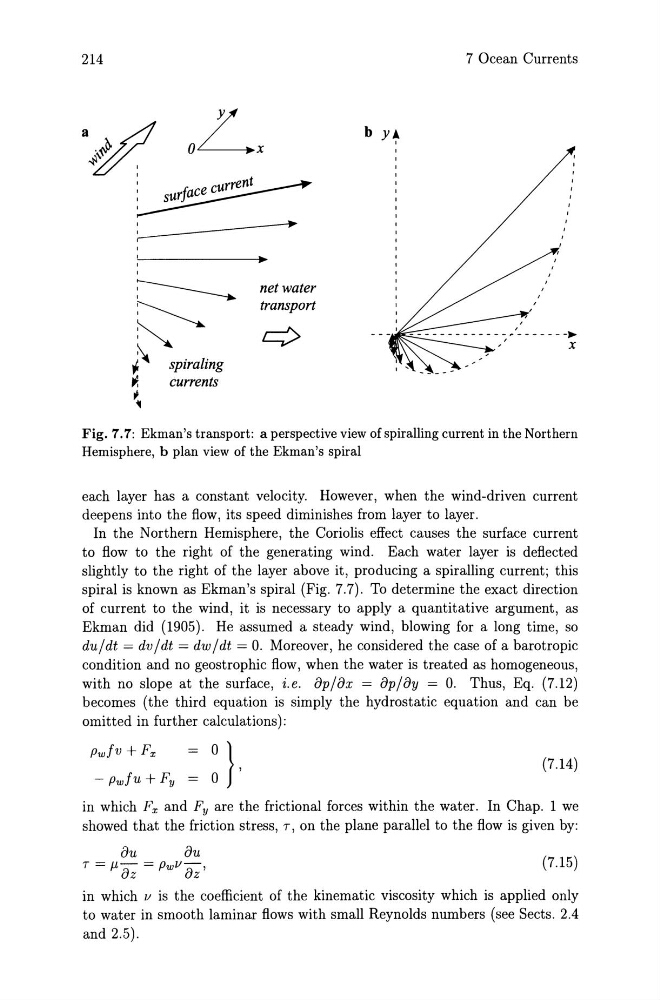
Fig. 7.7: Ekman's transport: a perspective view of spiralling current in the Northern
Hemisphere, b plan view of the Ekman's spiral
each layer has a constant velocity. However, when the wind-driven current
deepens into the flow, its speed diminishes from layer to layer.
In the Northern Hemisphere, the Coriolis effect causes the surface current
to flow to the right of the generating wind. Each water layer is deflected
slightly to the right of the layer above it, producing a spiralling current; this
spiral is known as Ekman's spiral (Fig. 7.7). To determine the exact direction
of current to the wind, it is necessary to apply a quantitative argument, as
Ekman did (1905). He assumed a steady wind, blowing for a long time, so
du/dt = dv/dt = dw/dt = O. Moreover, he considered the case of a barotropic
condition and no geostrophic flow, when the water is treated as homogeneous,
with no slope at the surface, i.e. 8p/8x = 8p/8y = O. Thus, Eq. (7.12)
becomes (the third equation is simply the hydrostatic equation and can be
omitted in further calculations):
Pwjv + Fx
= O},
- Pwju + Fy = 0
(7.14)
in which Fx and Fy are the frictional forces within the water. In Chap. 1 we
showed that the friction stress, T, on the plane parallel to the flow is given by:
8u
8u
T = f1 8z = Pw ll 8z'
(7.15)
in which II is the coefficient of the kinematic viscosity which is applied only
to water in smooth laminar flows with small Reynolds numbers (see Sects. 2.4
and 2.5).
~
~
~
~\ spiraling
~
currents
;~
net water
transport
b YA
I
7 Ocean Currents
,
,
Fig. 7.7: Ekman's transport: a perspective view of spiralling current in the Northern
Hemisphere, b plan view of the Ekman's spiral
each layer has a constant velocity. However, when the wind-driven current
deepens into the flow, its speed diminishes from layer to layer.
In the Northern Hemisphere, the Coriolis effect causes the surface current
to flow to the right of the generating wind. Each water layer is deflected
slightly to the right of the layer above it, producing a spiralling current; this
spiral is known as Ekman's spiral (Fig. 7.7). To determine the exact direction
of current to the wind, it is necessary to apply a quantitative argument, as
Ekman did (1905). He assumed a steady wind, blowing for a long time, so
du/dt = dv/dt = dw/dt = O. Moreover, he considered the case of a barotropic
condition and no geostrophic flow, when the water is treated as homogeneous,
with no slope at the surface, i.e. 8p/8x = 8p/8y = O. Thus, Eq. (7.12)
becomes (the third equation is simply the hydrostatic equation and can be
omitted in further calculations):
Pwjv + Fx
= O},
- Pwju + Fy = 0
(7.14)
in which Fx and Fy are the frictional forces within the water. In Chap. 1 we
showed that the friction stress, T, on the plane parallel to the flow is given by:
8u
8u
T = f1 8z = Pw ll 8z'
(7.15)
in which II is the coefficient of the kinematic viscosity which is applied only
to water in smooth laminar flows with small Reynolds numbers (see Sects. 2.4
and 2.5).