

6.4 Internal Waves when the Density Varies Continuously with Depth
195
a z
b
z
N
O'f------,-------~
O ____ +-__________ ~w~
r - - - - - -
........... ;- ..... -
- -
:n-l
,
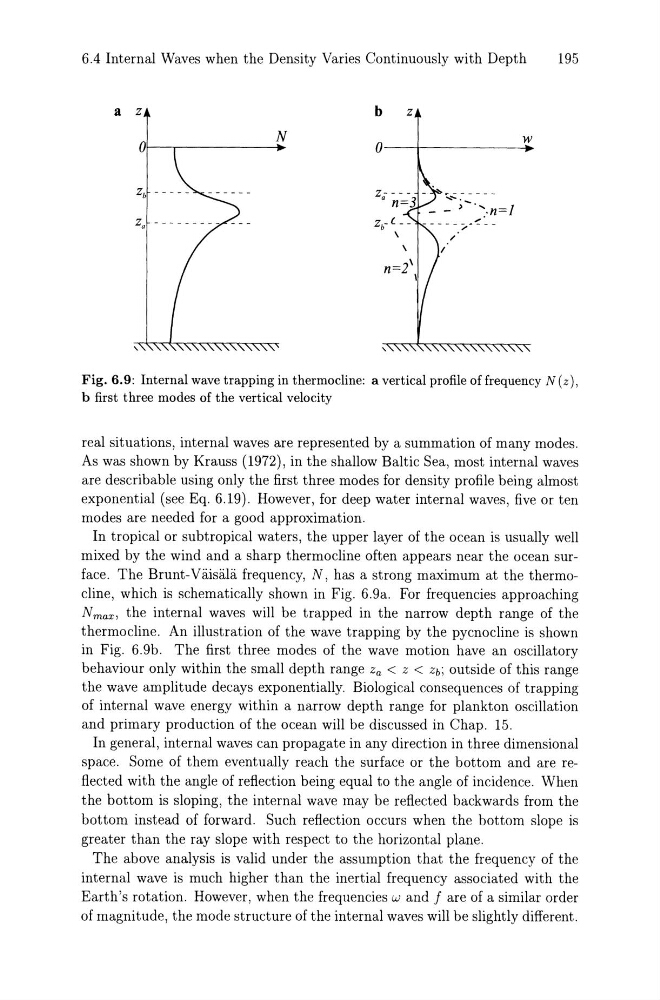
Fig. 6.9: Internal wave trapping in thermocline: a vertical profile offrequency N(z),
b first three modes of the vertical velocity
real situations, internal waves are represented by a summation of many modes.
As was shown by Krauss (1972), in the shallow Baltic Sea, most internal waves
are describable using only the first three modes for density profile being almost
exponential (see Eq. 6.19). However, for deep water internal waves, five or ten
modes are needed for a good approximation.
In tropical or subtropical waters, the upper layer of the ocean is usually well
mixed by the wind and a sharp thermocline often appears near the ocean surface. The Brunt-Viiisiilii frequency, N, has a strong maximum at the thermocline, which is schematically shown in Fig. 6.9a. For frequencies approaching
Nmax , the internal waves will be trapped in the narrow depth range of the
thermocline. An illustration of the wave trapping by the pycnocline is shown
in Fig. 6.9b. The first three modes of the wave motion have an oscillatory
behaviour only within the small depth range Za < Z < Zb; outside of this range
the wave amplitude decays exponentially. Biological consequences of trapping
of internal wave energy within a narrow depth range for plankton oscillation
and primary production of the ocean will be discussed in Chap. 15.
In general, internal waves can propagate in any direction in three dimensional
space. Some of them eventually reach the surface or the bottom and are reflected with the angle of reflection being equal to the angle of incidence. When
the bottom is sloping, the internal wave may be reflected backwards from the
bottom instead of forward. Such reflection occurs when the bottom slope is
greater than the ray slope with respect to the horizontal plane.
The above analysis is valid under the assumption that the frequency of the
internal wave is much higher than the inertial frequency associated with the
Earth's rotation. However, when the frequencies wand f are of a similar order
of magnitude, the mode structure of the internal waves will be slightly different.
195
a z
b
z
N
O'f------,-------~
O ____ +-__________ ~w~
r - - - - - -
........... ;- ..... -
- -
:n-l
,
Fig. 6.9: Internal wave trapping in thermocline: a vertical profile offrequency N(z),
b first three modes of the vertical velocity
real situations, internal waves are represented by a summation of many modes.
As was shown by Krauss (1972), in the shallow Baltic Sea, most internal waves
are describable using only the first three modes for density profile being almost
exponential (see Eq. 6.19). However, for deep water internal waves, five or ten
modes are needed for a good approximation.
In tropical or subtropical waters, the upper layer of the ocean is usually well
mixed by the wind and a sharp thermocline often appears near the ocean surface. The Brunt-Viiisiilii frequency, N, has a strong maximum at the thermocline, which is schematically shown in Fig. 6.9a. For frequencies approaching
Nmax , the internal waves will be trapped in the narrow depth range of the
thermocline. An illustration of the wave trapping by the pycnocline is shown
in Fig. 6.9b. The first three modes of the wave motion have an oscillatory
behaviour only within the small depth range Za < Z < Zb; outside of this range
the wave amplitude decays exponentially. Biological consequences of trapping
of internal wave energy within a narrow depth range for plankton oscillation
and primary production of the ocean will be discussed in Chap. 15.
In general, internal waves can propagate in any direction in three dimensional
space. Some of them eventually reach the surface or the bottom and are reflected with the angle of reflection being equal to the angle of incidence. When
the bottom is sloping, the internal wave may be reflected backwards from the
bottom instead of forward. Such reflection occurs when the bottom slope is
greater than the ray slope with respect to the horizontal plane.
The above analysis is valid under the assumption that the frequency of the
internal wave is much higher than the inertial frequency associated with the
Earth's rotation. However, when the frequencies wand f are of a similar order
of magnitude, the mode structure of the internal waves will be slightly different.