

194
6 Internal Waves
a
z
b
z
wla n
o
ukla k
x n Z
n=2 ../
""
/
.......... 1
""
"'>v
"
\
/
,
..n=3)
'<
1
,
, I
' "
,
1
,
,
1
n=3 ' I'---...
""
./'
I
\n=2
./'
,
/ ' ,
'-....
,
..........
.,.
"
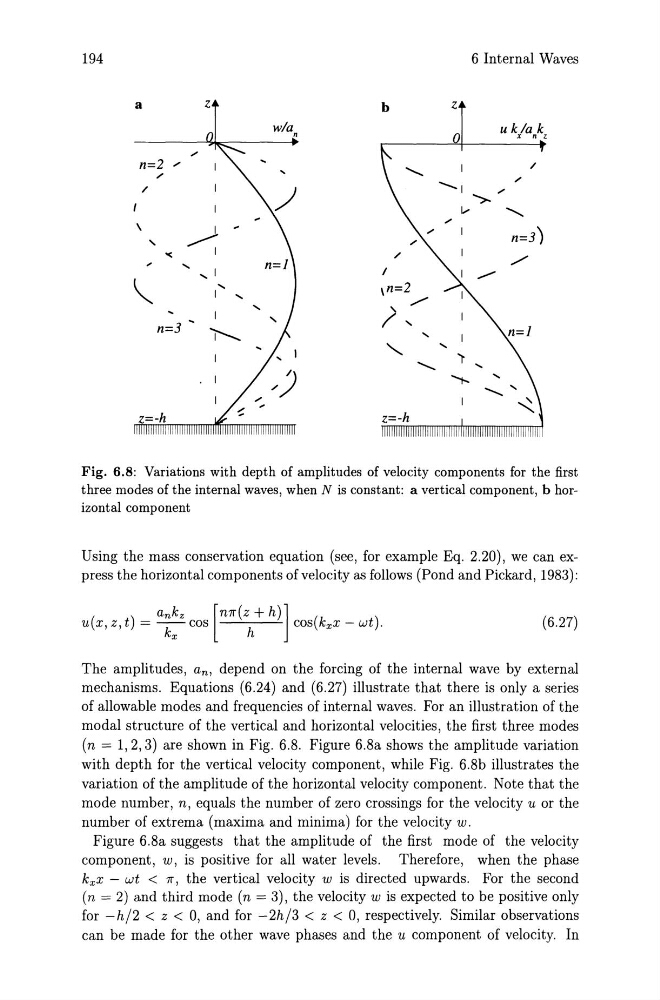
"'i-Fig. 6.8: Variations with depth of amplitudes of velocity components for the first
three modes of the internal waves, when N is constant: a vertical component, b horizontal component
Using the mass conservation equation (see, for example Eq. 2.20), we can express the horizontal components of velocity as follows (Pond and Pickard, 1983):
ankz
[mr(z + h)]
u(x, z, t) = - - cos
cos(kxx - wt).
kx
h
(6.27)
The amplitudes, an, depend on the forcing of the internal wave by external
mechanisms. Equations (6.24) and (6.27) illustrate that there is only a series
of allowable modes and frequencies of internal waves. For an illustration of the
modal structure of the vertical and horizontal velocities, the first three modes
(n = 1,2,3) are shown in Fig. 6.8. Figure 6.8a shows the amplitude variation
with depth for the vertical velocity component, while Fig. 6.8b illustrates the
variation of the amplitude of the horizontal velocity component. Note that the
mode number, n, equals the number of zero crossings for the velocity u or the
number of extrema (maxima and minima) for the velocity w.
Figure 6.8a suggests that the amplitude of the first mode of the velocity
component, w, is positive for all water levels. Therefore, when the phase
kxx - wt < Jr, the vertical velocity w is directed upwards. For the second
(n = 2) and third mode (n = 3), the velocity w is expected to be positive only
for -h/2 < z < 0, and for -2h/3 < z < 0, respectively. Similar observations
can be made for the other wave phases and the u component of velocity. In
6 Internal Waves
a
z
b
z
wla n
o
ukla k
x n Z
n=2 ../
""
/
.......... 1
""
"'>v
"
\
/
,
..n=3)
'<
1
,
, I
' "
,
1
,
,
1
n=3 ' I'---...
""
./'
I
\n=2
./'
,
/ ' ,
'-....
,
..........
.,.
"
"'i-Fig. 6.8: Variations with depth of amplitudes of velocity components for the first
three modes of the internal waves, when N is constant: a vertical component, b horizontal component
Using the mass conservation equation (see, for example Eq. 2.20), we can express the horizontal components of velocity as follows (Pond and Pickard, 1983):
ankz
[mr(z + h)]
u(x, z, t) = - - cos
cos(kxx - wt).
kx
h
(6.27)
The amplitudes, an, depend on the forcing of the internal wave by external
mechanisms. Equations (6.24) and (6.27) illustrate that there is only a series
of allowable modes and frequencies of internal waves. For an illustration of the
modal structure of the vertical and horizontal velocities, the first three modes
(n = 1,2,3) are shown in Fig. 6.8. Figure 6.8a shows the amplitude variation
with depth for the vertical velocity component, while Fig. 6.8b illustrates the
variation of the amplitude of the horizontal velocity component. Note that the
mode number, n, equals the number of zero crossings for the velocity u or the
number of extrema (maxima and minima) for the velocity w.
Figure 6.8a suggests that the amplitude of the first mode of the velocity
component, w, is positive for all water levels. Therefore, when the phase
kxx - wt < Jr, the vertical velocity w is directed upwards. For the second
(n = 2) and third mode (n = 3), the velocity w is expected to be positive only
for -h/2 < z < 0, and for -2h/3 < z < 0, respectively. Similar observations
can be made for the other wave phases and the u component of velocity. In