

6.2 Stability of Water Masses
187
Because Pw(Z2) < Pw(Zl), the resulting force is directed downwards and the
water element tends to sink back to its original level. A similar consideration
for the water element moved to position 3 (level Z3) yields the conclusion that
an excess buoyancy force moves the element back to its original position. Thus,
case a is related to the situation defined as stable. A water element approaching
its initial position oscillates around that position, until kinetic energy of the
element dissipates.
In case b, the water density decreases with depth. Hence, the balance of
forces for the water element moved to level Z2 is as follows:
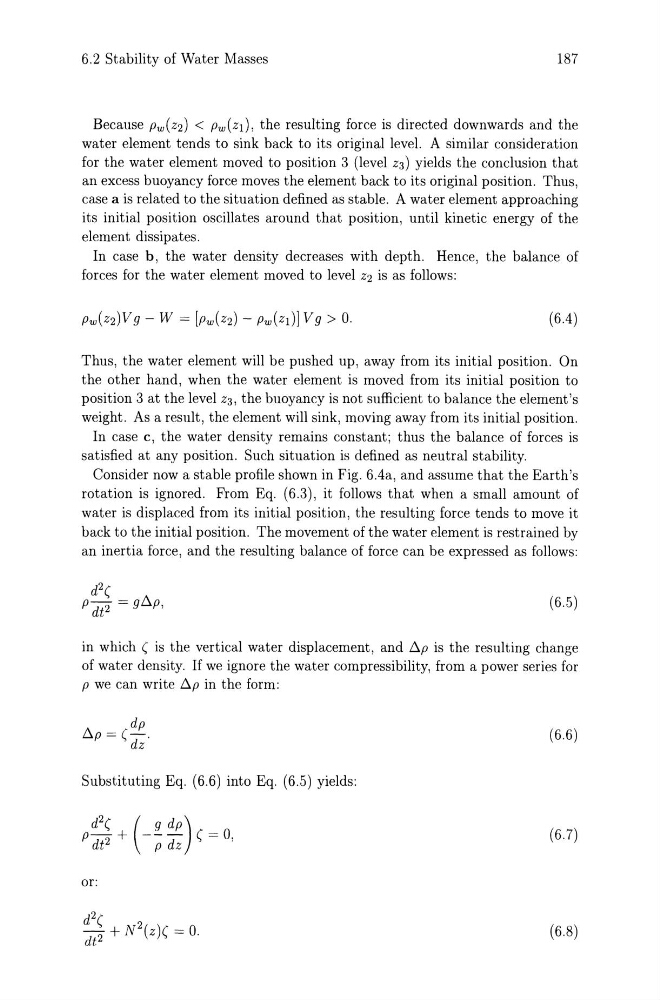
(6.4)
Thus, the water element will be pushed up, away from its initial position. On
the other hand, when the water element is moved from its initial position to
position 3 at the level Z3, the buoyancy is not sufficient to balance the element's
weight. As a result, the element will sink, moving away from its initial position.
In case c, the water density remains constant; thus the balance of forces is
satisfied at any position. Such situation is defined as neutral stability.
Consider now a stable profile shown in Fig. 6.4a, and assume that the Earth's
rotation is ignored. From Eq. (6.3), it follows that when a small amount of
water is displaced from its initial position, the resulting force tends to move it
back to the initial position. The movement of the water element is restrained by
an inertia force, and the resulting balance of force can be expressed as follows:
(6.5)
in which ( is the vertical water displacement, and /::"P is the resulting change
of water density. If we ignore the water compressibility, from a power series for
P we can write/::"p in the form:
dp
/::"p=(-.
dz
Substituting Eq. (6.6) into Eq. (6.5) yields:
d 2 (
(g dP)
p - + --- (= 0,
dt 2
P dz
or:
d 2 (
2
- 2 + N (Z)( = O.
dt
(6.6)
(6.7)
(6.8)
187
Because Pw(Z2) < Pw(Zl), the resulting force is directed downwards and the
water element tends to sink back to its original level. A similar consideration
for the water element moved to position 3 (level Z3) yields the conclusion that
an excess buoyancy force moves the element back to its original position. Thus,
case a is related to the situation defined as stable. A water element approaching
its initial position oscillates around that position, until kinetic energy of the
element dissipates.
In case b, the water density decreases with depth. Hence, the balance of
forces for the water element moved to level Z2 is as follows:
(6.4)
Thus, the water element will be pushed up, away from its initial position. On
the other hand, when the water element is moved from its initial position to
position 3 at the level Z3, the buoyancy is not sufficient to balance the element's
weight. As a result, the element will sink, moving away from its initial position.
In case c, the water density remains constant; thus the balance of forces is
satisfied at any position. Such situation is defined as neutral stability.
Consider now a stable profile shown in Fig. 6.4a, and assume that the Earth's
rotation is ignored. From Eq. (6.3), it follows that when a small amount of
water is displaced from its initial position, the resulting force tends to move it
back to the initial position. The movement of the water element is restrained by
an inertia force, and the resulting balance of force can be expressed as follows:
(6.5)
in which ( is the vertical water displacement, and /::"P is the resulting change
of water density. If we ignore the water compressibility, from a power series for
P we can write/::"p in the form:
dp
/::"p=(-.
dz
Substituting Eq. (6.6) into Eq. (6.5) yields:
d 2 (
(g dP)
p - + --- (= 0,
dt 2
P dz
or:
d 2 (
2
- 2 + N (Z)( = O.
dt
(6.6)
(6.7)
(6.8)