

186
6 Internal Waves
a~
c
"'''''''~~~~
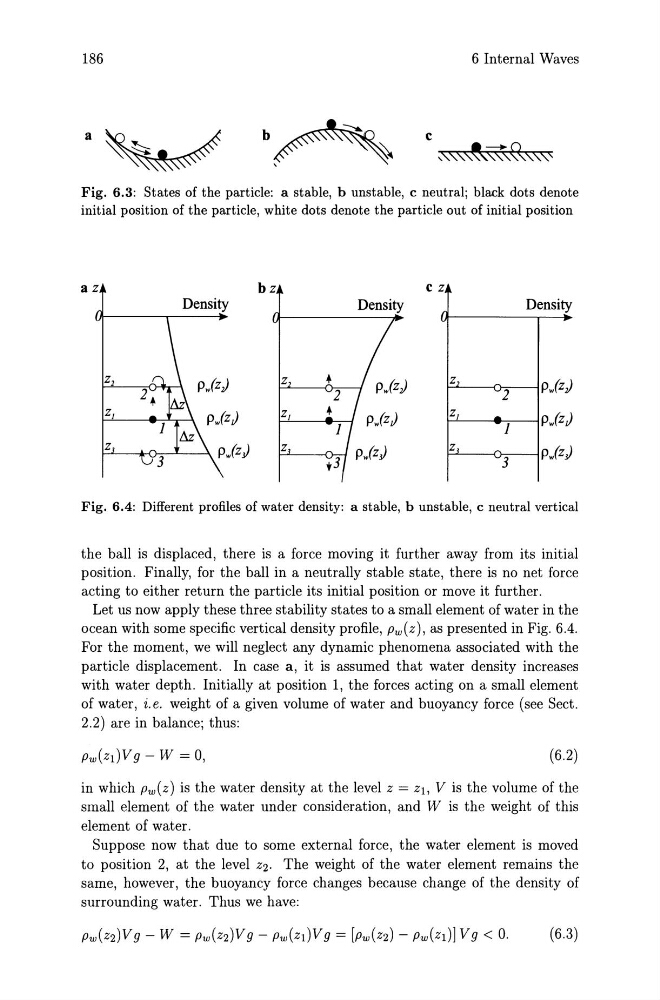
Fig. 6.3: States of the particle: a stable, b unstable, c neutral; black dots denote
initial position of the particle, white dots denote the particle out of initial position
az
bz
c z
Density
Density
t:
Density
Z2
pJz)
2
z
ZJ
pJzJ
1
z
~
A
pJzJ
3
z
Fig. 6.4: Different profiles of water density: a stable, b unstable, c neutral vertical
the ball is displaced, there is a force moving it further away from its initial
position. Finally, for the ball in a neutrally stable state, there is no net force
acting to either return the particle its initial position or move it further.
Let us now apply these three stability states to a small element of water in the
ocean with some specific vertical density profile, Pw(z), as presented in Fig. 6.4.
For the moment, we will neglect any dynamic phenomena associated with the
particle displacement. In case a, it is assumed that water density increases
with water depth. Initially at position 1, the forces acting on a small element
of water, i.e. weight of a given volume of water and buoyancy force (see Sect.
2.2) are in balance; thus:
(6.2)
in which Pw (z) is the water density at the level z = ZlJ V is the volume of the
small element of the water under consideration, and W is the weight of this
element of water.
Suppose now that due to some external force, the water element is moved
to position 2, at the level Z2. The weight of the water element remains the
same, however, the buoyancy force changes because change of the density of
surrounding water. Thus we have:
6 Internal Waves
a~
c
"'''''''~~~~
Fig. 6.3: States of the particle: a stable, b unstable, c neutral; black dots denote
initial position of the particle, white dots denote the particle out of initial position
az
bz
c z
Density
Density
t:
Density
Z2
pJz)
2
z
ZJ
pJzJ
1
z
~
A
pJzJ
3
z
Fig. 6.4: Different profiles of water density: a stable, b unstable, c neutral vertical
the ball is displaced, there is a force moving it further away from its initial
position. Finally, for the ball in a neutrally stable state, there is no net force
acting to either return the particle its initial position or move it further.
Let us now apply these three stability states to a small element of water in the
ocean with some specific vertical density profile, Pw(z), as presented in Fig. 6.4.
For the moment, we will neglect any dynamic phenomena associated with the
particle displacement. In case a, it is assumed that water density increases
with water depth. Initially at position 1, the forces acting on a small element
of water, i.e. weight of a given volume of water and buoyancy force (see Sect.
2.2) are in balance; thus:
(6.2)
in which Pw (z) is the water density at the level z = ZlJ V is the volume of the
small element of the water under consideration, and W is the weight of this
element of water.
Suppose now that due to some external force, the water element is moved
to position 2, at the level Z2. The weight of the water element remains the
same, however, the buoyancy force changes because change of the density of
surrounding water. Thus we have: