

5.4 Harmonic Analysis and Prediction of Tides
179
""' 7
§I
5
Cl
....
~I
..c:
OIl
6
$1
'0)
..c:
~
11)
1
'0
5
~
4
3
2
o
o
24
48
72
96
120
144
168
Time (hours)
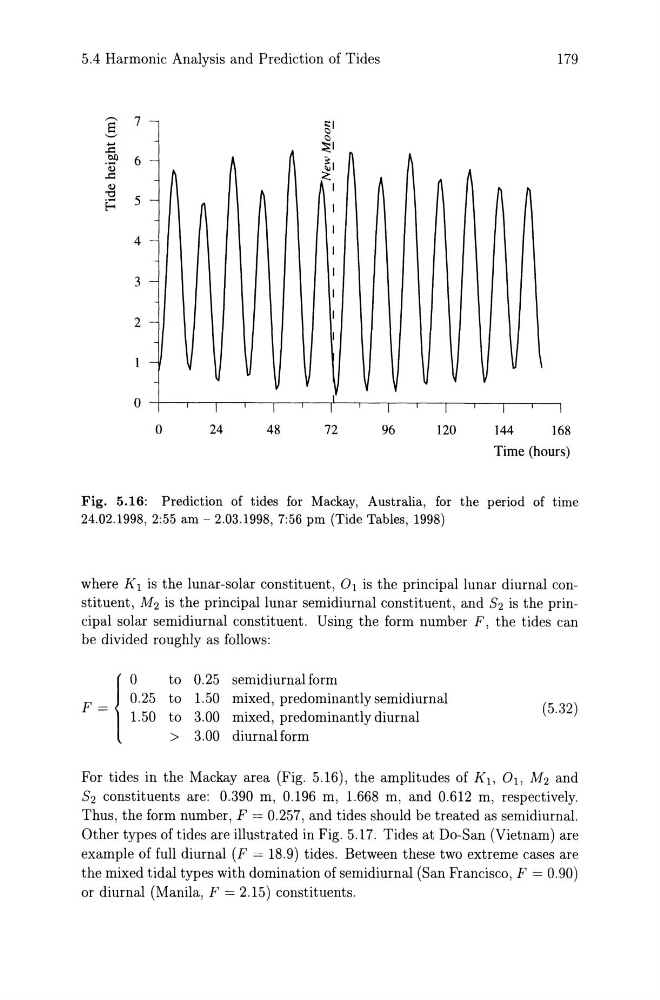
Fig. 5.16: Prediction of tides for Mackay, Australia, for the period of time
24.02.1998, 2:55 am - 2.03.1998, 7:56 pm (Tide Tables, 1998)
where K 1 is the lunar-solar constituent, 0 1 is the principal lunar diurnal constituent, M2 is the principal lunar semidiurnal constituent, and S2 is the principal solar semidiurnal constituent. Using the form number F, the tides can
be divided roughly as follows:
{
0
to 0.25 semidiurnal form
F = 0.25 to 1.50 mixed, predominantly semidiurnal
1.50 to 3.00 mixed, predominantly diurnal
> 3.00 diurnalform
(5.32)
For tides in the Mackay area (Fig. 5.16), the amplitudes of K 1 , 0 1 , M2 and
S2 constituents are: 0.390 m, 0.196 m, 1.668 m, and 0.612 m, respectively.
Thus, the form number, F = 0.257, and tides should be treated as semidiurnal.
Other types of tides are illustrated in Fig. 5.17. Tides at Do-San (Vietnam) are
example of full diurnal (F = 18.9) tides. Between these two extreme cases are
the mixed tidal types with domination of semidiurnal (San Francisco, F = 0.90)
or diurnal (Manila, F = 2.15) constituents.
179
""' 7
§I
5
Cl
....
~I
..c:
OIl
6
$1
'0)
..c:
~
11)
1
'0
5
~
4
3
2
o
o
24
48
72
96
120
144
168
Time (hours)
Fig. 5.16: Prediction of tides for Mackay, Australia, for the period of time
24.02.1998, 2:55 am - 2.03.1998, 7:56 pm (Tide Tables, 1998)
where K 1 is the lunar-solar constituent, 0 1 is the principal lunar diurnal constituent, M2 is the principal lunar semidiurnal constituent, and S2 is the principal solar semidiurnal constituent. Using the form number F, the tides can
be divided roughly as follows:
{
0
to 0.25 semidiurnal form
F = 0.25 to 1.50 mixed, predominantly semidiurnal
1.50 to 3.00 mixed, predominantly diurnal
> 3.00 diurnalform
(5.32)
For tides in the Mackay area (Fig. 5.16), the amplitudes of K 1 , 0 1 , M2 and
S2 constituents are: 0.390 m, 0.196 m, 1.668 m, and 0.612 m, respectively.
Thus, the form number, F = 0.257, and tides should be treated as semidiurnal.
Other types of tides are illustrated in Fig. 5.17. Tides at Do-San (Vietnam) are
example of full diurnal (F = 18.9) tides. Between these two extreme cases are
the mixed tidal types with domination of semidiurnal (San Francisco, F = 0.90)
or diurnal (Manila, F = 2.15) constituents.