

158
in which mb is the mass of the body. Thus:
mE
g=G- 2 ·
RE
5. Tides
(5.6)
Substituting all necessary quantities into Eq. (5.6) we obtain a gravitational
acceleration 9 = 9.805 m/s 2 when using the Earth's equatorial radius, and
9 = 9.870 m/s 2 when using the Earth's polar radius (see Appendix B).
It is apparent that the gravitational force will not be the same at all points on
the Earth's surface, because not all these points are at the same distance from
the Moon. Points on the Earth nearest to the Moon will experience greater
gravitational pull from the Moon than will the points on the opposite side of
the Earth.
Centrifugal Force. The gravitational force, Fg , between the Earth and the
Moon has to be balanced by another force, otherwise the Earth-Moon system
would become unstable and the Moon would collide with the Earth or vice
versa. The balancing force results from the fact that the Earth and the Moon
are not motionless bodies. If we forget for a moment that the Earth rotates
upon its own axis, then both the Moon and Earth are mutually revolving
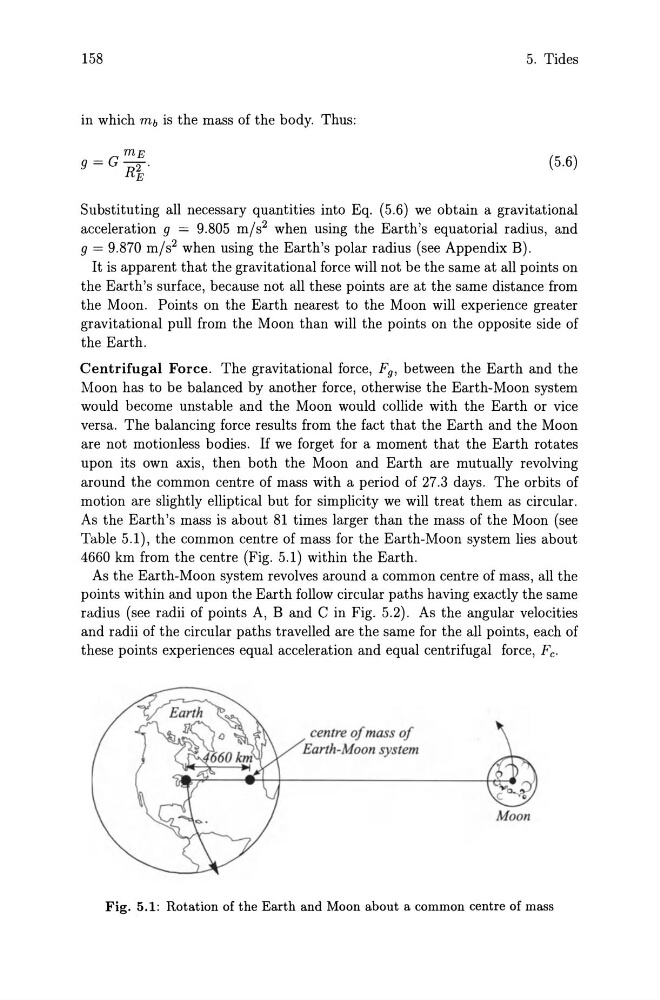
around the common centre of mass with a period of 27.3 days. The orbits of
motion are slightly elliptical but for simplicity we will treat them as circular.
As the Earth's mass is about 81 times larger than the mass of the Moon (see
Table 5.1), the common centre of mass for the Earth-Moon system lies about
4660 km from the centre (Fig. 5.1) within the Earth.
As the Earth-Moon system revolves around a common centre of mass, all the
points within and upon the Earth follow circular paths having exactly the same
radius (see radii of points A, Band C in Fig. 5.2). As the angular velocities
and radii of the circular paths travelled are the same for the all points, each of
these points experiences equal acceleration and equal centrifugal force, Fe.
centre of mass of
Earth-Moon system
Moon
Fig. 5.1: Rotation of the Earth and Moon about a common centre of mass
in which mb is the mass of the body. Thus:
mE
g=G- 2 ·
RE
5. Tides
(5.6)
Substituting all necessary quantities into Eq. (5.6) we obtain a gravitational
acceleration 9 = 9.805 m/s 2 when using the Earth's equatorial radius, and
9 = 9.870 m/s 2 when using the Earth's polar radius (see Appendix B).
It is apparent that the gravitational force will not be the same at all points on
the Earth's surface, because not all these points are at the same distance from
the Moon. Points on the Earth nearest to the Moon will experience greater
gravitational pull from the Moon than will the points on the opposite side of
the Earth.
Centrifugal Force. The gravitational force, Fg , between the Earth and the
Moon has to be balanced by another force, otherwise the Earth-Moon system
would become unstable and the Moon would collide with the Earth or vice
versa. The balancing force results from the fact that the Earth and the Moon
are not motionless bodies. If we forget for a moment that the Earth rotates
upon its own axis, then both the Moon and Earth are mutually revolving
around the common centre of mass with a period of 27.3 days. The orbits of
motion are slightly elliptical but for simplicity we will treat them as circular.
As the Earth's mass is about 81 times larger than the mass of the Moon (see
Table 5.1), the common centre of mass for the Earth-Moon system lies about
4660 km from the centre (Fig. 5.1) within the Earth.
As the Earth-Moon system revolves around a common centre of mass, all the
points within and upon the Earth follow circular paths having exactly the same
radius (see radii of points A, Band C in Fig. 5.2). As the angular velocities
and radii of the circular paths travelled are the same for the all points, each of
these points experiences equal acceleration and equal centrifugal force, Fe.
centre of mass of
Earth-Moon system
Moon
Fig. 5.1: Rotation of the Earth and Moon about a common centre of mass