

5.2 Tide Generating Forces and Equilibrium Theory
157
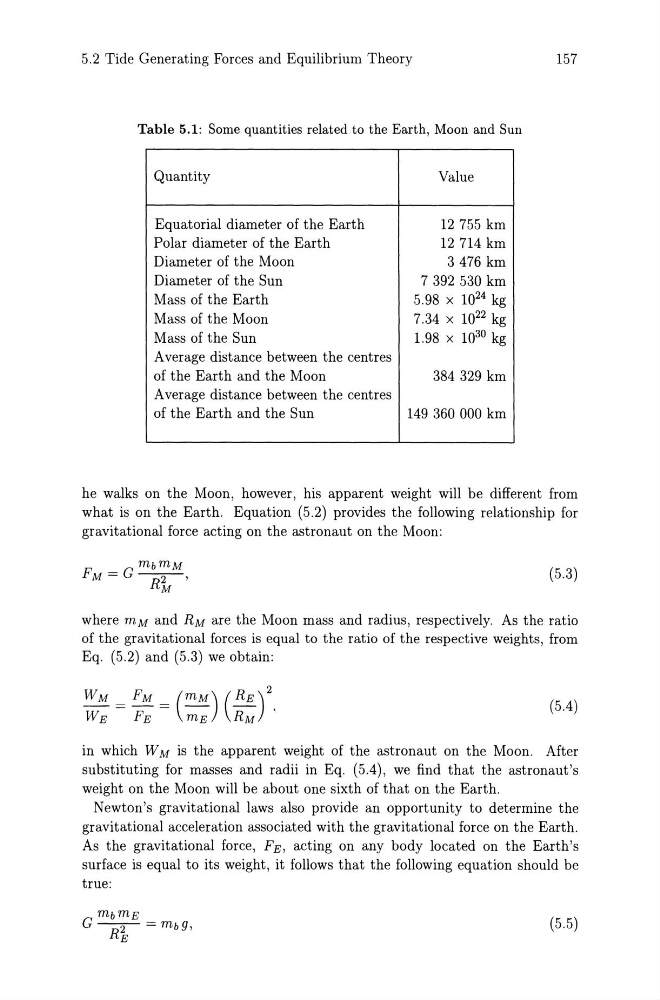
Table 5.1: Some quantities related to the Earth, Moon and Sun
Quantity
Value
Equatorial diameter of the Earth
12755 km
Polar diameter of the Earth
12714 km
Diameter of the Moon
3476 km
Diameter of the Sun
7392530 km
Mass of the Earth
5.98 x 10 24 kg
Mass of the Moon
7.34 x 10 22 kg
Mass of the Sun
l.98 x 10 30 kg
Average distance between the centres
of the Earth and the Moon
384329 km
Average distance between the centres
of the Earth and the Sun
149360000 km
he walks on the Moon, however, his apparent weight will be different from
what is on the Earth. Equation (5.2) provides the following relationship for
gravitational force acting on the astronaut on the Moon:
(5.3)
where mM and RM are the Moon mass and radius, respectively. As the ratio
of the gravitational forces is equal to the ratio of the respective weights, from
Eq. (5.2) and (5.3) we obtain:
(5.4)
in which W M is the apparent weight of the astronaut on the Moon. After
substituting for masses and radii in Eq. (5.4), we find that the astronaut's
weight on the Moon will be about one sixth of that on the Earth.
Newton's gravitational laws also provide an opportunity to determine the
gravitational acceleration associated with the gravitational force on the Earth.
As the gravitational force, FE, acting on any body located on the Earth's
surface is equal to its weight, it follows that the following equation should be
true:
(5.5)
157
Table 5.1: Some quantities related to the Earth, Moon and Sun
Quantity
Value
Equatorial diameter of the Earth
12755 km
Polar diameter of the Earth
12714 km
Diameter of the Moon
3476 km
Diameter of the Sun
7392530 km
Mass of the Earth
5.98 x 10 24 kg
Mass of the Moon
7.34 x 10 22 kg
Mass of the Sun
l.98 x 10 30 kg
Average distance between the centres
of the Earth and the Moon
384329 km
Average distance between the centres
of the Earth and the Sun
149360000 km
he walks on the Moon, however, his apparent weight will be different from
what is on the Earth. Equation (5.2) provides the following relationship for
gravitational force acting on the astronaut on the Moon:
(5.3)
where mM and RM are the Moon mass and radius, respectively. As the ratio
of the gravitational forces is equal to the ratio of the respective weights, from
Eq. (5.2) and (5.3) we obtain:
(5.4)
in which W M is the apparent weight of the astronaut on the Moon. After
substituting for masses and radii in Eq. (5.4), we find that the astronaut's
weight on the Moon will be about one sixth of that on the Earth.
Newton's gravitational laws also provide an opportunity to determine the
gravitational acceleration associated with the gravitational force on the Earth.
As the gravitational force, FE, acting on any body located on the Earth's
surface is equal to its weight, it follows that the following equation should be
true:
(5.5)