

4.3 Statistical and Spectral Properties of Waves
149
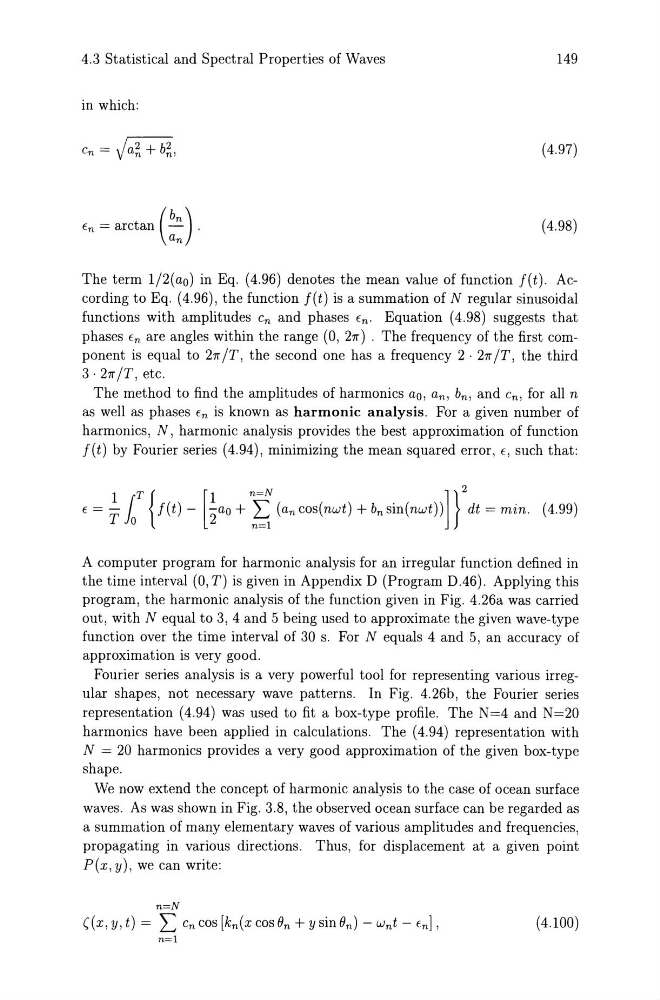
in which:
en = Ja~ + b~,
( 4.97)
En = arctan C:) .
( 4.98)
The term 1/2(ao) in Eq. (4.96) denotes the mean value of function f(t). According to Eq. (4.96), the function f(t) is a summation of N regular sinusoidal
functions with amplitudes en and phases En. Equation (4.98) suggests that
phases En are angles within the range (0, 271') . The frequency of the first component is equal to 271' IT, the second one has a frequency 2·271' IT, the third
3 . 271' IT, etc.
The method to find the amplitudes of harmonics ao, an, btl, and en, for all n
as well as phases En is known as harmonic analysis. For a given number of
harmonics, N, harmonic analysis provides the best approximation of function
f(t) by Fourier series (4.94), minimizing the mean squared error, E, such that:
1 T { [1 n=N
] }2
E = T fa f(t) - 2"ao + E (an cos(nwt) + bn sin(nwt)) dt = min. (4.99)
A computer program for harmonic analysis for an irregular function defined in
the time interval (0, T) is given in Appendix D (Program D.46). Applying this
program, the harmonic analysis of the function given in Fig. 4.26a was carried
out, with N equal to 3, 4 and 5 being used to approximate the given wave-type
function over the time interval of 30 s. For N equals 4 and 5, an accuracy of
approximation is very good.
Fourier series analysis is a very powerful tool for representing various irregular shapes, not necessary wave patterns. In Fig. 4.26b, the Fourier series
representation (4.94) was used to fit a box-type profile. The N=4 and N=20
harmonics have been applied in calculations. The (4.94) representation with
N = 20 harmonics provides a very good approximation of the given box-type
shape.
We now extend the concept of harmonic analysis to the case of ocean surface
waves. As was shown in Fig. 3.8, the observed ocean surface can be regarded as
a summation of many elementary waves of various amplitudes and frequencies,
propagating in various directions. Thus, for displacement at a given point
P(x, y), we can write:
n=N
((x, y, t) = L en cos [kn(x cos On + y sinOn) - wnt - En],
(4.100)
n=l
149
in which:
en = Ja~ + b~,
( 4.97)
En = arctan C:) .
( 4.98)
The term 1/2(ao) in Eq. (4.96) denotes the mean value of function f(t). According to Eq. (4.96), the function f(t) is a summation of N regular sinusoidal
functions with amplitudes en and phases En. Equation (4.98) suggests that
phases En are angles within the range (0, 271') . The frequency of the first component is equal to 271' IT, the second one has a frequency 2·271' IT, the third
3 . 271' IT, etc.
The method to find the amplitudes of harmonics ao, an, btl, and en, for all n
as well as phases En is known as harmonic analysis. For a given number of
harmonics, N, harmonic analysis provides the best approximation of function
f(t) by Fourier series (4.94), minimizing the mean squared error, E, such that:
1 T { [1 n=N
] }2
E = T fa f(t) - 2"ao + E (an cos(nwt) + bn sin(nwt)) dt = min. (4.99)
A computer program for harmonic analysis for an irregular function defined in
the time interval (0, T) is given in Appendix D (Program D.46). Applying this
program, the harmonic analysis of the function given in Fig. 4.26a was carried
out, with N equal to 3, 4 and 5 being used to approximate the given wave-type
function over the time interval of 30 s. For N equals 4 and 5, an accuracy of
approximation is very good.
Fourier series analysis is a very powerful tool for representing various irregular shapes, not necessary wave patterns. In Fig. 4.26b, the Fourier series
representation (4.94) was used to fit a box-type profile. The N=4 and N=20
harmonics have been applied in calculations. The (4.94) representation with
N = 20 harmonics provides a very good approximation of the given box-type
shape.
We now extend the concept of harmonic analysis to the case of ocean surface
waves. As was shown in Fig. 3.8, the observed ocean surface can be regarded as
a summation of many elementary waves of various amplitudes and frequencies,
propagating in various directions. Thus, for displacement at a given point
P(x, y), we can write:
n=N
((x, y, t) = L en cos [kn(x cos On + y sinOn) - wnt - En],
(4.100)
n=l