

4.3 Statistical and Spectral Properties of Waves
145
It should be noted that probability distributions F(() and FI (() are dimensionless, while the probability density distribution, f ((), possesses a dimension
depending on the dimension of the variable (. For example, for ( which denotes surface displacement, a dimension of f(() is m-I. For completeness, the
functions F and FI also are illustrated in Fig. 4.24.
In a similar way, we can determine the probability distribution functions
for other wave parameters. However, here we restrict ourselves to the wave
height only. A more thorough explanation of wave statistics can be found in
professional literature (for example, Phillips, 1977; Massel, 1996a).
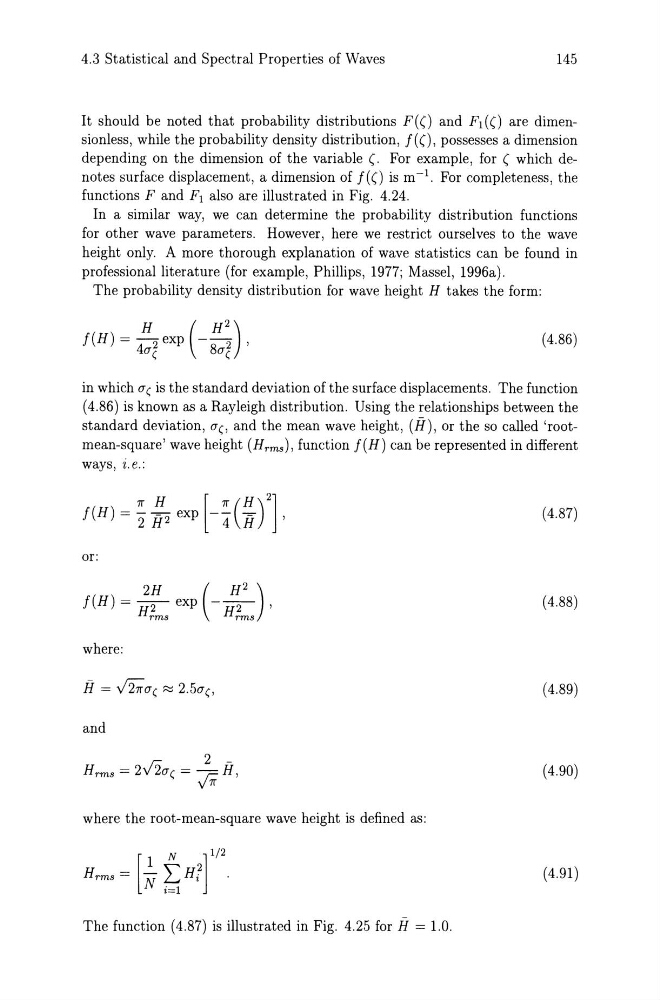
The probability density distribution for wave height H takes the form:
H
(H2)
f(H) = -exp - - ,
40'2
80'2
(
(
( 4.86)
in which 0'( is the standard deviation of the surface displacements. The function
(4.86) is known as a Rayleigh distribution. Using the relationships between the
standard deviation, 0'(, and the mean wave height, (II), or the so called 'rootmean-square' wave height (Hrms), function f(H) can be represented in different
ways, ~.e.:
Jr H
[Jr (H)2]
f(H) = ' 2 II2 exp -'4 II '
( 4.87)
or:
2H
(H2 )
f(H) = - 2 - exp - - 2 - ,
H rms
H rms
(4.88)
where:
(4.89)
and
~
2Hrms = 2v 20'( = "fir H,
(4.90)
where the root-mean-square wave height is defined as:
(4.91)
The function (4.87) is illustrated in Fig. 4.25 for II = 1.0.
145
It should be noted that probability distributions F(() and FI (() are dimensionless, while the probability density distribution, f ((), possesses a dimension
depending on the dimension of the variable (. For example, for ( which denotes surface displacement, a dimension of f(() is m-I. For completeness, the
functions F and FI also are illustrated in Fig. 4.24.
In a similar way, we can determine the probability distribution functions
for other wave parameters. However, here we restrict ourselves to the wave
height only. A more thorough explanation of wave statistics can be found in
professional literature (for example, Phillips, 1977; Massel, 1996a).
The probability density distribution for wave height H takes the form:
H
(H2)
f(H) = -exp - - ,
40'2
80'2
(
(
( 4.86)
in which 0'( is the standard deviation of the surface displacements. The function
(4.86) is known as a Rayleigh distribution. Using the relationships between the
standard deviation, 0'(, and the mean wave height, (II), or the so called 'rootmean-square' wave height (Hrms), function f(H) can be represented in different
ways, ~.e.:
Jr H
[Jr (H)2]
f(H) = ' 2 II2 exp -'4 II '
( 4.87)
or:
2H
(H2 )
f(H) = - 2 - exp - - 2 - ,
H rms
H rms
(4.88)
where:
(4.89)
and
~
2Hrms = 2v 20'( = "fir H,
(4.90)
where the root-mean-square wave height is defined as:
(4.91)
The function (4.87) is illustrated in Fig. 4.25 for II = 1.0.