

4.2 Wave Parameters Based on Small Amplitude Wave Theory
109
h
w~
p
u
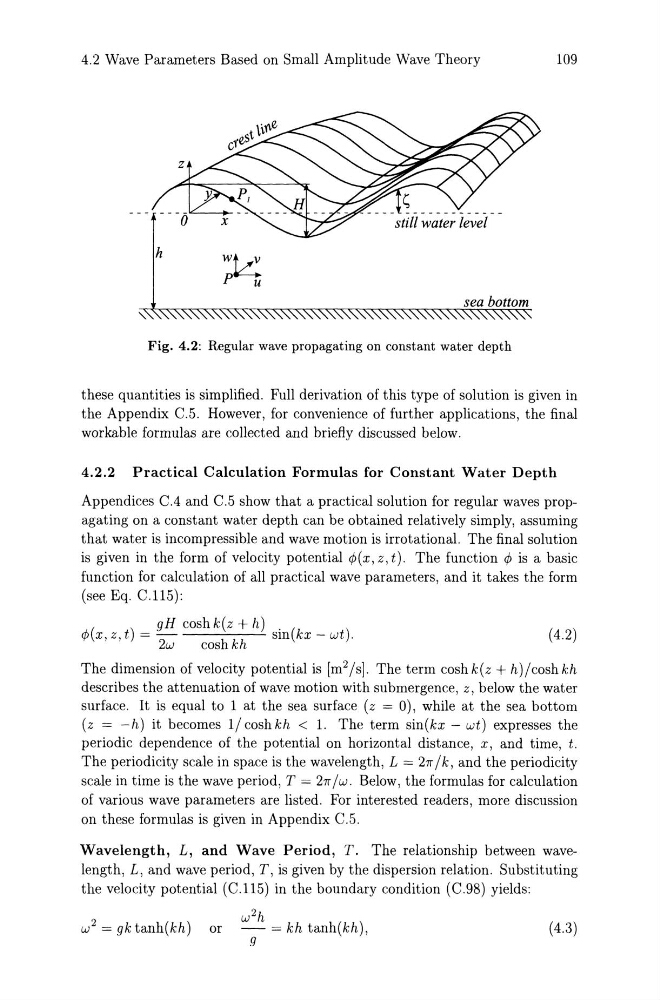
Fig. 4.2: Regular wave propagating on constant water depth
these quantities is simplified. Full derivation of this type of solution is given in
the Appendix C.5. However, for convenience of further applications, the final
workable formulas are collected and briefly discussed below.
4.2.2 Practical Calculation Formulas for Constant Water Depth
Appendices C.4 and C.5 show that a practical solution for regular waves propagating on a constant water depth can be obtained relatively simply, assuming
that water is incompressible and wave motion is irrotational. The final solution
is given in the form of velocity potential ¢(x, z, t). The function ¢ is a basic
function for calculation of all practical wave parameters, and it takes the form
(see Eq. C.1I5):
9 H cosh k (z + h)
¢(x, z, t) = -
sin(kx - wt).
2w
cosh kh
(4.2)
The dimension of velocity potential is [m 2 /s]. The term coshk(z + h)/coshkh
describes the attenuation of wave motion with submergence, z, below the water
surface. It is equal to 1 at the sea surface (z = 0), while at the sea bottom
(z = -h) it becomes 1/ coshkh < 1. The term sin(kx - wt) expresses the
periodic dependence of the potential on horizontal distance, x, and time, t.
The periodicity scale in space is the wavelength, L = 211" / k, and the periodicity
scale in time is the wave period, T = 211"/ w. Below, the formulas for calculation
of various wave parameters are listed. For interested readers, more discussion
on these formulas is given in Appendix C.5.
Wavelength, L, and Wave Period, T. The relationship between wavelength, L, and wave period, T, is given by the dispersion relation. Substituting
the velocity potential (C.1I5) in the boundary condition (C.9S) yields:
w 2 h
w 2 = gk tanh(kh) or -
= kh tanh(kh),
(4.3)
9
109
h
w~
p
u
Fig. 4.2: Regular wave propagating on constant water depth
these quantities is simplified. Full derivation of this type of solution is given in
the Appendix C.5. However, for convenience of further applications, the final
workable formulas are collected and briefly discussed below.
4.2.2 Practical Calculation Formulas for Constant Water Depth
Appendices C.4 and C.5 show that a practical solution for regular waves propagating on a constant water depth can be obtained relatively simply, assuming
that water is incompressible and wave motion is irrotational. The final solution
is given in the form of velocity potential ¢(x, z, t). The function ¢ is a basic
function for calculation of all practical wave parameters, and it takes the form
(see Eq. C.1I5):
9 H cosh k (z + h)
¢(x, z, t) = -
sin(kx - wt).
2w
cosh kh
(4.2)
The dimension of velocity potential is [m 2 /s]. The term coshk(z + h)/coshkh
describes the attenuation of wave motion with submergence, z, below the water
surface. It is equal to 1 at the sea surface (z = 0), while at the sea bottom
(z = -h) it becomes 1/ coshkh < 1. The term sin(kx - wt) expresses the
periodic dependence of the potential on horizontal distance, x, and time, t.
The periodicity scale in space is the wavelength, L = 211" / k, and the periodicity
scale in time is the wave period, T = 211"/ w. Below, the formulas for calculation
of various wave parameters are listed. For interested readers, more discussion
on these formulas is given in Appendix C.5.
Wavelength, L, and Wave Period, T. The relationship between wavelength, L, and wave period, T, is given by the dispersion relation. Substituting
the velocity potential (C.1I5) in the boundary condition (C.9S) yields:
w 2 h
w 2 = gk tanh(kh) or -
= kh tanh(kh),
(4.3)
9