

108
4 How to Determine Wave Parameters
initially unknown true
atmosphere - ocean boundary
ATMOSPHERE
- - - - - -\ - - - - - - - - - - - - - -
OCEAN
simplified plane boundary
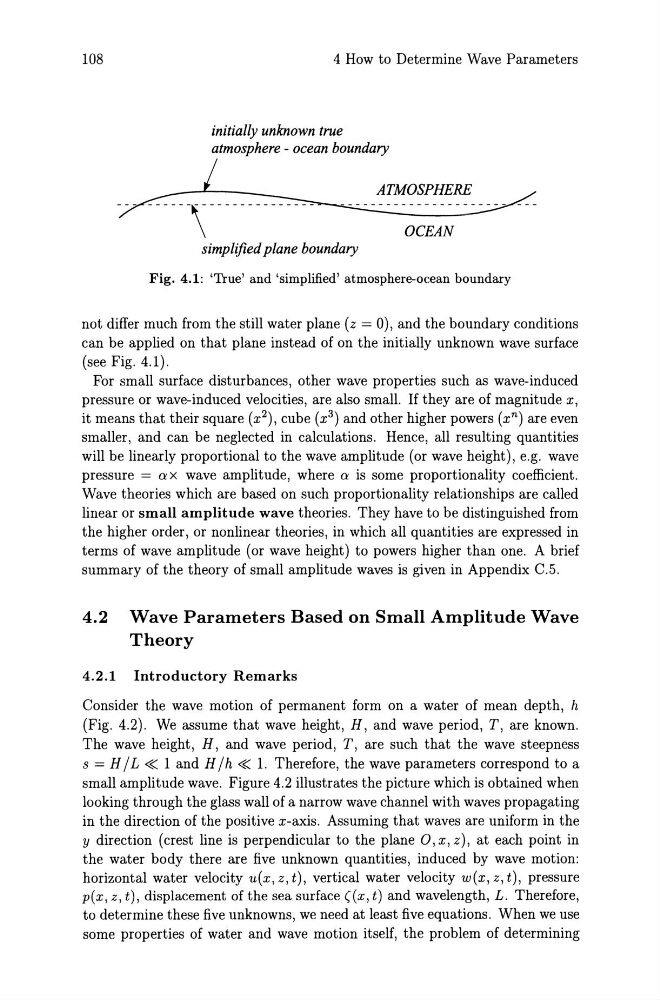
Fig. 4.1: 'True' and 'simplified' atmosphere-ocean boundary
not differ much from the still water plane (z = 0), and the boundary conditions
can be applied on that plane instead of on the initially unknown wave surface
(see Fig. 4.1).
For small surface disturbances, other wave properties such as wave-induced
pressure or wave-induced velocities, are also small. If they are of magnitude x,
it means that their square (x 2 ), cube (x 3 ) and other higher powers (xn) are even
smaller, and can be neglected in calculations. Hence, all resulting quantities
will be linearly proportional to the wave amplitude (or wave height), e.g. wave
pressure = a x wave amplitude, where a is some proportionality coefficient.
Wave theories which are based on such proportionality relationships are called
linear or small amplitude wave theories. They have to be distinguished from
the higher order, or nonlinear theories, in which all quantities are expressed in
terms of wave amplitude (or wave height) to powers higher than one. A brief
summary of the theory of small amplitude waves is given in Appendix C.5.
4.2 Wave Parameters Based on Small Amplitude Wave
Theory
4.2.1 Introductory Remarks
Consider the wave motion of permanent form on a water of mean depth, h
(Fig. 4.2). We assume that wave height, H, and wave period, T, are known.
The wave height, H, and wave period, T, are such that the wave steepness
s = H / L « 1 and H / h « 1. Therefore, the wave parameters correspond to a
small amplitude wave. Figure 4.2 illustrates the picture which is obtained when
looking through the glass wall of a narrow wave channel with waves propagating
in the direction of the positive x-axis. Assuming that waves are uniform in the
y direction (crest line is perpendicular to the plane 0, x, z), at each point in
the water body there are five unknown quantities, induced by wave motion:
horizontal water velocity u(x, z, t), vertical water velocity w(x, z, t), pressure
p(x, z, t), displacement of the sea surface «(x, t) and wavelength, L. Therefore,
to determine these five unknowns, we need at least five equations. When we use
some properties of water and wave motion itself, the problem of determining
4 How to Determine Wave Parameters
initially unknown true
atmosphere - ocean boundary
ATMOSPHERE
- - - - - -\ - - - - - - - - - - - - - -
OCEAN
simplified plane boundary
Fig. 4.1: 'True' and 'simplified' atmosphere-ocean boundary
not differ much from the still water plane (z = 0), and the boundary conditions
can be applied on that plane instead of on the initially unknown wave surface
(see Fig. 4.1).
For small surface disturbances, other wave properties such as wave-induced
pressure or wave-induced velocities, are also small. If they are of magnitude x,
it means that their square (x 2 ), cube (x 3 ) and other higher powers (xn) are even
smaller, and can be neglected in calculations. Hence, all resulting quantities
will be linearly proportional to the wave amplitude (or wave height), e.g. wave
pressure = a x wave amplitude, where a is some proportionality coefficient.
Wave theories which are based on such proportionality relationships are called
linear or small amplitude wave theories. They have to be distinguished from
the higher order, or nonlinear theories, in which all quantities are expressed in
terms of wave amplitude (or wave height) to powers higher than one. A brief
summary of the theory of small amplitude waves is given in Appendix C.5.
4.2 Wave Parameters Based on Small Amplitude Wave
Theory
4.2.1 Introductory Remarks
Consider the wave motion of permanent form on a water of mean depth, h
(Fig. 4.2). We assume that wave height, H, and wave period, T, are known.
The wave height, H, and wave period, T, are such that the wave steepness
s = H / L « 1 and H / h « 1. Therefore, the wave parameters correspond to a
small amplitude wave. Figure 4.2 illustrates the picture which is obtained when
looking through the glass wall of a narrow wave channel with waves propagating
in the direction of the positive x-axis. Assuming that waves are uniform in the
y direction (crest line is perpendicular to the plane 0, x, z), at each point in
the water body there are five unknown quantities, induced by wave motion:
horizontal water velocity u(x, z, t), vertical water velocity w(x, z, t), pressure
p(x, z, t), displacement of the sea surface «(x, t) and wavelength, L. Therefore,
to determine these five unknowns, we need at least five equations. When we use
some properties of water and wave motion itself, the problem of determining