

70
Marine Mammal Physiology: Requisites for Ocean Living
However, they still have to cope with changes in pressure many times per day, and rapidly
and repeatedly recruit their alveoli each time they surface. How do they avoid other problems
associated with pressure, such as atelectasis, the “bends” or decompression sickness (DCS),
high pressure nervous syndrome (HPNS), shallow-water blackout, or N 2 narcosis?
4.2 Current knowledge
4.2.1 General abilities of marine mammals
Different marine mammal species show very different diving patterns, driven by their
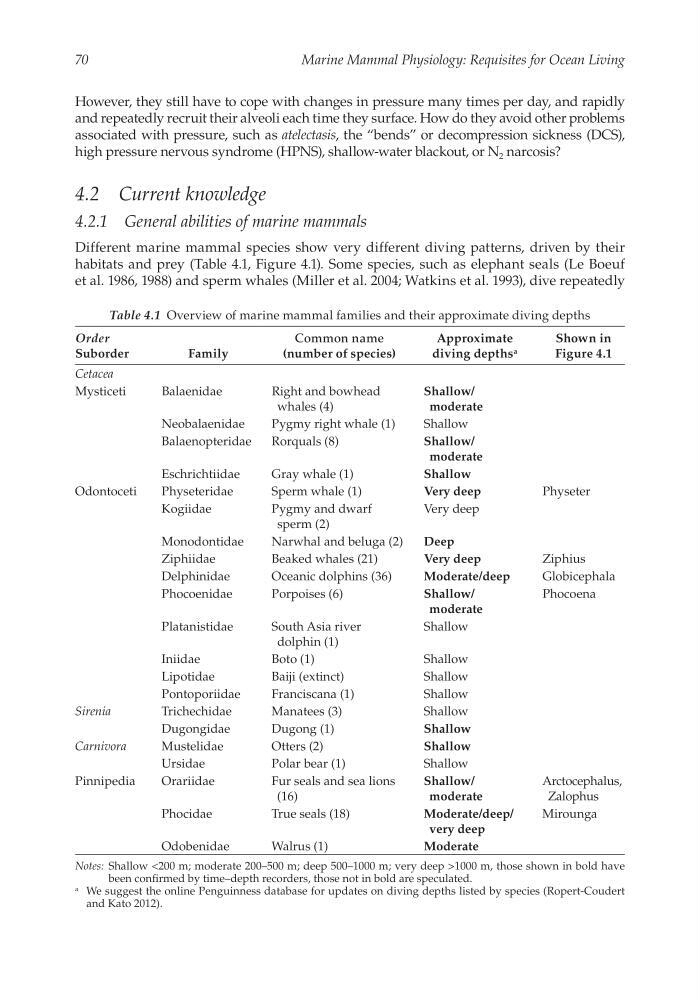
habitats and prey (Table 4.1, Figure 4.1). Some species, such as elephant seals (Le Boeuf
et al. 1986, 1988) and sperm whales (Miller et al. 2004; Watkins et al. 1993), dive repeatedly
Table 4.1 Overview of marine mammal families and their approximate diving depths
Order
Suborder
Family
Common name
(number of species)
Approximate
diving depths a
Shown in
Figure 4.1
Cetacea
Mysticeti
Balaenidae
Right and bowhead
whales (4)
Shallow/
moderate
Neobalaenidae
Pygmy right whale (1)
Shallow
Balaenopteridae
Rorquals (8)
Shallow/
moderate
Eschrichtiidae
Gray whale (1)
Shallow
Odontoceti
Physeteridae
Sperm whale (1)
Very deep
Physeter
Kogiidae
Pygmy and dwarf
sperm (2)
Very deep
Monodontidae
Narwhal and beluga (2)
Deep
Ziphiidae
Beaked whales (21)
Very deep
Ziphius
Delphinidae
Oceanic dolphins (36)
Moderate/deep
Globicephala
Phocoenidae
Porpoises (6)
Shallow/
moderate
Phocoena
Platanistidae
South Asia river
dolphin (1)
Shallow
Iniidae
Boto (1)
Shallow
Lipotidae
Baiji (extinct)
Shallow
Pontoporiidae
Franciscana (1)
Shallow
Sirenia
Trichechidae
Manatees (3)
Shallow
Dugongidae
Dugong (1)
Shallow
Carnivora
Mustelidae
Otters (2)
Shallow
Ursidae
Polar bear (1)
Shallow
Pinnipedia
Orariidae
Fur seals and sea lions
(16)
Shallow/
moderate
Arctocephalus,
Zalophus
Phocidae
True seals (18)
Moderate/deep/
very deep
Mirounga
Odobenidae
Walrus (1)
Moderate
Notes: Shallow <200 m; moderate 200–500 m; deep 500–1000 m; very deep >1000 m, those shown in bold have
been confirmed by time–depth recorders, those not in bold are speculated.
a We suggest the online Penguinness database for updates on diving depths listed by species (Ropert-Coudert
and Kato 2012).
Marine Mammal Physiology: Requisites for Ocean Living
However, they still have to cope with changes in pressure many times per day, and rapidly
and repeatedly recruit their alveoli each time they surface. How do they avoid other problems
associated with pressure, such as atelectasis, the “bends” or decompression sickness (DCS),
high pressure nervous syndrome (HPNS), shallow-water blackout, or N 2 narcosis?
4.2 Current knowledge
4.2.1 General abilities of marine mammals
Different marine mammal species show very different diving patterns, driven by their
habitats and prey (Table 4.1, Figure 4.1). Some species, such as elephant seals (Le Boeuf
et al. 1986, 1988) and sperm whales (Miller et al. 2004; Watkins et al. 1993), dive repeatedly
Table 4.1 Overview of marine mammal families and their approximate diving depths
Order
Suborder
Family
Common name
(number of species)
Approximate
diving depths a
Shown in
Figure 4.1
Cetacea
Mysticeti
Balaenidae
Right and bowhead
whales (4)
Shallow/
moderate
Neobalaenidae
Pygmy right whale (1)
Shallow
Balaenopteridae
Rorquals (8)
Shallow/
moderate
Eschrichtiidae
Gray whale (1)
Shallow
Odontoceti
Physeteridae
Sperm whale (1)
Very deep
Physeter
Kogiidae
Pygmy and dwarf
sperm (2)
Very deep
Monodontidae
Narwhal and beluga (2)
Deep
Ziphiidae
Beaked whales (21)
Very deep
Ziphius
Delphinidae
Oceanic dolphins (36)
Moderate/deep
Globicephala
Phocoenidae
Porpoises (6)
Shallow/
moderate
Phocoena
Platanistidae
South Asia river
dolphin (1)
Shallow
Iniidae
Boto (1)
Shallow
Lipotidae
Baiji (extinct)
Shallow
Pontoporiidae
Franciscana (1)
Shallow
Sirenia
Trichechidae
Manatees (3)
Shallow
Dugongidae
Dugong (1)
Shallow
Carnivora
Mustelidae
Otters (2)
Shallow
Ursidae
Polar bear (1)
Shallow
Pinnipedia
Orariidae
Fur seals and sea lions
(16)
Shallow/
moderate
Arctocephalus,
Zalophus
Phocidae
True seals (18)
Moderate/deep/
very deep
Mirounga
Odobenidae
Walrus (1)
Moderate
Notes: Shallow <200 m; moderate 200–500 m; deep 500–1000 m; very deep >1000 m, those shown in bold have
been confirmed by time–depth recorders, those not in bold are speculated.
a We suggest the online Penguinness database for updates on diving depths listed by species (Ropert-Coudert
and Kato 2012).