

54
Marine Mammal Physiology: Requisites for Ocean Living
2012 Olympic gold medal sprint pace of Michael Phelps was 1.9 m s −1 for an 800 m swim with
an obvious, significant increase in respiratory rate during the post-race period.
The second effect of the curvilinear relationship between oxygen consumption and
speed is that high speed swimming is enormously expensive. Small changes in speed as
marine mammals move past preferred ranges result in a progressive increase in the cost of
transport (COT), that is the energetic cost to move a unit of body mass a meter (SchmidtNielsen 1972) (Figure 3.3b,c), calculated from
COT (J kg m
VO
Speed
1
1
2
-
-
=
)
(3.2)
where
VO 2 is in J kg −1 s −1
speed is in m s −1
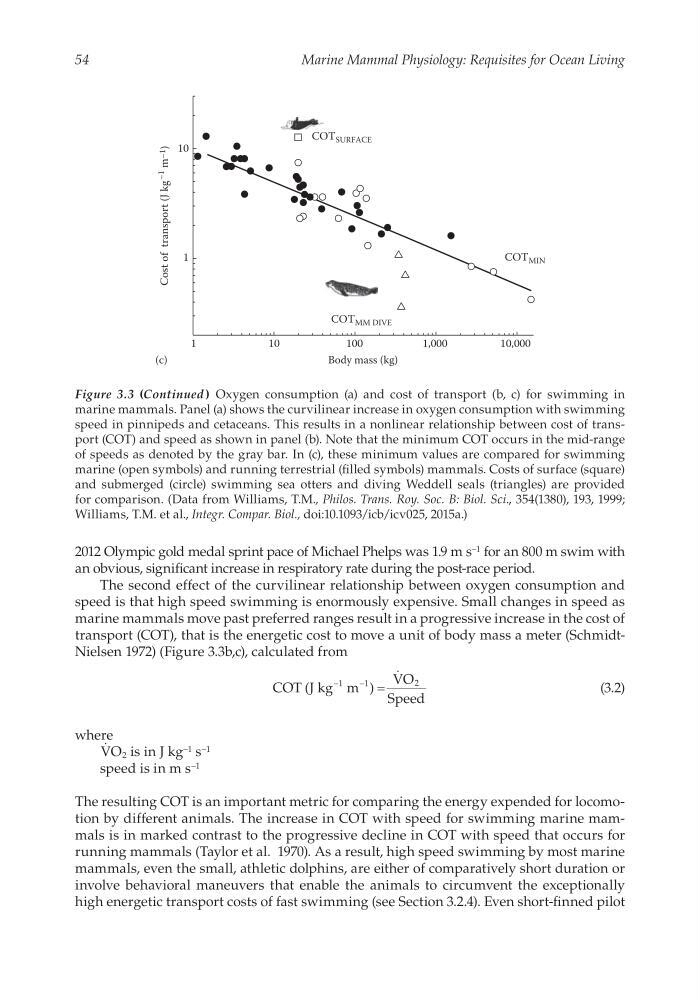
The resulting COT is an important metric for comparing the energy expended for locomotion by different animals. The increase in COT with speed for swimming marine mammals is in marked contrast to the progressive decline in COT with speed that occurs for
running mammals (Taylor et al. 1970). As a result, high speed swimming by most marine
mammals, even the small, athletic dolphins, are either of comparatively short duration or
involve behavioral maneuvers that enable the animals to circumvent the exceptionally
high energetic transport costs of fast swimming (see Section 3.2.4). Even short-finned pilot
10
1
1
1 0
100
1,000
Body mass (kg)
COT MM DIVE
10,000
COT SURFACE
COT MIN
(c)
Cost of transport (J kg
–1
m –1
)
Figure 3.3 (Continued ) Oxygen consumption (a) and cost of transport (b, c) for swimming in
marine mammals. Panel (a) shows the curvilinear increase in oxygen consumption with swimming
speed in pinnipeds and cetaceans. This results in a nonlinear relationship between cost of transport (COT) and speed as shown in panel (b). Note that the minimum COT occurs in the mid-range
of speeds as denoted by the gray bar. In (c), these minimum values are compared for swimming
marine (open symbols) and running terrestrial (filled symbols) mammals. Costs of surface (square)
and submerged (circle) swimming sea otters and diving Weddell seals (triangles) are provided
for comparison. (Data from Williams, T.M., Philos. Trans. Roy. Soc. B: Biol. Sci., 354(1380), 193, 1999;
Williams, T.M. et al., Integr. Compar. Biol., doi:10.1093/icb/icv025, 2015a.)
Marine Mammal Physiology: Requisites for Ocean Living
2012 Olympic gold medal sprint pace of Michael Phelps was 1.9 m s −1 for an 800 m swim with
an obvious, significant increase in respiratory rate during the post-race period.
The second effect of the curvilinear relationship between oxygen consumption and
speed is that high speed swimming is enormously expensive. Small changes in speed as
marine mammals move past preferred ranges result in a progressive increase in the cost of
transport (COT), that is the energetic cost to move a unit of body mass a meter (SchmidtNielsen 1972) (Figure 3.3b,c), calculated from
COT (J kg m
VO
Speed
1
1
2
-
-
=
)
(3.2)
where
VO 2 is in J kg −1 s −1
speed is in m s −1
The resulting COT is an important metric for comparing the energy expended for locomotion by different animals. The increase in COT with speed for swimming marine mammals is in marked contrast to the progressive decline in COT with speed that occurs for
running mammals (Taylor et al. 1970). As a result, high speed swimming by most marine
mammals, even the small, athletic dolphins, are either of comparatively short duration or
involve behavioral maneuvers that enable the animals to circumvent the exceptionally
high energetic transport costs of fast swimming (see Section 3.2.4). Even short-finned pilot
10
1
1
1 0
100
1,000
Body mass (kg)
COT MM DIVE
10,000
COT SURFACE
COT MIN
(c)
Cost of transport (J kg
–1
m –1
)
Figure 3.3 (Continued ) Oxygen consumption (a) and cost of transport (b, c) for swimming in
marine mammals. Panel (a) shows the curvilinear increase in oxygen consumption with swimming
speed in pinnipeds and cetaceans. This results in a nonlinear relationship between cost of transport (COT) and speed as shown in panel (b). Note that the minimum COT occurs in the mid-range
of speeds as denoted by the gray bar. In (c), these minimum values are compared for swimming
marine (open symbols) and running terrestrial (filled symbols) mammals. Costs of surface (square)
and submerged (circle) swimming sea otters and diving Weddell seals (triangles) are provided
for comparison. (Data from Williams, T.M., Philos. Trans. Roy. Soc. B: Biol. Sci., 354(1380), 193, 1999;
Williams, T.M. et al., Integr. Compar. Biol., doi:10.1093/icb/icv025, 2015a.)