

52
Marine Mammal Physiology: Requisites for Ocean Living
other aquatic species with low metabolic rates. Until additional data that adhere to standard Kleiber measurement conditions are available for a wider range of marine mammals,
some confusion regarding what physiological state represents baseline or resting conditions in aquatic mammals will remain.
3.2.2 Metabolic costs of swimming and diving
As for any active animal, the metabolic rate of marine mammals increases in response to the
level of physical exertion. However, the energy expended for swimming by marine mammals
differs from the pattern observed for running by terrestrial mammals and reflects the unique
physical forces that must be overcome to move through water. In Chapter 1, we learned that
the body drag of swimmers increases exponentially with locomotor speed. This has a profound effect on the cost of swimming, especially at higher speeds. For runners, the rate of
oxygen consumption (VO 2
) typically increases linearly with speed until aerobic limits are
1,000,000
Resting metabolic rate (kJ day
–1
)
100,000
10,000
1,000
10
(a)
100
1,000
10,000
Field metabolic rate (kJ day
–1
)
1,000,000
100,000
10,000
1,000
(b)
10
100
Mass (kg)
1,000
10,000
Otariid
Phocid
Odobenid
Odontocete
Sea otter
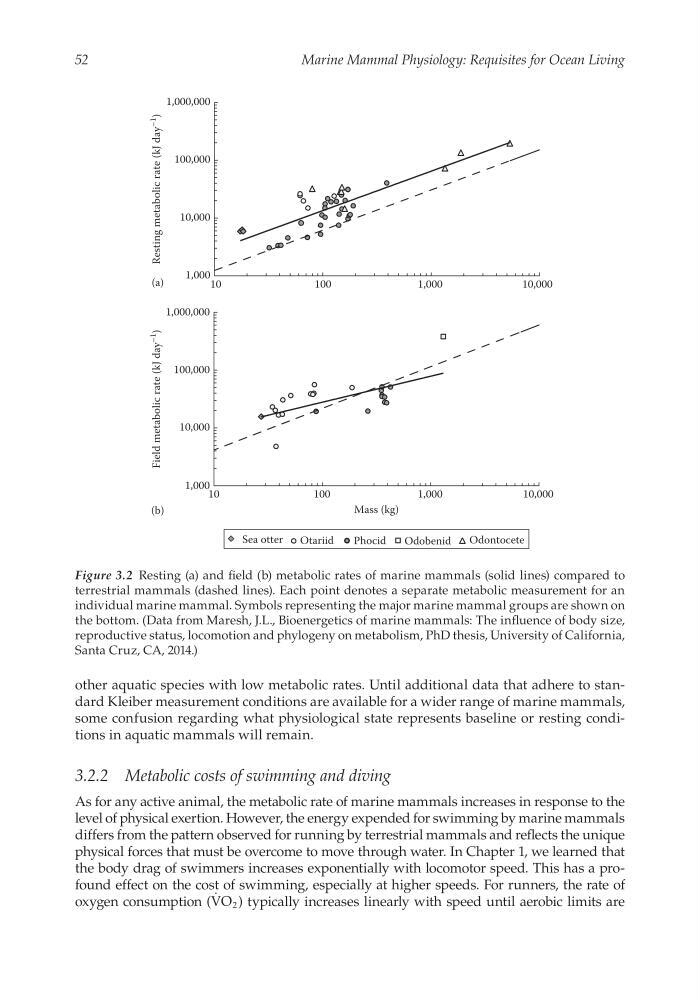
Figure 3.2 Resting (a) and field (b) metabolic rates of marine mammals (solid lines) compared to
terrestrial mammals (dashed lines). Each point denotes a separate metabolic measurement for an
individual marine mammal. Symbols representing the major marine mammal groups are shown on
the bottom. (Data from Maresh, J.L., Bioenergetics of marine mammals: The influence of body size,
reproductive status, locomotion and phylogeny on metabolism, PhD thesis, University of California,
Santa Cruz, CA, 2014.)
Marine Mammal Physiology: Requisites for Ocean Living
other aquatic species with low metabolic rates. Until additional data that adhere to standard Kleiber measurement conditions are available for a wider range of marine mammals,
some confusion regarding what physiological state represents baseline or resting conditions in aquatic mammals will remain.
3.2.2 Metabolic costs of swimming and diving
As for any active animal, the metabolic rate of marine mammals increases in response to the
level of physical exertion. However, the energy expended for swimming by marine mammals
differs from the pattern observed for running by terrestrial mammals and reflects the unique
physical forces that must be overcome to move through water. In Chapter 1, we learned that
the body drag of swimmers increases exponentially with locomotor speed. This has a profound effect on the cost of swimming, especially at higher speeds. For runners, the rate of
oxygen consumption (VO 2
) typically increases linearly with speed until aerobic limits are
1,000,000
Resting metabolic rate (kJ day
–1
)
100,000
10,000
1,000
10
(a)
100
1,000
10,000
Field metabolic rate (kJ day
–1
)
1,000,000
100,000
10,000
1,000
(b)
10
100
Mass (kg)
1,000
10,000
Otariid
Phocid
Odobenid
Odontocete
Sea otter
Figure 3.2 Resting (a) and field (b) metabolic rates of marine mammals (solid lines) compared to
terrestrial mammals (dashed lines). Each point denotes a separate metabolic measurement for an
individual marine mammal. Symbols representing the major marine mammal groups are shown on
the bottom. (Data from Maresh, J.L., Bioenergetics of marine mammals: The influence of body size,
reproductive status, locomotion and phylogeny on metabolism, PhD thesis, University of California,
Santa Cruz, CA, 2014.)