

36
Marine Mammal Physiology: Requisites for Ocean Living
2.3 Toolbox: How these parameters are measured
The measurement of these physiological parameters is challenging in a number of ways.
The calculation of O 2 stores requires a number of anatomical or physiological measurements which can be made using a variety of methods. However, these measurements or
calculations often require a number of assumptions which have not been verified in diving
marine mammals. As a result, accurate measurement of each O 2 store has its own limitations. There are also significant challenges in heart rate measurements and the determination of ADLs. As mentioned earlier, the results from early studies of forcibly submerged
animals can be quite different from how animals respond while freely diving. Yet, making
similar measurements in freely diving animals is much more difficult.
Recent work on the physiological responses in freely diving animals has been assisted
by technological advances, which have paved the way for small microprocessor-based
data recorders that can be attached to free-diving animals. However, while the ability to
record physiological data has improved, the need to recapture the animal and remove the
physiological sensors is still a major impediment in increasing our understanding of the
diving physiology of many marine mammals.
This section will address current methods for determining: (1) O 2 stores; (2) heart rate;
and (3) the ADL in marine mammals.
2.3.1 Measuring the respiratory O 2 store
The respiratory O 2 store is not the maximum amount of O 2 that can be stored in the
lungs. There are two primary factors in measuring the respiratory O 2 store: (1) the diving
12
10
8
6
4
2
0
0
Lactate concentration (mM)
10
20
30
40
Dive duration (min)
50
60
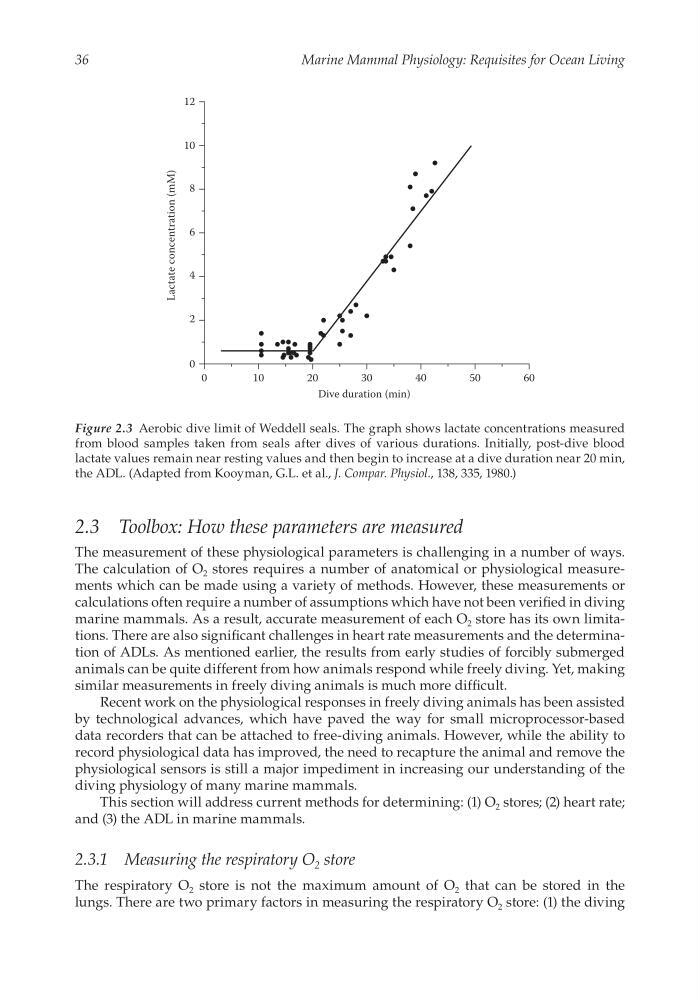
Figure 2.3 Aerobic dive limit of Weddell seals. The graph shows lactate concentrations measured
from blood samples taken from seals after dives of various durations. Initially, post-dive blood
l actate values remain near resting values and then begin to increase at a dive duration near 20 min,
the ADL. (Adapted from Kooyman, G.L. et al., J. Compar. Physiol., 138, 335, 1980.)
Marine Mammal Physiology: Requisites for Ocean Living
2.3 Toolbox: How these parameters are measured
The measurement of these physiological parameters is challenging in a number of ways.
The calculation of O 2 stores requires a number of anatomical or physiological measurements which can be made using a variety of methods. However, these measurements or
calculations often require a number of assumptions which have not been verified in diving
marine mammals. As a result, accurate measurement of each O 2 store has its own limitations. There are also significant challenges in heart rate measurements and the determination of ADLs. As mentioned earlier, the results from early studies of forcibly submerged
animals can be quite different from how animals respond while freely diving. Yet, making
similar measurements in freely diving animals is much more difficult.
Recent work on the physiological responses in freely diving animals has been assisted
by technological advances, which have paved the way for small microprocessor-based
data recorders that can be attached to free-diving animals. However, while the ability to
record physiological data has improved, the need to recapture the animal and remove the
physiological sensors is still a major impediment in increasing our understanding of the
diving physiology of many marine mammals.
This section will address current methods for determining: (1) O 2 stores; (2) heart rate;
and (3) the ADL in marine mammals.
2.3.1 Measuring the respiratory O 2 store
The respiratory O 2 store is not the maximum amount of O 2 that can be stored in the
lungs. There are two primary factors in measuring the respiratory O 2 store: (1) the diving
12
10
8
6
4
2
0
0
Lactate concentration (mM)
10
20
30
40
Dive duration (min)
50
60
Figure 2.3 Aerobic dive limit of Weddell seals. The graph shows lactate concentrations measured
from blood samples taken from seals after dives of various durations. Initially, post-dive blood
l actate values remain near resting values and then begin to increase at a dive duration near 20 min,
the ADL. (Adapted from Kooyman, G.L. et al., J. Compar. Physiol., 138, 335, 1980.)