

313
Chapter fourteen: Toxicology and poisons
Se up to 7.69, 4.99, and 9.09 μg/g in the liver of ringed seals, beluga whales, and polar
bears, respectively; which compare favorably to the lower thresholds of chronic toxicity
reported in the liver for cattle (1.25–7.0 μg/g), pig (4.0–20.0 μg/g), and rabbit (7.04 μg/g)
(Puls 1994). Research into the diversity of selenocysteine (Sec) incorporating proteins (selenoproteomes) found that terrestrial eukaryotes have a smaller and less diverse selenoproteome than aquatic eukaryotes (Lobanov et al. 2007). The authors of the aforementioned
study attribute the diversity of selenoproteomes in aquatic species to, at least in part, the
abundance of bioavailable selenium (organic selenides) in the marine environment. While
terrestrial mammals likely share a number, if not all, of their related marine mammal
selenoproteins (a comparative study between mammalian selenoproteomes is not known),
it is worth noting that Lobanov et al. (2007) found that the lack of diversity of terrestrial
selenoproteomes was due to several independent losses, thus, it is conceivable that marine
mammal selenoproteomes differ from their terrestrial counterparts.
1 : 1
m
o l a r
r a t i o
Potential Se deficiency
Hypothetical potential Se toxicity
(Hg deficiency)
Hypothetical potential Hg toxicity
(Se deficiency)
Molar concentration of mercury
Molar concentration of selenium
Hypothetical
optimal range
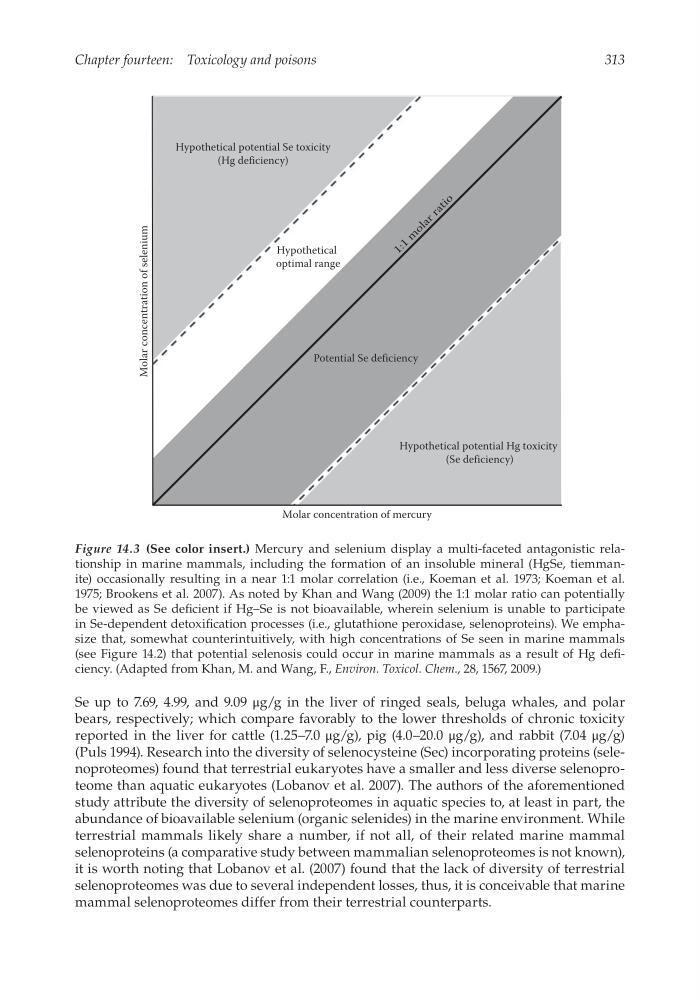
Figure 14.3 (See color insert.) Mercury and selenium display a multi-faceted antagonistic relationship in marine mammals, including the formation of an insoluble mineral (HgSe, tiemmanite) occasionally resulting in a near 1:1 molar correlation (i.e., Koeman et al. 1973; Koeman et al.
1975; Brookens et al. 2007). As noted by Khan and Wang (2009) the 1:1 molar ratio can potentially
be viewed as Se deficient if Hg–Se is not bioavailable, wherein selenium is unable to participate
in Se-dependent detoxification processes (i.e., glutathione peroxidase, selenoproteins). We emphasize that, somewhat counterintuitively, with high concentrations of Se seen in marine mammals
(see Figure 14.2) that potential selenosis could occur in marine mammals as a result of Hg deficiency. (Adapted from Khan, M. and Wang, F., Environ. Toxicol. Chem., 28, 1567, 2009.)
Chapter fourteen: Toxicology and poisons
Se up to 7.69, 4.99, and 9.09 μg/g in the liver of ringed seals, beluga whales, and polar
bears, respectively; which compare favorably to the lower thresholds of chronic toxicity
reported in the liver for cattle (1.25–7.0 μg/g), pig (4.0–20.0 μg/g), and rabbit (7.04 μg/g)
(Puls 1994). Research into the diversity of selenocysteine (Sec) incorporating proteins (selenoproteomes) found that terrestrial eukaryotes have a smaller and less diverse selenoproteome than aquatic eukaryotes (Lobanov et al. 2007). The authors of the aforementioned
study attribute the diversity of selenoproteomes in aquatic species to, at least in part, the
abundance of bioavailable selenium (organic selenides) in the marine environment. While
terrestrial mammals likely share a number, if not all, of their related marine mammal
selenoproteins (a comparative study between mammalian selenoproteomes is not known),
it is worth noting that Lobanov et al. (2007) found that the lack of diversity of terrestrial
selenoproteomes was due to several independent losses, thus, it is conceivable that marine
mammal selenoproteomes differ from their terrestrial counterparts.
1 : 1
m
o l a r
r a t i o
Potential Se deficiency
Hypothetical potential Se toxicity
(Hg deficiency)
Hypothetical potential Hg toxicity
(Se deficiency)
Molar concentration of mercury
Molar concentration of selenium
Hypothetical
optimal range
Figure 14.3 (See color insert.) Mercury and selenium display a multi-faceted antagonistic relationship in marine mammals, including the formation of an insoluble mineral (HgSe, tiemmanite) occasionally resulting in a near 1:1 molar correlation (i.e., Koeman et al. 1973; Koeman et al.
1975; Brookens et al. 2007). As noted by Khan and Wang (2009) the 1:1 molar ratio can potentially
be viewed as Se deficient if Hg–Se is not bioavailable, wherein selenium is unable to participate
in Se-dependent detoxification processes (i.e., glutathione peroxidase, selenoproteins). We emphasize that, somewhat counterintuitively, with high concentrations of Se seen in marine mammals
(see Figure 14.2) that potential selenosis could occur in marine mammals as a result of Hg deficiency. (Adapted from Khan, M. and Wang, F., Environ. Toxicol. Chem., 28, 1567, 2009.)