

312
Marine Mammal Physiology: Requisites for Ocean Living
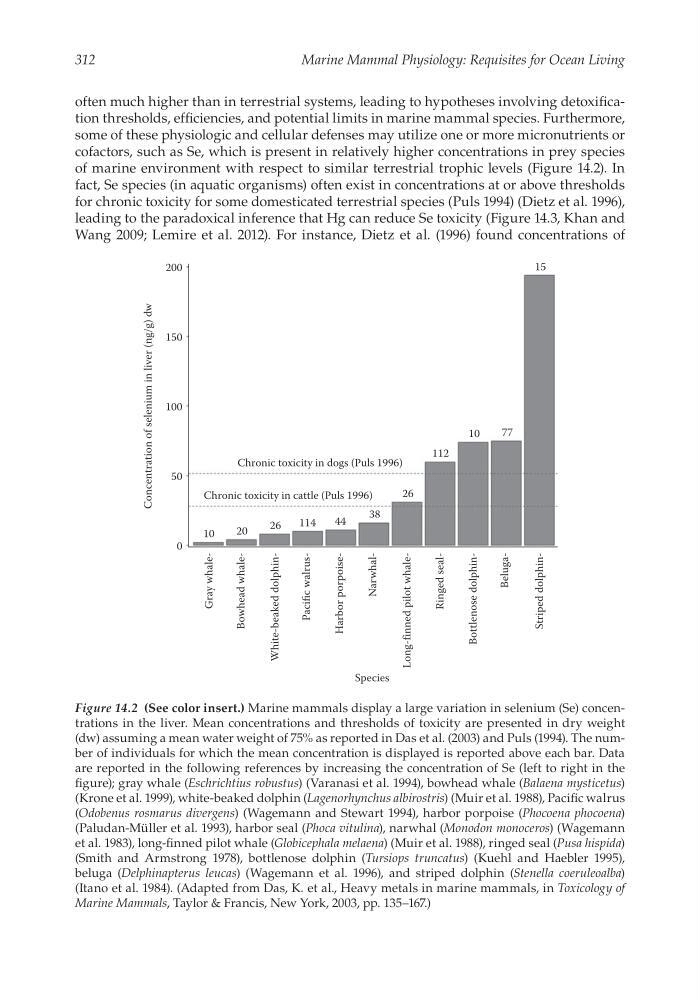
often much higher than in terrestrial systems, leading to hypotheses involving detoxification thresholds, efficiencies, and potential limits in marine mammal species. Furthermore,
some of these physiologic and cellular defenses may utilize one or more micronutrients or
cofactors, such as Se, which is present in relatively higher concentrations in prey species
of marine environment with respect to similar terrestrial trophic levels (Figure 14.2). In
fact, Se species (in aquatic organisms) often exist in concentrations at or above thresholds
for chronic toxicity for some domesticated terrestrial species (Puls 1994) (Dietz et al. 1996),
leading to the paradoxical inference that Hg can reduce Se toxicity (Figure 14.3, Khan and
Wang 2009; Lemire et al. 2012). For instance, Dietz et al. (1996) found concentrations of
200
150
100
50
0
10
Gray whaleBowhead whaleConcentration of selenium in liver (ng/g) dw
White-beaked dolphinPaciic
NarwhalRinged
BelugaLong-finned pilot whaleBottlenose dolphinStriped dolphinHarbor porpoise20
26
Chronic toxicity in dogs (Puls 1996)
Chronic toxicity in cattle (Puls 1996)
114
44
Species
38
26
112
10
77
15
Figure 14.2 (See color insert.) Marine mammals display a large variation in selenium (Se) concentrations in the liver. Mean concentrations and thresholds of toxicity are presented in dry weight
(dw) assuming a mean water weight of 75% as reported in Das et al. (2003) and Puls (1994). The number of individuals for which the mean concentration is displayed is reported above each bar. Data
are reported in the following references by increasing the concentration of Se (left to right in the
figure); gray whale (Eschrichtius robustus) (Varanasi et al. 1994), bowhead whale (Balaena mysticetus)
(Krone et al. 1999), white-beaked dolphin (Lagenorhynchus albirostris) (Muir et al. 1988), Pacific walrus
(Odobenus rosmarus divergens) (Wagemann and Stewart 1994), harbor porpoise (Phocoena phocoena)
(Paludan-Müller et al. 1993), harbor seal (Phoca vitulina), narwhal (Monodon monoceros) (Wagemann
et al. 1983), long-finned pilot whale (Globicephala melaena) (Muir et al. 1988), ringed seal (Pusa hispida)
(Smith and Armstrong 1978), bottlenose dolphin (Tursiops truncatus) (Kuehl and Haebler 1995),
beluga (Delphinapterus leucas) (Wagemann et al. 1996), and striped dolphin (Stenella coeruleoalba)
(Itano et al. 1984). (Adapted from Das, K. et al., Heavy metals in marine mammals, in Toxicology of
Marine Mammals, Taylor & Francis, New York, 2003, pp. 135–167.)
Marine Mammal Physiology: Requisites for Ocean Living
often much higher than in terrestrial systems, leading to hypotheses involving detoxification thresholds, efficiencies, and potential limits in marine mammal species. Furthermore,
some of these physiologic and cellular defenses may utilize one or more micronutrients or
cofactors, such as Se, which is present in relatively higher concentrations in prey species
of marine environment with respect to similar terrestrial trophic levels (Figure 14.2). In
fact, Se species (in aquatic organisms) often exist in concentrations at or above thresholds
for chronic toxicity for some domesticated terrestrial species (Puls 1994) (Dietz et al. 1996),
leading to the paradoxical inference that Hg can reduce Se toxicity (Figure 14.3, Khan and
Wang 2009; Lemire et al. 2012). For instance, Dietz et al. (1996) found concentrations of
200
150
100
50
0
10
Gray whaleBowhead whaleConcentration of selenium in liver (ng/g) dw
White-beaked dolphinPaciic
NarwhalRinged
BelugaLong-finned pilot whaleBottlenose dolphinStriped dolphinHarbor porpoise20
26
Chronic toxicity in dogs (Puls 1996)
Chronic toxicity in cattle (Puls 1996)
114
44
Species
38
26
112
10
77
15
Figure 14.2 (See color insert.) Marine mammals display a large variation in selenium (Se) concentrations in the liver. Mean concentrations and thresholds of toxicity are presented in dry weight
(dw) assuming a mean water weight of 75% as reported in Das et al. (2003) and Puls (1994). The number of individuals for which the mean concentration is displayed is reported above each bar. Data
are reported in the following references by increasing the concentration of Se (left to right in the
figure); gray whale (Eschrichtius robustus) (Varanasi et al. 1994), bowhead whale (Balaena mysticetus)
(Krone et al. 1999), white-beaked dolphin (Lagenorhynchus albirostris) (Muir et al. 1988), Pacific walrus
(Odobenus rosmarus divergens) (Wagemann and Stewart 1994), harbor porpoise (Phocoena phocoena)
(Paludan-Müller et al. 1993), harbor seal (Phoca vitulina), narwhal (Monodon monoceros) (Wagemann
et al. 1983), long-finned pilot whale (Globicephala melaena) (Muir et al. 1988), ringed seal (Pusa hispida)
(Smith and Armstrong 1978), bottlenose dolphin (Tursiops truncatus) (Kuehl and Haebler 1995),
beluga (Delphinapterus leucas) (Wagemann et al. 1996), and striped dolphin (Stenella coeruleoalba)
(Itano et al. 1984). (Adapted from Das, K. et al., Heavy metals in marine mammals, in Toxicology of
Marine Mammals, Taylor & Francis, New York, 2003, pp. 135–167.)