

261
Chapter eleven: Acoustics
11.5 Lingering mysteries
One of the greatest mysteries related to marine mammal sound production and hearing
is the frequency range of hearing and hearing sensitivity of any mysticete whale. To date,
no mysticete whale has ever had its hearing effectively tested, although attempts have
been made. For example, evoked potential methods were attempted on a gray whale calf
(Eschrichtius robustus) in an effort to obtain some information about hearing in this species (Ridgway and Carder 2001). The attempt met with limited success and no frequencyspecific information on hearing sensitivity was obtained. Other methods have also been
used to try and assess what the large mysticetes can hear; these include anatomical modeling (Figure 11.6), looking for behavioral reactions to sound exposure, and determining
the frequency range over which vocalizations are produced. Unfortunately, none of these
methods can fully answer the question about the perceptual aspect of hearing. Although
behavioral reactions may indicate that a whale heard a sound, whales may not respond
to signals they hear due to contextual factors, such as their motivational state (e.g., greater
desire to continue feeding during a feeding bout) or a lack of concern over the sound
source. In other words, because an animal does not respond to a sound exposure cannot
be interpreted as it not hearing a sound. It is also not possible to extrapolate the frequency
range of hearing for an animal from the frequencies at which it vocalizes. Most mammals,
including humans, hear across a much greater range of frequencies than that within which
they vocalize.
Mysticetes provide an immense challenge to empirically determining hearing capabilities. Mysticetes are too large to maintain under human care for the time necessary to
perform behavioral audiometry. For this reason, much of what we believe about mysticete
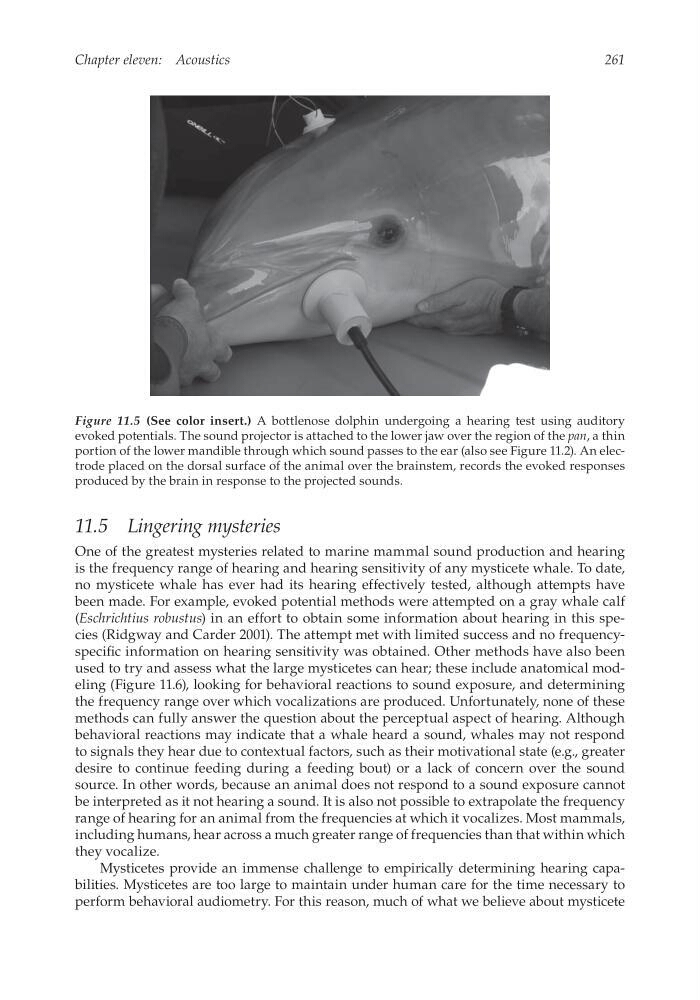
Figure 11.5 (See color insert.) A bottlenose dolphin undergoing a hearing test using auditory
evoked potentials. The sound projector is attached to the lower jaw over the region of the pan, a thin
portion of the lower mandible through which sound passes to the ear (also see Figure 11.2). An electrode placed on the dorsal surface of the animal over the brainstem, records the evoked responses
produced by the brain in response to the projected sounds.
Chapter eleven: Acoustics
11.5 Lingering mysteries
One of the greatest mysteries related to marine mammal sound production and hearing
is the frequency range of hearing and hearing sensitivity of any mysticete whale. To date,
no mysticete whale has ever had its hearing effectively tested, although attempts have
been made. For example, evoked potential methods were attempted on a gray whale calf
(Eschrichtius robustus) in an effort to obtain some information about hearing in this species (Ridgway and Carder 2001). The attempt met with limited success and no frequencyspecific information on hearing sensitivity was obtained. Other methods have also been
used to try and assess what the large mysticetes can hear; these include anatomical modeling (Figure 11.6), looking for behavioral reactions to sound exposure, and determining
the frequency range over which vocalizations are produced. Unfortunately, none of these
methods can fully answer the question about the perceptual aspect of hearing. Although
behavioral reactions may indicate that a whale heard a sound, whales may not respond
to signals they hear due to contextual factors, such as their motivational state (e.g., greater
desire to continue feeding during a feeding bout) or a lack of concern over the sound
source. In other words, because an animal does not respond to a sound exposure cannot
be interpreted as it not hearing a sound. It is also not possible to extrapolate the frequency
range of hearing for an animal from the frequencies at which it vocalizes. Most mammals,
including humans, hear across a much greater range of frequencies than that within which
they vocalize.
Mysticetes provide an immense challenge to empirically determining hearing capabilities. Mysticetes are too large to maintain under human care for the time necessary to
perform behavioral audiometry. For this reason, much of what we believe about mysticete
Figure 11.5 (See color insert.) A bottlenose dolphin undergoing a hearing test using auditory
evoked potentials. The sound projector is attached to the lower jaw over the region of the pan, a thin
portion of the lower mandible through which sound passes to the ear (also see Figure 11.2). An electrode placed on the dorsal surface of the animal over the brainstem, records the evoked responses
produced by the brain in response to the projected sounds.