

246
Marine Mammal Physiology: Requisites for Ocean Living
11.2 Knowledge by order
11.2.1 Order Cetacea
11.2.1.1 Hearing
The auditory system of the terrestrial mammal is adapted for transducing changes in air
pressure (sound waves) to neurological signals that are perceived as pitch and loudness,
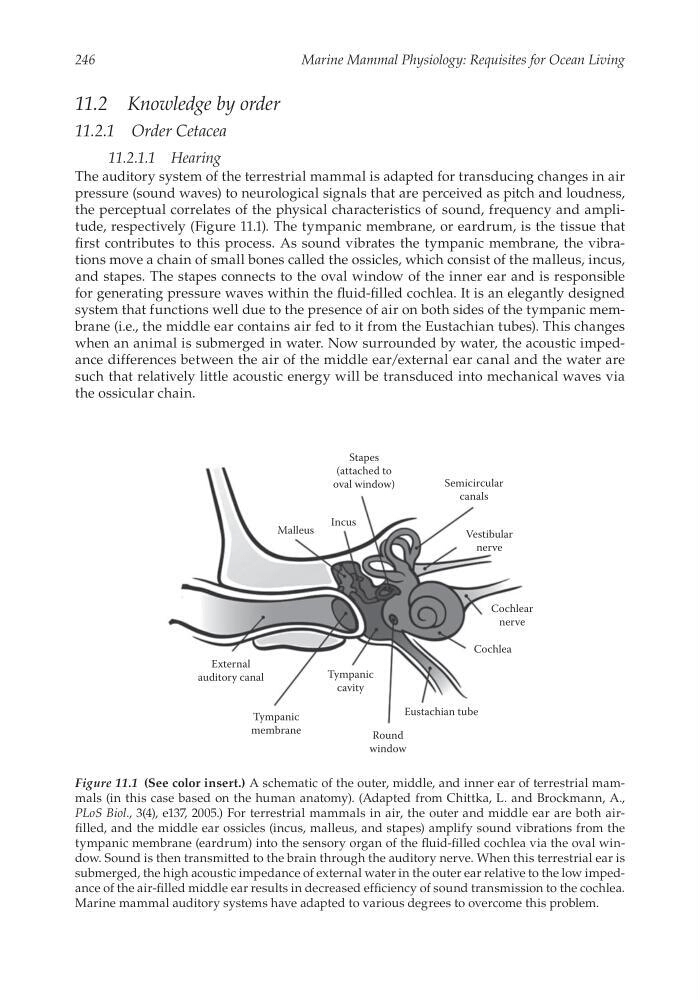
the perceptual correlates of the physical characteristics of sound, frequency and amplitude, respectively (Figure 11.1). The tympanic membrane, or eardrum, is the tissue that
first contributes to this process. As sound vibrates the tympanic membrane, the vibrations move a chain of small bones called the ossicles, which consist of the malleus, incus,
and stapes. The stapes connects to the oval window of the inner ear and is responsible
for generating pressure waves within the fluid-filled cochlea. It is an elegantly designed
system that functions well due to the presence of air on both sides of the tympanic membrane (i.e., the middle ear contains air fed to it from the Eustachian tubes). This changes
when an animal is submerged in water. Now surrounded by water, the acoustic impedance differences between the air of the middle ear/external ear canal and the water are
such that relatively little acoustic energy will be transduced into mechanical waves via
the ossicular chain.
Incus
Malleus
Cochlea
Round
window
Eustachian tube
Tympanic
cavity
Tympanic
membrane
External
auditory canal
Cochlear
nerve
Vestibular
nerve
Semicircular
canals
Stapes
(attached to
oval window)
Figure 11.1 (See color insert.) A schematic of the outer, middle, and inner ear of terrestrial mammals (in this case based on the human anatomy). (Adapted from Chittka, L. and Brockmann, A.,
PLoS Biol., 3(4), e137, 2005.) For terrestrial mammals in air, the outer and middle ear are both airfilled, and the middle ear ossicles (incus, malleus, and stapes) amplify sound vibrations from the
tympanic membrane (eardrum) into the sensory organ of the fluid-filled cochlea via the oval window. Sound is then transmitted to the brain through the auditory nerve. When this terrestrial ear is
submerged, the high acoustic impedance of external water in the outer ear relative to the low impedance of the air-filled middle ear results in decreased efficiency of sound transmission to the cochlea.
Marine mammal auditory systems have adapted to various degrees to overcome this problem.
Marine Mammal Physiology: Requisites for Ocean Living
11.2 Knowledge by order
11.2.1 Order Cetacea
11.2.1.1 Hearing
The auditory system of the terrestrial mammal is adapted for transducing changes in air
pressure (sound waves) to neurological signals that are perceived as pitch and loudness,
the perceptual correlates of the physical characteristics of sound, frequency and amplitude, respectively (Figure 11.1). The tympanic membrane, or eardrum, is the tissue that
first contributes to this process. As sound vibrates the tympanic membrane, the vibrations move a chain of small bones called the ossicles, which consist of the malleus, incus,
and stapes. The stapes connects to the oval window of the inner ear and is responsible
for generating pressure waves within the fluid-filled cochlea. It is an elegantly designed
system that functions well due to the presence of air on both sides of the tympanic membrane (i.e., the middle ear contains air fed to it from the Eustachian tubes). This changes
when an animal is submerged in water. Now surrounded by water, the acoustic impedance differences between the air of the middle ear/external ear canal and the water are
such that relatively little acoustic energy will be transduced into mechanical waves via
the ossicular chain.
Incus
Malleus
Cochlea
Round
window
Eustachian tube
Tympanic
cavity
Tympanic
membrane
External
auditory canal
Cochlear
nerve
Vestibular
nerve
Semicircular
canals
Stapes
(attached to
oval window)
Figure 11.1 (See color insert.) A schematic of the outer, middle, and inner ear of terrestrial mammals (in this case based on the human anatomy). (Adapted from Chittka, L. and Brockmann, A.,
PLoS Biol., 3(4), e137, 2005.) For terrestrial mammals in air, the outer and middle ear are both airfilled, and the middle ear ossicles (incus, malleus, and stapes) amplify sound vibrations from the
tympanic membrane (eardrum) into the sensory organ of the fluid-filled cochlea via the oval window. Sound is then transmitted to the brain through the auditory nerve. When this terrestrial ear is
submerged, the high acoustic impedance of external water in the outer ear relative to the low impedance of the air-filled middle ear results in decreased efficiency of sound transmission to the cochlea.
Marine mammal auditory systems have adapted to various degrees to overcome this problem.