

208
Marine Mammal Physiology: Requisites for Ocean Living
Antarctic water (−1.9°C), the smallest bodied pups consistently showed obligate thermoregulatory heat costs. Juvenile Weddell seals (yearlings), having the least blubber insulation, lost heat at the fastest rate as their swim speed (and therefore convective water
flow over their bodies) increased. This type of information will help scientists to understand when higher thermoregulatory heat production becomes necessary to maintain
stable core body temperature, and when changes in the environment or in animal conditions impose thermoregulatory costs for wild marine mammals (Figure 9.5).
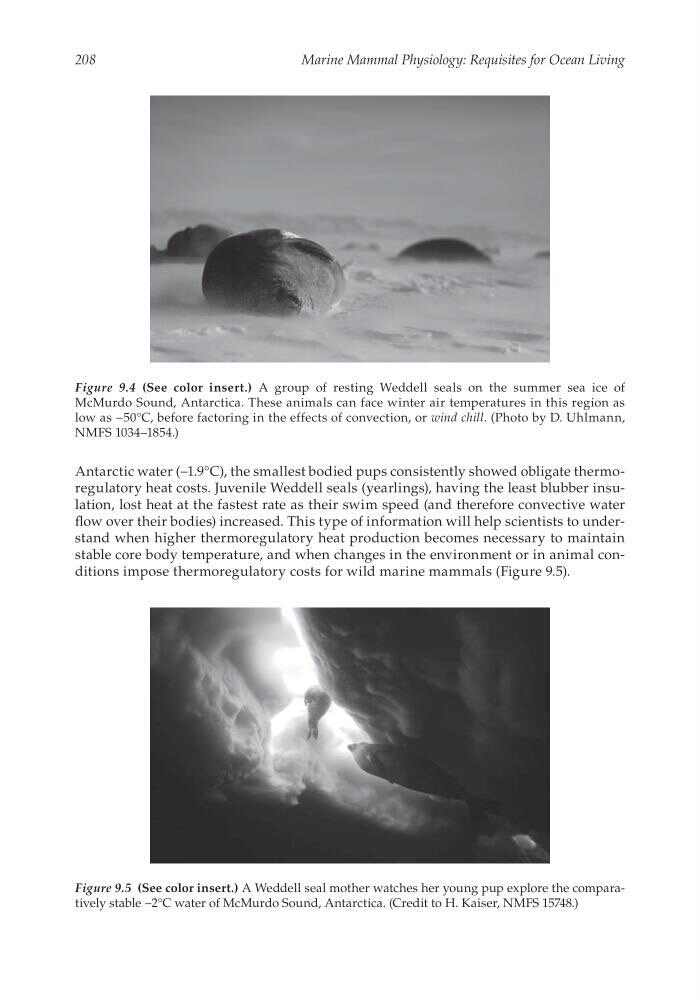
Figure 9.4 (See color insert.) A group of resting Weddell seals on the summer sea ice of
McMurdo Sound, Antarctica. These animals can face winter air temperatures in this region as
low as −50°C, before factoring in the effects of convection, or wind chill. (Photo by D. Uhlmann,
NMFS 1034–1854.)
Figure 9.5 (See color insert.) A Weddell seal mother watches her young pup explore the comparatively stable −2°C water of McMurdo Sound, Antarctica. (Credit to H. Kaiser, NMFS 15748.)
Marine Mammal Physiology: Requisites for Ocean Living
Antarctic water (−1.9°C), the smallest bodied pups consistently showed obligate thermoregulatory heat costs. Juvenile Weddell seals (yearlings), having the least blubber insulation, lost heat at the fastest rate as their swim speed (and therefore convective water
flow over their bodies) increased. This type of information will help scientists to understand when higher thermoregulatory heat production becomes necessary to maintain
stable core body temperature, and when changes in the environment or in animal conditions impose thermoregulatory costs for wild marine mammals (Figure 9.5).
Figure 9.4 (See color insert.) A group of resting Weddell seals on the summer sea ice of
McMurdo Sound, Antarctica. These animals can face winter air temperatures in this region as
low as −50°C, before factoring in the effects of convection, or wind chill. (Photo by D. Uhlmann,
NMFS 1034–1854.)
Figure 9.5 (See color insert.) A Weddell seal mother watches her young pup explore the comparatively stable −2°C water of McMurdo Sound, Antarctica. (Credit to H. Kaiser, NMFS 15748.)