

207
Chapter nine: Thermoregulation
calculate the heat flow that is moving through them. Noren et al. (1999) were able to
adapt this technology by putting the disks on a tool that could be placed against the
skin of dolphins accustomed to divers. In this way, they were able to measure heat flow
from the surface of the dolphin skin at multiple sites around the body, after the animals
had been resting, exercising, and so on. They found that most of their extra heat from
exercise was actually dissipated when they returned to the surface and that the diving
responses over-rode the need to dump heat to the periphery. Evidence for this included
that heat flow from the fins and flukes decreased when the animals were underwater,
suggesting a reduction in blood flow which would be consistent with blood flow redistribution during diving.
A pair of highly trained sea lions at the Vancouver Aquarium provided the stage for
application of this method to otariid seals (Willis et al. 2005). Custom-made housings
allowed for a temporary attachment of heat flux sensors for up to 7 days during routine
swim bouts. This allowed the determination of correction factors required, as they discovered that the attachment itself could greatly impact the heat flux readings. Pilot deployments of this method led to a recent full-scale effort with Weddell seals in McMurdo
Sound, Antarctica.
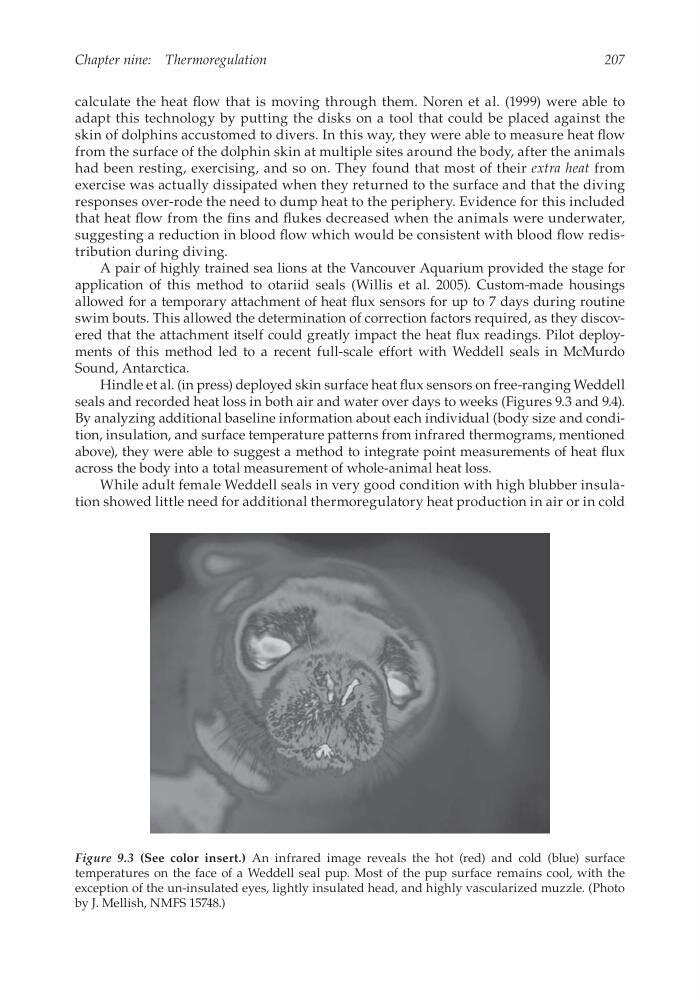
Hindle et al. (in press) deployed skin surface heat flux sensors on free-ranging Weddell
seals and recorded heat loss in both air and water over days to weeks (Figures 9.3 and 9.4).
By analyzing additional baseline information about each individual (body size and condition, insulation, and surface temperature patterns from infrared thermograms, mentioned
above), they were able to suggest a method to integrate point measurements of heat flux
across the body into a total measurement of whole-animal heat loss.
While adult female Weddell seals in very good condition with high blubber insulation showed little need for additional thermoregulatory heat production in air or in cold
Figure 9.3 (See color insert.) An infrared image reveals the hot (red) and cold (blue) surface
temperatures on the face of a Weddell seal pup. Most of the pup surface remains cool, with the
exception of the un-insulated eyes, lightly insulated head, and highly vascularized muzzle. (Photo
by J. Mellish, NMFS 15748.)
Chapter nine: Thermoregulation
calculate the heat flow that is moving through them. Noren et al. (1999) were able to
adapt this technology by putting the disks on a tool that could be placed against the
skin of dolphins accustomed to divers. In this way, they were able to measure heat flow
from the surface of the dolphin skin at multiple sites around the body, after the animals
had been resting, exercising, and so on. They found that most of their extra heat from
exercise was actually dissipated when they returned to the surface and that the diving
responses over-rode the need to dump heat to the periphery. Evidence for this included
that heat flow from the fins and flukes decreased when the animals were underwater,
suggesting a reduction in blood flow which would be consistent with blood flow redistribution during diving.
A pair of highly trained sea lions at the Vancouver Aquarium provided the stage for
application of this method to otariid seals (Willis et al. 2005). Custom-made housings
allowed for a temporary attachment of heat flux sensors for up to 7 days during routine
swim bouts. This allowed the determination of correction factors required, as they discovered that the attachment itself could greatly impact the heat flux readings. Pilot deployments of this method led to a recent full-scale effort with Weddell seals in McMurdo
Sound, Antarctica.
Hindle et al. (in press) deployed skin surface heat flux sensors on free-ranging Weddell
seals and recorded heat loss in both air and water over days to weeks (Figures 9.3 and 9.4).
By analyzing additional baseline information about each individual (body size and condition, insulation, and surface temperature patterns from infrared thermograms, mentioned
above), they were able to suggest a method to integrate point measurements of heat flux
across the body into a total measurement of whole-animal heat loss.
While adult female Weddell seals in very good condition with high blubber insulation showed little need for additional thermoregulatory heat production in air or in cold
Figure 9.3 (See color insert.) An infrared image reveals the hot (red) and cold (blue) surface
temperatures on the face of a Weddell seal pup. Most of the pup surface remains cool, with the
exception of the un-insulated eyes, lightly insulated head, and highly vascularized muzzle. (Photo
by J. Mellish, NMFS 15748.)